 SWME TRADE
Commercial Landscaping
Commercial landscaping is the volume end of the stone trade: office parks, public spaces, housing developments…
SWME TRADE · Blog
Roof ballast calls for washed, rounded to sub-rounded stone graded roughly 20–60 mm with fines below 1%, applied at 50–60 kg/m² in the roof field and up to 100–120 kg/m² at perimeters and corners. This guide covers the grades membrane manufacturers accept, the coverage maths per tonne and container, and the specification lines to put on a bulk order.
Published · By Gardenstone Editorial Team · Educational article from the SWME TRADE team
The correct white gravel for roof ballast is a washed, rounded to sub-rounded stone graded roughly 20–60 mm, with silt and fines below about 1%, spread at 50–60 kg per square metre across the roof field and 100–120 kg/m² at perimeters and corners where wind uplift is strongest. Crushed, angular decorative gravel is not accepted on ballasted single-ply roofs: sharp edges can bruise the membrane under foot traffic and unwashed fines wash into the drains. One tonne of ballast gravel covers roughly 10–20 m² depending on the application rate.
Buyers — roofing contractors, waterproofing distributors and construction importers — usually meet this material as "washed round ballast stone" rather than as the decorative white gravel sold for garden beds, even though the colour and stone type can be identical. The sections below explain what the ballast layer does, which size and shape the membrane manufacturers specify, how far a tonne and a container actually go, where white gravel and white pebbles differ for this job, and the exact lines to write on a bulk purchase order.
On a ballasted single-ply roof — EPDM and TPO systems are the common examples — a loose-laid membrane is held down by weight instead of by fasteners or adhesive. The stone layer resists wind uplift across the field, shields the membrane from ultraviolet light so it ages far more slowly, and adds mass that keeps the sheet flat under foot traffic. The governing design reference in North America is the ANSI/SPRI RP-4 wind design standard for ballasted single-ply systems, which sets the ballast weight from wind speed, building height, exposure and perimeter detail.
The weight is not uniform. Field zones typically carry 50–60 kg/m², while perimeter zones and corners are stepped up — commonly to around 100–120 kg/m² — because wind suction concentrates at edges. Two consequences follow for a buyer. First, the structural engineer must confirm the roof can carry the added dead load, roughly 50–120 kg/m² dry and more when the stone is wet. Second, the tonnage scales with the design zone split, not just the roof area, so the order should be priced against the actual zone layout rather than a single flat rate.
Membrane manufacturers converge on the same specification: washed, rounded to sub-rounded stone in a band of roughly 20–60 mm (about ¾–2½ inches). Rounded grains shed water, settle into a stable blanket and cannot cut the membrane when walked on. The wash requirement matters as much as the size: a screened-but-unwashed gravel carries 3–5% dust that migrates during the first rains, silts up roof drains, stains the facade below and dulls whatever reflectance the light colour was chosen to deliver. Ask for washed material with fines below about 1%.
Shape rules out the cheapest look-alike. Crushed angular white gravel — the standard decorative product in 3–20 mm — is rejected on ballasted roofs for two reasons: sharp edges bruise or puncture the sheet under maintenance traffic, and angular chips interlock into a surface that is hard to rake back open around penetrations and drains. Stone type also deserves a question: hard quartzite and granite wear slowly, while softer carbonate stone such as marble and dolomite can abrade into fines over years of traffic. For most low-traffic ballasted roofs a sound dolomite or marble gravel is acceptable, but a buyer who asks for hardness data and a washed, graded sample per lot avoids the downgrade entirely.
The arithmetic is set by bulk density. Washed 20–60 mm gravel runs about 1.5–1.6 tonnes per cubic metre, and the design layers are thin: 40 mm of stone at 1.6 t/m³ weighs 64 kg/m², which matches the common field rate. Working from the standard rates, one tonne covers roughly 20 m² at 50 kg/m², about 16 m² at 60 kg/m², and about 10 m² in the heavily ballasted perimeter zones at 100 kg/m². A 1,000 m² roof with a typical perimeter allowance therefore lands somewhere near 55–70 tonnes in total.
Containers close the gap between tonnage and procurement. A 20-foot container carries around 24–27 tonnes of bagged gravel, so a 55–70 tonne order is two to three containers, packed in one-tonne jumbo bags for crane handling or 25 kg bags where the roof is reached by hoist and hand. Because the cargo is weight-limited rather than volume-limited, there is no saving from mixing ballast with lighter products in the same container — but a mixed load of two ballast size fractions, for example a 20–40 mm field grade and a 40–60 mm perimeter grade, is a practical way to match a zone layout exactly.
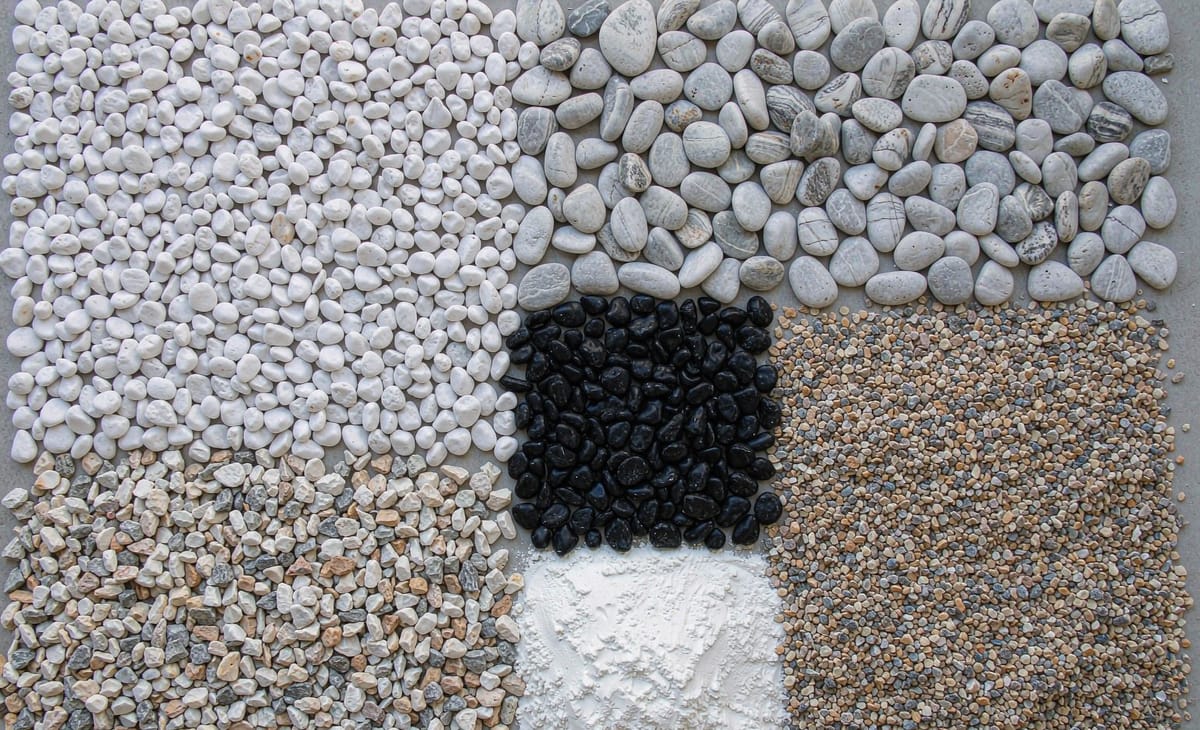
The two products are cousins, not substitutes. White gravel is mechanically crushed: angular chips, most commonly 3–20 mm, bright and economical, and it compacts into a firm surface that suits large garden beds and ground cover. White pebbles are naturally tumbled by rivers or the sea: rounded grains, typically 15–50 mm, chosen for decorative finishes where the surface is seen and touched up close. Neither stock product, as sold for landscaping, is exactly a roof ballast grade — ballast needs the rounded shape of a pebble in the larger 20–60 mm band of a gravel grade, washed hard, and it should be ordered as washed round ballast stone.
Where white ballast genuinely earns its colour is thermal performance. A light stone surface reflects far more solar radiation than dark ballast, which measurably cuts the heat load through the roof and is one reason light ballast is specified on cooling-dominated buildings. The honest caveats: dust films age the reflectance down within the first seasons — another argument for washed stone — and very bright roofs can produce glare toward neighbouring tall glazing or flight paths, which a few jurisdictions control. For ground-level work the choice stays simple: crushed white gravel for large anonymous areas, white pebbles for borders and visible detail, and the rounded washed ballast grade only on the roof.
One spec block covers it: washed round ballast stone, rounded to sub-rounded grains, size range 20–60 mm (or two fractions such as 20–40 mm and 40–60 mm by zone), fines and silt below 1%, no sharp crushed edges, packed in one-tonne jumbo bags or 25 kg bags as the site requires, with a sieve analysis per production lot. Add sealed wet-and-dry samples before the container closes and photographs of the packed bags with the size labels visible — two size fractions look alike in a photograph, and the labels and sieve curves are what keep zones from being swapped on site.
Handling conditions belong in the order too. Jumbo bags should be lifted to the roof in stages and spread as they go, never dumped into one pile that overloads the deck; most specifications cap a single drop point and require the contractor to work from the membrane outward. Stone is kept clear of drains and penetrations, geotextile under the ballast on assemblies that call for it, and maintenance walkway pads remain visible after spreading. A processing supplier who washes and screens in-house can quote against this language directly; a trader reselling unwashed decorative gravel usually cannot — which is precisely the check a buyer wants the specification to perform.
Roof fields are ballasted at roughly 50–60 kg/m², with perimeters and corners increased to about 100–120 kg/m² under the ANSI/SPRI RP-4 wind design standard. One tonne therefore covers roughly 20 m² of field or 10 m² of perimeter zone, and a 1,000 m² roof typically needs 55–70 tonnes in total.
Washed, rounded to sub-rounded stone graded roughly 20–60 mm (¾–2½ inches), with fines below about 1%. The rounded shape prevents membrane damage under foot traffic, and washing keeps dust from migrating into roof drains and staining the facade.
No. Crushed angular gravel has sharp edges that bruise or puncture the membrane under maintenance traffic, and membrane manufacturers require rounded, washed stone for ballasted systems. Crushed white gravel remains the right product for garden beds and ground cover — just not on a loose-laid roof.
Yes. A light stone surface reflects substantially more solar radiation than dark ballast, cutting the heat gained through the roof in cooling-dominated buildings. Reflectance falls as dust films age on unwashed stone, which is why washed ballast is specified, and very bright roofs may need a glare check toward neighbouring buildings or airports.
“Trade Map provides comprehensive global trade data for over 230 economies, with monthly, quarterly and yearly updates using official reported data and mirror data techniques.”
ITC Trade Map, trademap.org — official page
Commercial landscaping is the volume end of the stone trade: office parks, public spaces, housing developments…
Garden landscaping brings together every stone category: ground cover for beds and borders, gravel for paths, …
Everflorae — Artificial Plants & Trees
From the same supplier group, Everflorae supplies UV-stable artificial trees, palms and green walls that pair with stone — one source for hotels, resorts, malls and Japanese gardens.
Send your product, specification and destination — our sales team will prepare a quotation.