 SWME TRADE
Garden Landscaping
Garden landscaping brings together every stone category: ground cover for beds and borders, gravel for paths, …
SWME TRADE · Blog
White gravel in bulk is bought by grain band and by weight: crushed white stone runs at roughly 1.4–1.6 tonnes per cubic metre, a 50 mm dressing needs about 70–80 kg per square metre, and one 20 ft container carries about 24–27 tonnes — which at that density is only 16–19 cubic metres, so the container fills by weight long before it fills by volume. This guide covers the three base stones behind white gravel and why they decide hardness, acid resistance and soil pH, the grain bands and where each belongs, coverage and container arithmetic, how to vet a white gravel manufacturer, packing and pre-shipment inspection, and the cost factors behind a wholesale quotation.
Published · By Gardenstone Editorial Team · Educational article from the SWME TRADE team
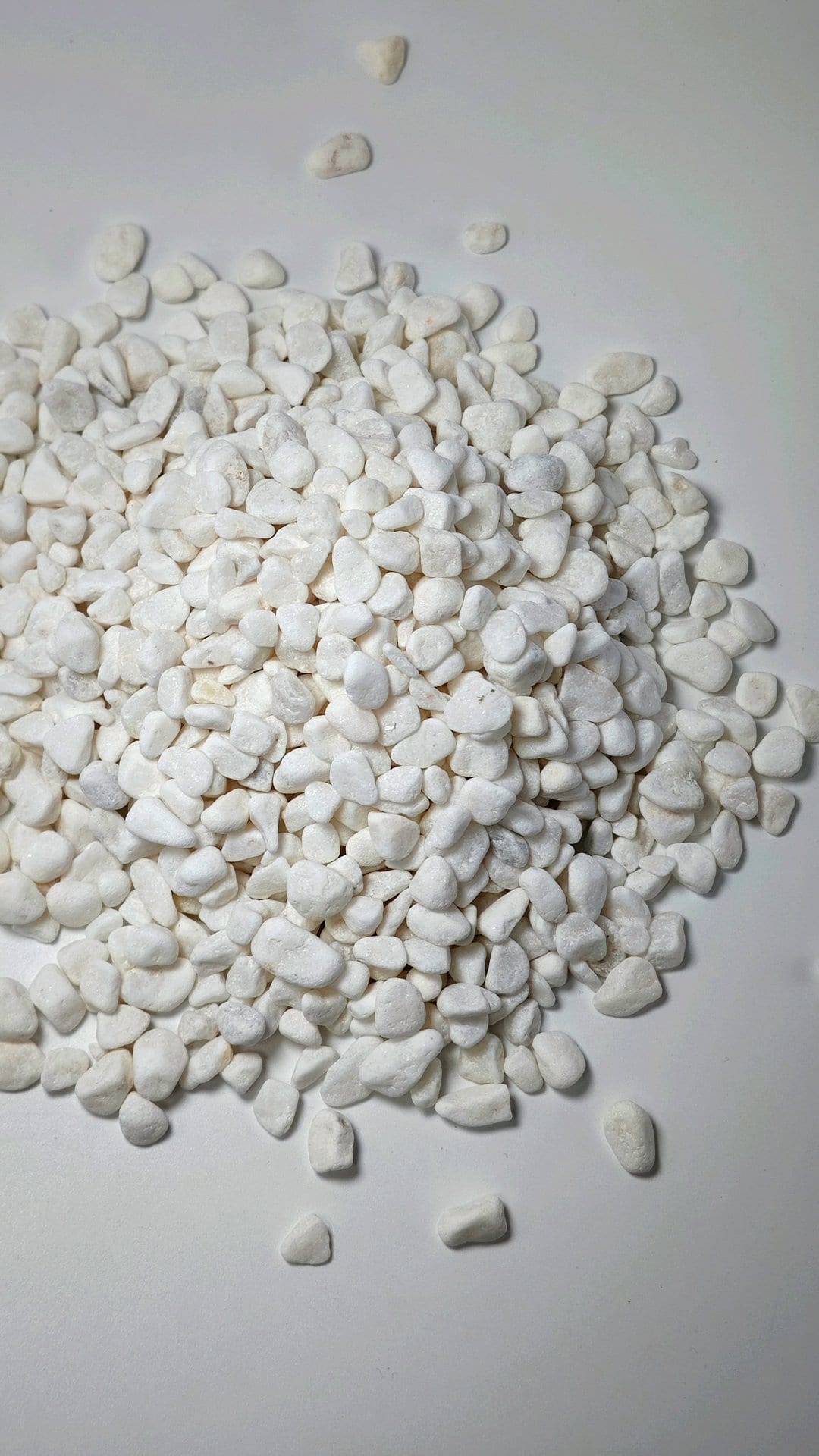
White gravel in bulk is bought by grain band and by weight, not by photograph. Crushed white stone runs at roughly 1.4–1.6 tonnes per cubic metre, a 50 mm decorative dressing needs about 70–80 kg per square metre, and one 20 ft container carries about 24–27 tonnes — only 16–19 cubic metres at that density, so it fills by weight well before it fills by volume.
Two facts define white gravel commercially, and both come from the word crushed. First, it is angular: the pieces interlock and stay put on a slope or a driveway, which rounded pebble simply cannot do. Second, it is white: no other colour shows dust, iron staining and organic film so immediately, so washing quality and packing hygiene matter more here than on any other product in the range.
There is a third variable most buyers only discover after the first container, and it decides whether the material is right for the site at all — the base stone the gravel was crushed from. Marble, dolomite and quartz produce three visually similar white gravels with very different hardness, acid resistance and effect on soil pH. That is the first question to put to a supplier, and it costs nothing to ask.
White gravel is crushed and screened from one of three common light-toned base stones, and the specification sheet should name which one. Calcite-based white marble gravel is the softest at around 3 on the Mohs scale; it is the brightest and the cheapest to produce, but it is also acid-sensitive and slightly calcareous. Dolomite-based gravel sits a little harder at roughly Mohs 3.5–4, with similar brightness and better weathering resistance. Quartz and quartzite-based gravel is the hardest by a wide margin at about Mohs 7, and it is effectively acid-resistant — but it is denser, more expensive to crush, and often a slightly cooler, greyer white.
The hardness difference changes where the material can be used. On a driveway, in a tree pit, or anywhere grit is ground underfoot or under tyres, a soft marble gravel breaks down and generates fines that turn the bright surface grey within a season or two, while quartz-based gravel holds its grade far longer. On a decorative bed that is only raked and topped up, soft marble gravel is perfectly serviceable and buys brightness at a lower cost per tonne.
Acid resistance matters more than most buyers expect. Calcite and dolomite gravels are attacked by acidic cleaners, by concentrated leaf tannin under trees, and — in exposed schemes — by acid deposition, all of which leave dull, etched patches that look like dirt but cannot be scrubbed off. Any exterior white gravel scheme should carry a written instruction that acidic cleaners are not to be used. The calcareous content also raises the pH of the soil beneath it, which is a genuine problem in flower beds built for acid-loving planting such as azaleas, rhododendrons, camellias and blueberries; there a quartz-based white gravel, or a decorative sand, is the safer specification.
Four bands cover almost all commercial white gravel work, and the choice is driven by traffic rather than by appearance. The 6–10 mm band is a fine dressing for raked beds, contrast bands next to dark paving and areas that are viewed closely and never walked on heavily. The 10–14 mm band is the general-purpose garden topping grade: heavy enough not to blow about, fine enough to read as a smooth bright plane. The 14–20 mm band is the standard ground-cover and light-path grade, and it is the band most commercial landscape schemes specify by default. The 20–40 mm band is the structural grade for driveways, car parks and any surface that has to carry a wheel, because it is the smallest size that reliably interlocks instead of rolling.
Angularity is the reason those bands behave differently from the equivalent pebble sizes. A 20–40 mm crushed gravel driven over locks together into a firm, semi-stable crust, whereas rounded pebbles of the same size displace under a tyre and scatter to the edges of the driveway — and on a hard surface they are a genuine slip hazard. Where a client wants the look of rounded white pebble, the usual compromise is to lay white gravel as the broad working surface and reserve white pebbles for borders, accent bands and areas that are never trafficked.
Grading discipline matters as much as the nominal size. A supplier quoting a single median figure is telling you very little; ask for the sieve analysis as a percentage passing each screen, and set an explicit cap on oversize particles. In white gravel the oversize fraction is what shows up as a lumpy, uneven surface and what chips mower blades and rakes, and it is invisible in a photograph of the heap.
Buy by depth and show the arithmetic in the enquiry so both sides can check it. At a bulk density of roughly 1.4–1.6 tonnes per cubic metre, a 30 mm decorative dressing needs about 42–48 kg per square metre, a 50 mm dressing about 70–80 kg per square metre, and a 75 mm deep working surface about 105–120 kg per square metre. Add 5–10% for settlement, edge build-up, spillage and later top-ups, and increase the depth by about 25% on any surface that takes vehicle traffic, because gravel compacts and migrates under load.
Container capacity is where white gravel differs most from the sand and pebble arithmetic buyers are used to. A 20 ft container carries about 24–27 tonnes, but because crushed white stone is comparatively light per cubic metre, that tonnage occupies only 16–19 cubic metres of a container that holds roughly 33. In other words the container is weight-limited, not volume-limited — so there is little to be gained by switching from bags to loose loading, and a mixed shipment of white gravel plus white pebbles or sand may reach the weight ceiling well before the doors will not close.
That has one practical consequence worth stating in the purchase order: on a multi-product shipment, ask the supplier for a loading plan showing the weight and volume of each line before the container is packed. A shipment planned on volume alone routinely arrives overweight at the port, and re-stuffing a container at that point costs more than the grading premium the buyer was trying to avoid.
A white gravel manufacturer should be judged on the processing plant, not the sample room. Four questions separate a producer from a trader holding a stocklist: where is the deposit or quarry the material is crushed from; what crushing and screening equipment is installed; how is colour consistency held between runs; and does the plant run its own washing and bagging lines for the packing format you need. A supplier who answers all four without consulting a third party is selling you its own material; one who cannot is adding a layer of margin and a layer of quality risk.
The second test is lot-to-lot consistency, which matters more on white gravel than on any coloured product. The specification that counts is the brightness and grading you receive in container eight, not container one. Ask how the plant holds colour between production runs — sealed wet references, retained lot samples, a stated tolerance on the fines and oversize percentages — and what happens to the feed when the working face of the deposit shifts. On a phased scheme, drift that appears in container two is an easy re-order; drift that appears in container eight is already laid across several hundred square metres and cannot be matched.
The third test is the approval protocol, and on white material it has one extra requirement. Insist that the reference sample is drawn from production rather than hand-picked from the sample room, that it is judged wet as well as dry, and that the sample is taken from the same base stone as the shipment. White gravel darkens and shifts tone noticeably when damp, and marble, dolomite and quartz gravels look close enough side by side in a dry bag that a substituted base stone can pass a casual inspection — then weather differently on site, which is how a brightness complaint becomes a replacement claim six months later.
Write the order against numbers rather than adjectives, and every later disagreement becomes a measurement instead of an opinion. A workable commercial specification for bulk white gravel covers seven items: grain band in millimetres with a stated sieve analysis; a named base stone, so hardness, acid resistance and pH behaviour are fixed in writing; colour held as a sealed wet 1 kg reference signed by both parties; a cap on the oversize fraction; fines and dust content, which is both freight weight and the main cause of a hazy, dirty-looking surface on arrival; unit mass tolerance per bag or jumbo bag; and washing quality, described as the visible dust residue after a defined rinse rather than as the word clean.
Pre-shipment inspection should be simple and repeatable. Draw three random 1 kg scoops from different pallets rather than accepting the one open bag, wet them and compare against the sealed reference in daylight, confirm the sieve analysis on a retained sample, and take photographs of the washed and unwashed material side by side. For the base stone, the cheapest independent check is a drop of dilute acid on a sample during the pre-shipment visit: a calcite or dolomite gravel fizzes, quartz gravel does not. It is a thirty-second test that tells the buyer which of the three materials is actually in the bag.
Two clauses do the heavy lifting across a phased order. The first is lot retention — keep one labelled reference sample from every production lot, so a brightness or grading shift surfaces in the second container rather than on site in the eighth, when the surface is already laid. The second is packing integrity: bags or liners must be intact on arrival, because a split bag of white gravel in a humid climate takes on moisture and dirt and is no longer a white product. Both clauses cost the supplier very little and remove the two failures that turn a repeat order into a dispute.
Four factors move a white gravel quotation more than the headline rate, and none of them is visible on a single line of it. Base stone is the first: quartz and quartzite gravel carries a higher crushing cost than calcite marble and is quoted higher for the same size and colour. Grading tightness is the second, because a narrow band means more screening and more reject material. Washing quality is the third, and it changes both how bright the material looks on arrival and how much dust weight you are paying to ship. Packing is the fourth — 20–25 kg retail bags on lined pallets, one-tonne jumbo bags and loose loading are three genuinely different cost structures, and the right one depends on whether the gravel is going to a project or onto a merchant's shelf.
Because white gravel is a low-value, heavy product, ocean freight and inland haulage are a large share of the delivered figure, and the weight-limited container is the single biggest lever in the whole calculation. Ask for the packing density and container loading figures for the exact grain band, base stone and packing format you intend to order, and price the scheme in cost per square metre at the specified depth rather than per tonne alone — that is the only honest way to compare two quotations that arrive in different units.
The last practical point is order size and mixing. Wholesale white gravel normally starts at one 20 ft container, about 24–27 tonnes. Ask for the minimum order quantity per grain band and per base stone rather than per product line, because a supplier willing to mix two bands inside a single container is quoting a different minimum from one that will not. And because a white gravel container is weight-limited, check the loading plan before it is stuffed whenever the order combines gravel with pebbles, sand or other dense material in the same shipment.
Fix the grain band first — 6–10 mm for fine dressings, 10–14 mm for garden topping, 14–20 mm for ground cover and light paths, 20–40 mm for driveways — then buy by weight. Crushed white stone runs at roughly 1.4–1.6 tonnes per cubic metre, a 50 mm dressing needs about 70–80 kg per square metre, and one 20 ft container carries about 24–27 tonnes, which is only 16–19 cubic metres. Write the base stone and a sealed wet reference sample into the order.
At roughly 1.4–1.6 tonnes per cubic metre, a 30 mm dressing needs about 42–48 kg per square metre, a 50 mm dressing about 70–80 kg per square metre, and a 75 mm deep working surface about 105–120 kg per square metre. Add 5–10% for settlement, edge build-up and spillage, and increase the depth by about 25% on driveways and any other trafficked surface.
Judge the processing plant rather than the sample room. Ask where the deposit or quarry is, what crushing and screening equipment is installed, how colour is held between production runs, and whether the plant runs its own washing and bagging lines. Then check lot-to-lot consistency with sealed wet references and retained lot samples, and insist that the reference sample is drawn from production, judged wet as well as dry, and taken from the same base stone as the shipment.
Yes, at the right size and base stone. Specify 20–40 mm angular crushed gravel, because that is the smallest band that interlocks into a firm crust instead of rolling under a tyre, and specify a quartz or quartzite base if the driveway carries regular traffic — soft marble gravel breaks down into fines that turn the surface grey. Lay it over a compacted sub-base at about 75 mm, and never use rounded white pebbles as a driveway wearing course.
“Trade Map provides comprehensive global trade data for over 230 economies, with monthly, quarterly and yearly updates using official reported data and mirror data techniques.”
ITC Trade Map, trademap.org — official page
Garden landscaping brings together every stone category: ground cover for beds and borders, gravel for paths, …
Pathways combine the functional and decorative sides of landscaping stone: the surface must stay stable underf…
Commercial landscaping is the volume end of the stone trade: office parks, public spaces, housing developments…
Stone-topped flower beds replace mulch with a permanent surface: stones suppress weeds when laid over membrane…
Everflorae — Artificial Plants & Trees
From the same supplier group, Everflorae supplies UV-stable artificial trees, palms and green walls that pair with stone — one source for hotels, resorts, malls and Japanese gardens.
Send your product, specification and destination — our sales team will prepare a quotation.