 SWME TRADE
Commercial Landscaping
Commercial landscaping is the volume end of the stone trade: office parks, public spaces, housing developments…
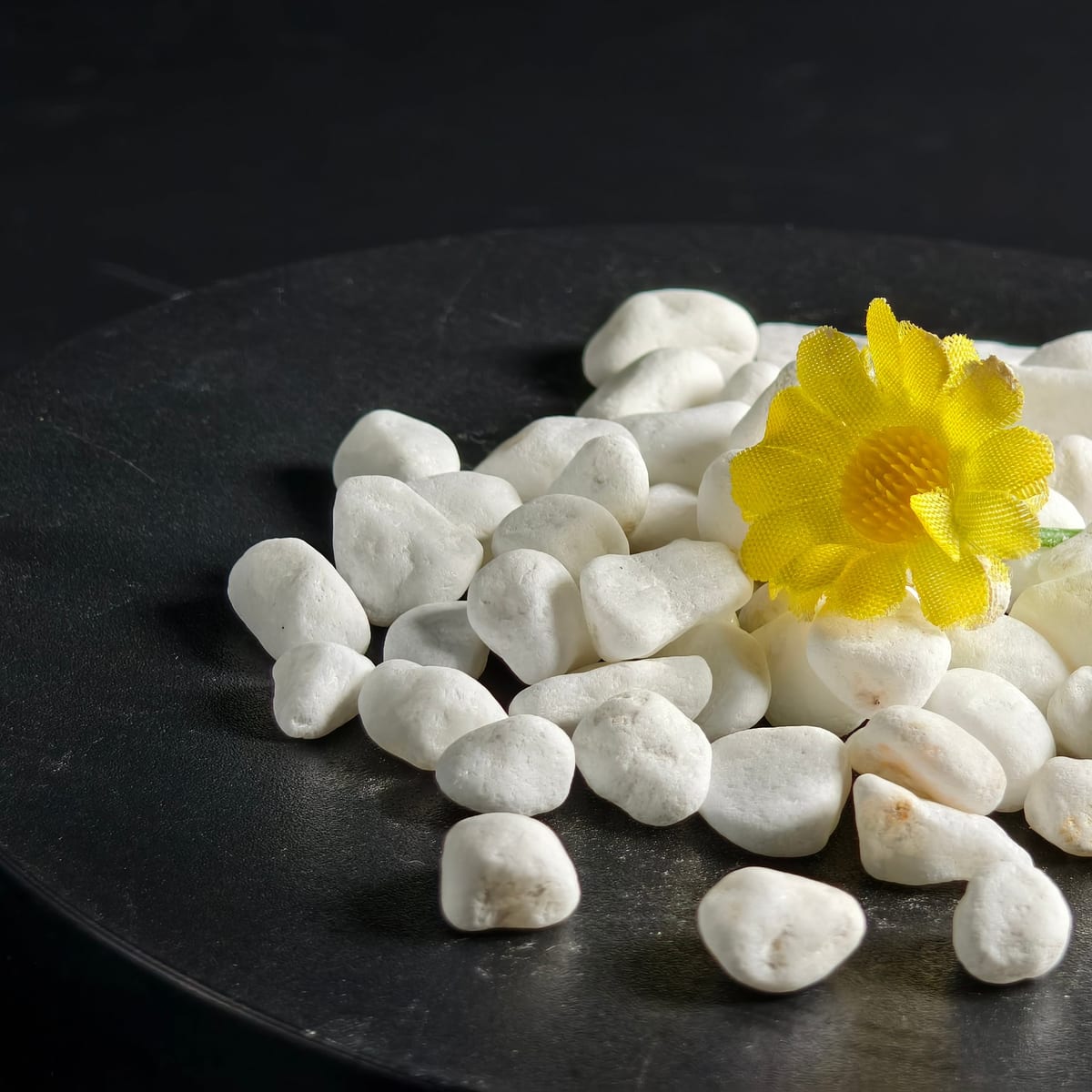
SWME TRADE · Blog
The best white pebbles for commercial landscaping are washed, uncoated, near-white river or marble pebbles screened into a tight band: 8–16 mm for paths and water-feature surrounds, 20–40 mm for beds and borders, and 40–75 mm for wide decorative planes. Allow 60–80 kg per square metre at 40 mm depth and about 24–27 tonnes per 20 ft container. This guide covers whiteness grades and the grey-undertone trap, why white pebbles yellow or go green and how to stop it, the size bands worth quoting, an enforceable specification, driveway use and bulk buying from a white pebbles supplier.
Published · By Gardenstone Editorial Team · Educational article from the SWME TRADE team
The best white pebbles for commercial landscaping are washed, uncoated, near-white river or marble pebbles screened into a tight band: 8–16 mm for paths, tree pits and water-feature surrounds, 20–40 mm for beds and borders, and 40–75 mm for wide decorative planes and forecourts. Allow 60–80 kg per square metre at 40 mm depth, and plan on about 24–27 tonnes per 20 ft container.
White is the most demanding colour in the whole pebble range, and that is exactly why it sells. On a commercial scheme the stone is one flat plane read from thirty metres away, and a white plane shows every defect a grey or mixed plane hides: a patch of grey-toned stone, a streak of iron dust, a green film along a drainage line, a rake track that has pulled soil into the surface. Buyers do not notice the good white bed — they only notice the one that has gone dirty.
So the question a landscape contractor or importer should actually be asking is not which white pebble is whitest, but which white pebble still looks like the approved reference after two winters of rain, irrigation splash and foot traffic. That answer is a specification question, and it has four moving parts: whiteness grade and undertone, the size band, whether the stone is genuinely through-coloured, and how the bed is detailed underneath so water and soil never reach the surface.
White is not a single product. In the trade it is a grade, and the grades run from true snow-white through off-white and ivory to cream, light grey and the salt-and-pepper mixes where white and grey stones are sold together. Whiteness is normally judged on the L* brightness scale, where 100 is perfect white; a usable commercial decorative grade usually sits in the high 80s to low 90s, and anything under about L* 80 will read grey the moment it is laid beside a brighter batch or beside a white wall.
The trap that costs importers the most money is undertone. Two grades can both measure L* 88 and still look like different materials, because one has a cool blue-grey cast and the other a warm cream cast. Laid in the same bed they look dirty; laid in two phases of the same project they look like two different purchases. Undertone has to be agreed and written down, not left to the word white on a quotation.
Photographs are the second trap. A container photo taken under a warm warehouse lamp, or a phone that has auto-corrected the white balance, can make a cream stone look snow-white, and a stone approved dry in a hot climate regularly arrives looking grey after a wet week. The workable rule is to approve the material wet, in daylight, against a physical reference: a signed 1 kg wet sample sealed in a clear bag, plus the undertone named in the specification. When a new lot arrives, compare it to that sealed reference rather than to the original photograph, because the reference does not change and the photograph does.
White pebbles are not damaged by weather; they are damaged by what arrives on top of them. Three mechanisms account for almost every complaint on a white commercial bed.
The first is soil and iron dust. Splash from bare soil, mud tracked in from a path, and the fine mineral dust that sits in any unwashed load all read as a brown or yellow haze on white stone. It is worse where mulch, sand or soil sits directly beside the bed with no separation, and worse again where the pebble layer is thin, so a rake or a foot reaches the soil underneath in one pass. The second is biological: where water stands or drains slowly, algae and cyanobacteria grow a green-black biofilm that is far more visible on white than on any other colour. Overhead irrigation that splashes the bed, and a fall that holds water instead of shedding it, both feed this. The third applies only to marble-based white pebbles, which are acid-sensitive; strong acidic cleaners, some pool chemicals and long exposure to acidic run-off dull and etch the surface permanently.
All three are designed out before the stone is ordered. Put a geotextile membrane between the soil and the pebble so soil cannot pump up through the bed. Lay 40–50 mm of pebble rather than the bare 20 mm, so a rake stays in the stone. Give the bed a fall to a drain or a permeable edge so water never ponds, and keep overhead irrigation off the pebble plane. Separate the bed from mulch and bare soil with a rigid edge. On marble grades, rule out acidic and hypochlorite cleaning in the maintenance manual and specify a neutral pH cleaner plus a rinse. And budget the upkeep honestly: a white bed typically needs one wash and rake cycle a year, with a 5–10% top-up, and if the client will not fund that, a mixed grey and cream grade will hold its appearance far longer for the same money.
Size band decides how a white bed reads, how much material a square metre consumes, and how easily the surface is raked between maintenance visits. Five bands cover almost all commercial work, plus the fine rounds used in bound paving.
8–16 mm washed white rounds read as a smooth continuous plane and suit garden paths, tree pits, water-feature surrounds and gravel-in-tray details, but they track on boots and displace easily, so they want a contained edge. The 16–25 mm band makes a good transition and planting apron. The 20–40 mm band is the commercial workhorse: big enough to stay put in a border, small enough to rake level, and the standard for beds, borders, roundabout margins and planting aprons. The 40–75 mm band is a wide-plane material for large open decorative areas, hotel forecourts and dry creek features, where a coarse texture stays legible at distance and resists being kicked out of place. Above 60–90 mm the stone behaves like a small rock — useful for dry-creek beds and informal edging, awkward to walk on.
Two further choices matter on white. Rounded river pebble gives a soft, quiet surface; marble chips are angular and their sharp edges catch light, which many designers prefer for white contrast bands but which is harder underfoot and harsher on a rake. And when a scheme mixes a white plane with a black or mixed-colour plane for contrast, keep the two physically separate and clearly labelled in the container; a mixed pallet arriving on site is the fastest route to laying the wrong colour in the wrong zone.
Choosing white pebbles is really a question of what the purchase order can measure on a sample. Write the order against numbers rather than adjectives, and every later disagreement becomes a measurement instead of an opinion. A workable commercial specification covers six items.
Size band in millimetres, with 90–95% of stones inside the nominal band, the remainder in one adjacent band, and an explicit cap on oversize particles — oversize stone is what actually damages rakes and mowers. Whiteness stated as a measured grade, for example a wet L* value with a floor such as L* 87 and above, together with the undertone named as cool or warm, held against a sealed wet 1 kg reference signed by both parties. Through-colour verification, stated as untinted and uncoated stone, and confirmed by the break-and-wash test on a production sample: break a stone and the fresh face should match the surface, and washing a handful should leave only a fine mineral haze rather than pigment in the water. Washed stone with fines and dust at or below 1–2%, measured after a standard wash test, because dust is weight you pay freight on and haze you pay a contractor to hose off. Broken and fractured particles at or below 3–5%, tightened to 3% for a premium decorative white. And unit mass tolerance of about ±1% on a 20–25 kg bag or ±1–2% on a one-tonne jumbo bag.
On white grades one extra clause is worth the paper it is written on: require a written declaration of how the whiteness is obtained — stone selection and colour sorting, or some form of surface treatment. Selected and sorted white stone keeps its grade when it is raked, washed and topped up; a coated or brightened product looks excellent in the sample room and then goes patchy as the coating wears off, which on a 500 m² white bed is unfixable. Two further clauses do the heavy lifting on phased projects: approval samples must be drawn from production rather than from the sample room, and a labelled reference sack should be kept from every production lot so that drift shows up in container two rather than on site in container eight.
On a driveway the best role for white pebbles is contrast and delineation, not the driven surface itself. A white band along the verge, a white turning head or a white margin against a grey or black main plane makes the drive legible from the road, marks the edge so vehicles stay off the planting, and reads cleanly at night. That is usually how a designer gets the white look the client asked for without asking rounded white stone to behave like a road surface.
The driven surface is a different engineering question. Loose rounded white pebbles should not carry a lane: they roll out from under tyres, migrate into gullies and leave ruts within a season, and white shows the resulting tyre marks, rubber transfer and oil drips more than any other colour. Where the client wants white rounded stone on the lane itself, the standard commercial answer is a bound surface — 2–6 mm washed white rounds in a resin-bound or grid-stabilised system over a compacted permeable sub-base, which takes foot and light-vehicle traffic and still reads as white pebble. Where the drive has to be loose, specify light-coloured angular gravel at 20–40 mm and a compacted 50–75 mm depth over a compacted sub-base with the fall running across rather than down the drive, then keep the loose rounded white pebble on the margins behind a rigid edge restraint, laid over geotextile. Always lay a bound apron over the first 1–2 m where the drive meets the road so stone does not track onto the highway.
Two maintenance points are specific to white driveways. Expect visible tyre marks on white margins and plan a seasonal wash rather than treating it as a defect, and avoid de-icing salt on or beside white stone — the residue and the dirt it attracts leave a grey bloom that is hard to rinse out — using sand or grit instead. A white driveway is a maintenance commitment, not a one-off purchase, and it should be sold that way.
Buy by depth and do the arithmetic in the enquiry so both sides can check it. Bulk white pebbles run at roughly 1.5–1.7 tonnes per cubic metre, with dense marble and quartz grades at the top of that range and lighter limestone below. On that basis a 20 mm bed needs about 30–34 kg per square metre, so one tonne covers roughly 30 m². A 40 mm bed needs about 60–68 kg per m², or around 15 m² per tonne; a 50 mm bed about 75–85 kg per m², or 12–13 m² per tonne; and a 75 mm decorative plane about 115–125 kg per m², or around 8 m² per tonne. Add 5–10% for settlement, edge build-up, spillage and later top-ups.
The same arithmetic is the only honest way to compare quotations that arrive in different units. A rate per 20 kg bag and a rate per 25 kg bag are not the same product, and the difference disappears once both are converted to cost per tonne and then to cost per square metre at the specified depth. Where a scheme mixes a fine white entrance band with a coarse open plane, price each area separately rather than averaging, because the coarse band consumes noticeably more tonnage for the same coverage.
Container capacity follows the same logic. A 20 ft container takes about 24–27 tonnes of pebbles, or roughly 1,200–1,350 × 20 kg bags when loose-loaded, and about 1,000–1,150 bags when palletised, because pallets consume volume that loose loading gives back to stone. At 40 mm depth one container dresses roughly 360–400 m², so area-heavy schemes are usually weight-limited rather than volume-limited. Wholesale white pebbles normally start at one 20 ft container, so ask for the minimum order quantity per size band rather than per product line, because a white pebbles supplier willing to mix two bands and one whiteness grade inside a single container is quoting a different minimum from one that will not.
Packing should follow where the stone is going. For retail and merchant resale, 20–25 kg PP bags on pallets with a printed grade label hold up and stack better than jumbo bags. For direct project delivery, one-tonne FIBC bags cut the handling on site, though they need a forklift once they land. For large open areas that can receive a tipping trailer, loose loading in a lined container is the cheapest way to buy tonnage. On landed cost, treat four factors as the real price drivers instead of the headline rate: the whiteness grade and colour sorting, which move the price more than any other attribute; the size band; the washing quality, which changes both appearance and how much dust you ship; and ocean freight plus inland haulage, which is a large share of the delivered figure because pebble is heavy and low-value per tonne. Ask for the quotation split into material, packing and freight to your port.
Use washed, uncoated, near-white river or marble pebbles screened into a tight band: 8–16 mm for paths, tree pits and water-feature surrounds, 20–40 mm for beds, borders and planting aprons, and 40–75 mm for wide decorative planes and forecourts. Allow 60–80 kg per square metre at 40 mm depth, plan on about 24–27 tonnes per 20 ft container, and state a whiteness grade with the undertone named, held against a sealed wet 1 kg reference.
At roughly 1.5–1.7 tonnes per cubic metre, a 20 mm bed needs about 30–34 kg per square metre, so one tonne covers around 30 m². At 40 mm it is about 60–68 kg per m², or roughly 15 m² per tonne; at 50 mm about 75–85 kg per m², or 12–13 m² per tonne; and at a 75 mm decorative plane about 115–125 kg per m², or around 8 m² per tonne. Add 5–10% for settlement, edge build-up and spillage.
Yes, but usually as contrast rather than as the driven surface. Use a white band along the verge, a white turning head or a white margin behind a rigid edge restraint to mark the drive and keep vehicles off planting. For the lane itself, use 2–6 mm washed white rounds in a resin-bound or grid-stabilised surface over a compacted permeable sub-base, or light-coloured angular gravel at 20–40 mm and a compacted 50–75 mm depth if the drive must be loose. Loose rounded white pebbles rut and migrate under tyres.
Three things cause it. Soil and iron dust splash onto the bed and read as a brown or yellow haze, so use a geotextile membrane, lay 40–50 mm of stone rather than 20 mm, and keep mulch and bare soil separated by a rigid edge. Algae and cyanobacteria grow a green-black film wherever water stands, so give the bed a fall to a drain and keep overhead irrigation off the pebble plane. And marble-based white pebbles are acid-sensitive, so avoid acidic and hypochlorite cleaners in favour of a neutral pH cleaner and a rinse.
“Trade Map provides comprehensive global trade data for over 230 economies, with monthly, quarterly and yearly updates using official reported data and mirror data techniques.”
ITC Trade Map, trademap.org — official page
Commercial landscaping is the volume end of the stone trade: office parks, public spaces, housing developments…
Hotel and resort landscapes are commercial projects with residential finish quality: large areas, premium appe…
Pathways combine the functional and decorative sides of landscaping stone: the surface must stay stable underf…
Pool surroundings combine hard performance requirements with a resort aesthetic: stone around pools must toler…
Everflorae — Artificial Plants & Trees
From the same supplier group, Everflorae supplies UV-stable artificial trees, palms and green walls that pair with stone — one source for hotels, resorts, malls and Japanese gardens.
Send your product, specification and destination — our sales team will prepare a quotation.