 SWME TRADE
Garden Pathways
Pathways combine the functional and decorative sides of landscaping stone: the surface must stay stable underf…
SWME TRADE · Blog
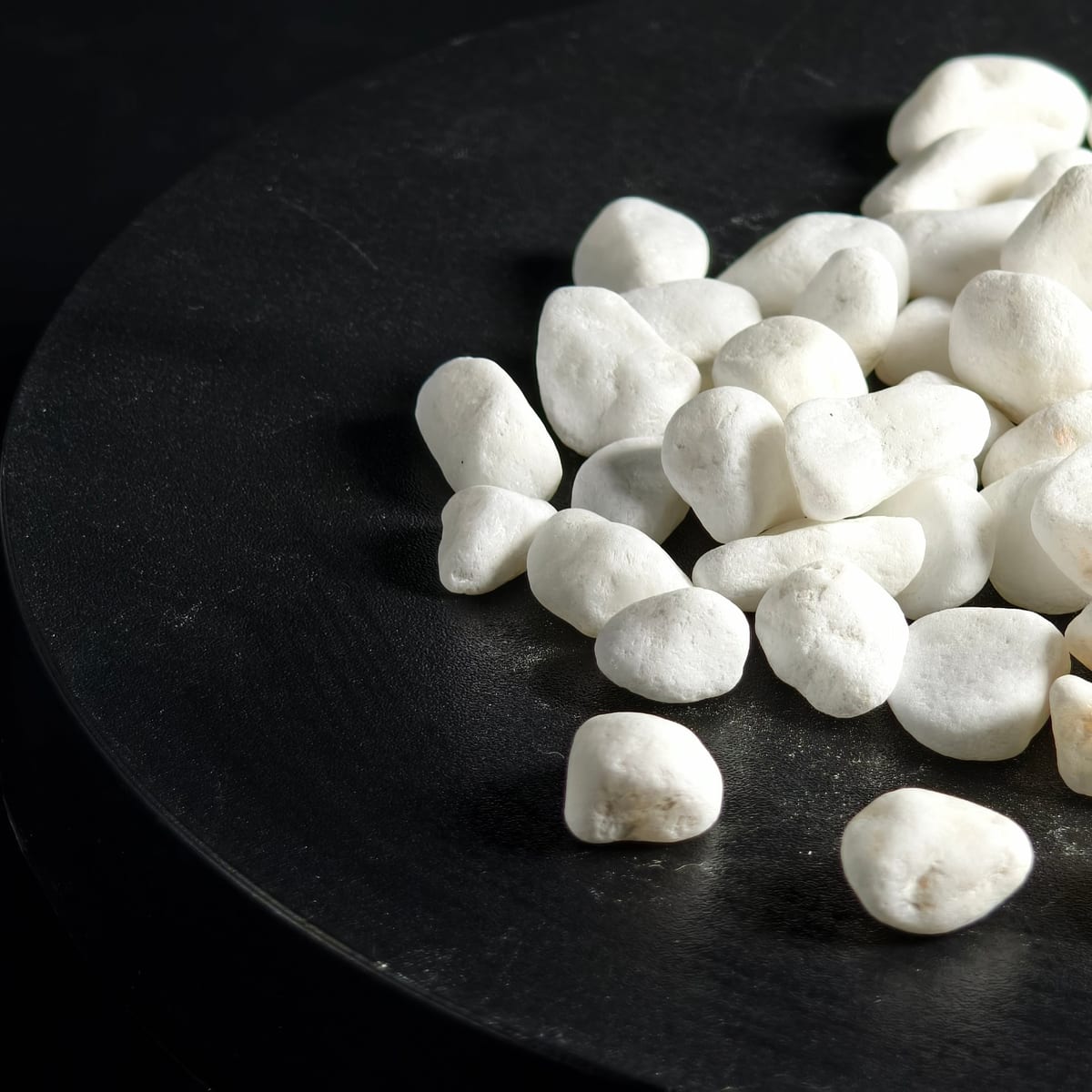
White pebbles laid at 50 mm need about 75 kg per square meter — roughly 13 m² per tonne. This guide gives contractors and importers the coverage mathematics at every depth, the base preparation and geotextile specification that stops migration, the laying sequence that keeps white stone looking white, and how much area one 20ft container actually covers.
Published · By Gardenstone Editorial Team · Educational article from the SWME TRADE team
White pebbles laid at a 50 mm depth need roughly 75 kg per square meter, which works out at about 13 m² per tonne — so a 25 tonne container covers around 325 m². At a light 25 mm dressing the requirement falls to about 38 kg/m² (roughly 26 m² per tonne); at 75 mm it rises to about 113 kg/m² (roughly 9 m² per tonne). Add 5–10% for settlement and site waste.
The arithmetic is simple enough to hand to a customer: kilograms per square meter equals depth in metres multiplied by bulk density, and white pebbles run at about 1,400–1,600 kg/m³ depending on size band and how much fine material sits between the stones. A 120 m² flower bed at 50 mm therefore needs 120 × 75 = 9,000 kg, or 9 tonnes, rising to about 9.7 tonnes once you allow 8% waste — roughly 40% of one 20ft container.
Depth is a cost decision as much as a visual one, because every extra 25 mm adds about 38 kg per square meter to the order. As working guidance: 25–40 mm is a refresh dressing over an already stable, weed-suppressed base; 50 mm is the standard for flower beds, borders and garden paths; 75–100 mm suits commercial landscaping and any bed where weed suppression matters more than budget. Beds a maintenance crew will rake or leaf-blow season after season need the deeper end of that range, because shallow stone exposes the membrane underneath within a single season.
Two edge details decide whether the installation survives. Keep the finished pebble surface 25–50 mm below adjacent paving, kerb or damp-proof course, so stone cannot migrate onto hard surfaces where it becomes a trip and mower hazard. Restrain the edges with a properly haunched stone kerb or a metal strip. On slopes, specify a larger 40–60 mm band, because pebbles shift downhill on gradients steeper than roughly 1:12.
A white pebble bed is only as level as the base beneath it, and the base is where most installations actually fail. Excavate to the full build-up — pebble depth plus 20–30 mm for a blinding layer of sharp sand or fine gravel. Strip all organic material, because anything that can rot will settle and leave hollows under the stone. Compact the subgrade, and on commercial footpaths carrying trolleys or equipment add 100–150 mm of compacted granular sub-base rather than relying on native soil.
Then separate the stone from the ground. A woven geotextile of 100–130 g/m² is the standard choice beneath decorative pebbles: it stops soil pumping up into the stone and suppresses most weed growth while still draining freely. Where the subgrade is soft or peaty, step up to a non-woven fabric of 200–300 g/m². Lap joints by at least 300 mm and turn the fabric up 50 mm behind the edge restraint. Do not substitute solid plastic sheeting — it traps water, and a white bed sitting over a puddle will stain from below within one wet season.
Place stone from the far end of the bed and work backwards, so nobody has to walk across finished work. Lay in 25–50 mm lifts and level against a straight edge or string line rather than by eye. Never run a plate compactor over decorative pebbles: vibration fractures the stone, generates exactly the fines you paid to have washed out, and leaves an uneven sheen across the surface.
White stone punishes handling mistakes far more visibly than grey. Mud carried in on boots or barrow wheels reads as a brown streak that no amount of hosing removes cleanly, so keep barrows on boards laid over the finished area and stage bagged material at the edge of the bed. Rinse the stone at the end of the day so dust and silt leave the bed instead of settling into it. Contractors who keep a pallet of 20 kg bags on site for touch-ups after handover report noticeably fewer 'the stone looks dirty' calls.
A 1×20GP container floor-loaded with white pebbles carries approximately 24–27 tonnes of payload. At the standard 50 mm installation depth that is about 320–350 m² of finished bed — enough for a large residential project or a mid-size commercial landscape. Palletised cargo loses 10–15% of payload to pallet weight and void space, reducing coverage to roughly 275–300 m². Bagged material is the most convenient and least volume-efficient: 25 tonnes in 20 kg bags is 1,250 bags, and in 25 kg bags it is 1,000 bags.
This is why importers should quote coverage, not tonnage. Telling a contractor that one container of 20–40 mm white pebbles finishes about 330 m² at 50 mm turns a vague enquiry into a concrete order, and the same sentence works in reverse as a stocking calculation. The practical container mix is usually palletised 20 kg bags for retail and small landscapers, one-tonne and 1.5-tonne jumbo bags for established contractors, and floor-loaded stock for large project accounts.
Write the specification against the use, because 'white pebbles' on its own buys whatever the quarry was running that week. Define the size band in millimetres — 8–16 mm for top dressing and bowls, 16–25 mm for beds and paths, 20–40 mm for larger beds and commercial work, 40–60 mm for slopes and features. State colour as a physical reference rather than a word: a sealed sample plus an agreed lightness tolerance, since white ranges from cool blue-grey to warm cream, and mixing two batches of different undertone is immediately visible on site. Cap residual dust at around 1% and broken or fractured stone at under 5%.
The commercial details matter as much as the geology. Write bag weight tolerance at about ±1%, because contractors price work per square meter and light bags quietly destroy their margins. Ask what moisture level the stone is packed at — washed pebbles in a humid month can arrive visibly damp, which is normal for natural stone but should be communicated in advance rather than discovered at the gate. Verify all of it against a sealed sample before the container leaves: a sieve test for grading, a wash test for dust, and a wet comparison for colour.
Give the buyer a maintenance line and you protect the reorder. A correctly laid white pebble bed loses depth gradually — stone settles into the base, some leaves with the leaf litter, some is walked onto adjacent paving — so plan an annual top-up of roughly 10–15% of the original quantity. On a 120 m² bed installed at 50 mm that is about 1–1.4 tonnes a year, or 50–70 bags, which is exactly the predictable repeat purchase that makes a white pebble line worth stocking.
Cleaning should follow the same restraint as the installation. Leaf-blowers, not rakes, keep white stone level and remove debris without dragging soil into the bed; a low-pressure hose rinse once or twice a year lifts general grime; and acid or chloride cleaners should be avoided entirely, because they etch the surface and leave a permanent dull patch. Pass these rules on at handover and the bed keeps its colour long enough to sell the next project.
At a 50 mm laid depth, white pebbles require about 75 kg per square meter, which is roughly 13 m² of coverage per tonne. At a light 25 mm dressing the figure is about 38 kg/m², and at 75 mm it rises to about 113 kg/m². The calculation is depth in metres multiplied by a bulk density of roughly 1,400–1,600 kg/m³, and you should add 5–10% to the total for settlement and site waste.
Use 25–40 mm as a refresh dressing over an existing stable base, 50 mm as the standard depth for flower beds, borders and garden paths, and 75–100 mm for commercial landscaping and beds that need strong weed suppression. Keep the finished surface 25–50 mm below adjacent paving or kerbs, and specify a larger 40–60 mm band on slopes because pebbles migrate downhill on gradients steeper than about 1:12.
A 1×20GP container carries roughly 24–27 tonnes of white pebbles, which at a 50 mm depth covers about 320–350 m² of finished bed. If the cargo is palletised, payload drops by 10–15%, reducing coverage to roughly 275–300 m². The same 25 tonnes in 20 kg bags is 1,250 bags, so floor-loaded or jumbo bag supply gives the lowest cost per square meter on large projects.
No — plain loose white pebbles are not suitable for regular vehicle traffic. Tyres crush the rounded stones, produce fines that turn the surface grey, and push stone off the compacted line into ruts and onto adjacent ground. For driveways specify angular gravel of 20 mm or larger over a properly compacted sub-base, or a resin-bound surface, and keep white pebbles for flower beds, garden paths, courtyards and decorative features.
“Trade Map provides comprehensive global trade data for over 230 economies, with monthly, quarterly and yearly updates using official reported data and mirror data techniques.”
ITC Trade Map, trademap.org — official page
Pathways combine the functional and decorative sides of landscaping stone: the surface must stay stable underf…
Stone-topped flower beds replace mulch with a permanent surface: stones suppress weeds when laid over membrane…
Commercial landscaping is the volume end of the stone trade: office parks, public spaces, housing developments…
Everflorae — Artificial Plants & Trees
From the same supplier group, Everflorae supplies UV-stable artificial trees, palms and green walls that pair with stone — one source for hotels, resorts, malls and Japanese gardens.
Send your product, specification and destination — our sales team will prepare a quotation.