 SWME TRADE
Garden Landscaping
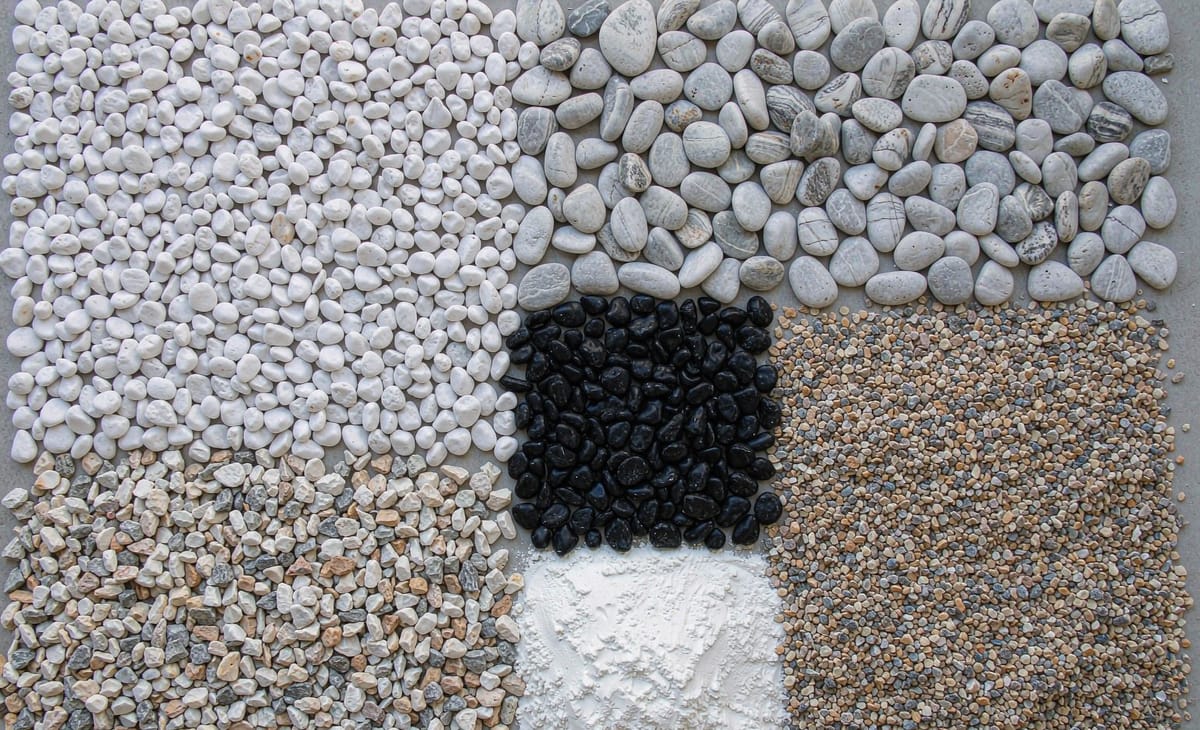
Garden landscaping brings together every stone category: ground cover for beds and borders, gravel for paths, …
SWME TRADE · Blog
The price of white gravel per tonne is set by the colour grade and the reject rate, not by the tonne alone: a bright, tightly screened limestone or marble chip costs more than a grey run of the same rock, and freight dominates the delivered figure. One 20 ft container holds about 24–27 tonnes, a 20 mm layer needs roughly 30–34 kg per square metre, and one tonne covers about 30–33 square metres at that depth.
Published · By Gardenstone Editorial Team · Educational article from the SWME TRADE team
There is no single white gravel price per tonne, because 'white gravel' is a colour-graded stone and freight dominates the delivered cost. Plan with the structure: one 20 ft container holds about 24–27 tonnes, a 20 mm layer needs roughly 30–34 kg per square metre, and one tonne covers about 30–33 square metres. The per-tonne figure then moves with grade, grain band, washing and packing, quoted as separate material, packing and freight lines to your named port.
Treat any quotation offering one flat per-tonne rate with no grade definition as unpriceable rather than cheap. Two suppliers can both write 'white gravel' and be selling different products: a bright washed limestone chip, a harder marble or quartz chip that holds its tone outdoors, or a general run where a few grey and buff particles turn a bright bed patchy in sunlight. The rest of this article walks through what actually sits inside a white gravel price per tonne, how to convert it into a cost per square metre you can budget, and how to compare two white gravel supplier quotations fairly.
White gravel is priced on a ladder defined by brightness and the reject rate, and the rungs are far apart. A grey gravel moves almost everything the screen produces; a white grade has to be colour-sorted and the discoloured grain — grey, buff, iron-stained — rejected. Because that reject is sold as something cheaper or discarded, the yield of true first-grade white stone from a deposit, not the deposit itself, is what the per-tonne price is really buying. A harder rock such as marble or quartz costs more than limestone not for colour but for the durability that keeps the white bright under weather and footfall.
This is why the specification belongs in the enquiry before the price does. Ask each supplier to state the rock type, the grain band in millimetres with a sieve analysis, and a brightness held as a sealed wet reference sample — wet, because colour shifts as stone dries. A price quoted against that definition is comparable; a price quoted against the words 'white gravel' is a different product every time you re-order, and the difference usually appears in container two, when the tone drifts and the bed has to be matched.
A white gravel price per tonne is a stack, and each layer can be queried. The material layer covers the rock cost, crushing and screening, washing, drying fuel and bagging labour. The logistics layer covers inland haulage from the plant, port charges, documentation and ocean freight to your named port. On a dense, low-value-per-tonne mineral like gravel, the logistics layer is commonly the larger share of the delivered figure — which is why the same stone can land at very different totals at two ports, and why a quotation that hides freight inside a per-tonne number hides the part that actually varies.
Moisture is the layer buyers most often miss, and it is pure loss. Gravel is sold by weight, so water in the load is freight you pay ocean rates on and product you never see. At a 2% moisture content, a 25-tonne container carries about half a tonne of water; specify a moisture maximum on an oven-dry basis with a test report, and the same container delivers measurably more saleable stone for the same freight. Washing quality works the other way: fines are also weight you ship, but fines that arrive on a bright white surface are a cleaning bill and a hazy first impression, so the dust limit earns its line in the specification.
Converting the per-tonne price into a cost per square metre is the single most useful piece of arithmetic in this trade, because it makes every quotation — per tonne, per bulk bag, per pallet — directly comparable. Loose dry white gravel runs at roughly 1.5–1.7 tonnes per cubic metre. A 20 mm dressing therefore needs about 30–34 kg per square metre, which means one tonne covers roughly 30–33 square metres at that depth. A 10 mm dressing halves it to about 15–17 kg per square metre; a 40 mm layer doubles it to about 60–68 kg.
Run the same conversion at container scale for budgeting. A 20 ft container of 24–27 tonnes covers roughly 700–800 square metres at 20 mm, or about 300–330 linear metres of a 0.6 m-wide garden pathway at the same depth. Add 5–10% for settlement, edge build-up, spillage and later top-ups, and increase the allowance where wind, foot traffic or raking will disturb the surface. Price the scheme per square metre at the depth you actually specify and every supplier becomes comparable — and every coverage promise a supplier makes becomes checkable before the order, not after the second container.
The commercial floor for exported white gravel is one 20 ft container, about 24–27 tonnes loose, because gravel is dense enough to reach the container's weight limit long before it fills the cube — the same reason a 40 ft container is not the better deal, since its payload is only marginally higher under the same weight limits and destination road rules often cap axle loads further. Because MOQ is counted per product rather than per grade, ask for the minimum order quantity per grade, not per product line, so you know exactly where the floor sits on the white chip you actually want.
Within that floor, how the supplier treats MOQ across grades matters more than the headline number. A supplier who will split one container across two or three grain bands — say a 6–10 mm chip for resin-bound work and a 20–40 mm chip for loose beds — lets you meet the white gravel MOQ with a mixed first order, which is exactly what a first-time buyer needs to test the market. Expect a small handling premium for the mixed load and treat it as cheap insurance against committing 24–27 tonnes of one size you have never sold. Bagged and jumbo-bag orders carry their own MOQ, usually expressed in pallets or units, so get the policy in writing before the price is agreed.
Compare two white gravel supplier quotations only after pinning four things on both sides: the rock type and grain band with a sieve analysis, the brightness method with a sealed wet reference sample, the moisture maximum on an oven-dry basis, and the packing format with unit-mass tolerance. Then normalise everything to cost per square metre at your specified depth, adjusting for moisture — a damp, dusty grade at a low per-tonne rate can cost more laid down than a clean, dry, narrow grade at a higher rate, once freight, fines and top-up are counted. The conversion removes the illusion that per-tonne numbers create.
Close the comparison with evidence, not adjectives. Ask each supplier for a certificate of analysis, loading photographs with lot references, and a retained sealed reference sample held by both parties. On a limestone versus marble question, a drop of dilute acid on a sample settles it: limestone fizzes, marble fizzes only faintly and quartz not at all, and that single test tells you how the bed will weather. Two random 1 kg scoops from different pallets, wetted and compared in daylight against the sealed reference, show whether the brightness holds across the lot. A supplier who welcomes these tests is quoting a product; one who resists them has told you what the shipment is before it sails.
Four forces move white gravel prices between quotation and delivery. Season is the first: construction demand peaks, a rainy season raises washing and drying costs, and the Chinese New Year shutdown compresses production and vessel space into the weeks either side. Energy and fuel are the second — drying fuel and inland haulage feed directly into both material and freight lines. Container freight rates are the third and often the largest swing on the delivered figure. Currency is the fourth, and it is the reason quotes are usually dollar-denominated with a stated validity.
The contract levers that hold a price are simple and worth writing in. Fix a price validity window of 30–60 days in the purchase order; on annual programmes, agree a base price with a stated adjustment cap tied to published freight indices rather than open-ended renegotiation. Book vessel space before the peak season rather than after, order the full project quantity from one production lot so brightness cannot drift between phases, and keep per-lot retention sacks so any later top-up order can be matched to the sealed reference. A white gravel price locked this way is not just cheaper on average — it is predictable, and predictability is what lets a merchant quote retail with confidence.
There is no single price, because brightness and the reject rate set the material cost — a tight white limestone or marble chip costs more than a grey run of the same rock — and freight dominates the delivered figure. Plan with the structure: one 20 ft container holds about 24–27 tonnes, and a quotation should be split into material, packing and freight lines to your named port, each tied to a stated rock type, grain band and sealed wet brightness reference.
The commercial floor is one 20 ft container, about 24–27 tonnes loose, because gravel reaches the container weight limit before it fills the volume, which is also why a 40 ft container is not the better deal under the same weight limits. Ask for the MOQ per grade rather than per product line; many suppliers will split one container across two or three grain bands for a small handling premium, letting a first-time buyer meet the white gravel MOQ with a mixed test order.
At a loose bulk density of roughly 1.5–1.7 tonnes per cubic metre, one tonne covers about 30–33 square metres at a 20 mm depth, about 60–65 square metres at 10 mm, and about 15–16 square metres at 40 mm. A 20 ft container of 24–27 tonnes therefore covers roughly 700–800 square metres at 20 mm, or about 300–330 linear metres of a 0.6 m-wide garden pathway; add 5–10% for settlement, edges and spillage.
The premium buys colour sorting, not colour alone: a grey grade moves almost everything the screen produces, while a white grade has to reject the grey, buff and iron-stained grain, and the yield of first-grade white stone from the deposit is what the price really pays for. A harder marble or quartz chip costs more than limestone for the outdoor durability that keeps the white bright, and tighter screening to hold a narrow band adds further reject cost.
“Trade Map provides comprehensive global trade data for over 230 economies, with monthly, quarterly and yearly updates using official reported data and mirror data techniques.”
ITC Trade Map, trademap.org — official page
Garden landscaping brings together every stone category: ground cover for beds and borders, gravel for paths, …
Pathways combine the functional and decorative sides of landscaping stone: the surface must stay stable underf…
Zen gardens reduce the landscape to three materials: raked sand or fine gravel for water and openness, selecte…
Commercial landscaping is the volume end of the stone trade: office parks, public spaces, housing developments…
Everflorae — Artificial Plants & Trees
From the same supplier group, Everflorae supplies UV-stable artificial trees, palms and green walls that pair with stone — one source for hotels, resorts, malls and Japanese gardens.
Send your product, specification and destination — our sales team will prepare a quotation.