 SWME TRADE
Garden Pathways
Pathways combine the functional and decorative sides of landscaping stone: the surface must stay stable underf…
SWME TRADE · Blog
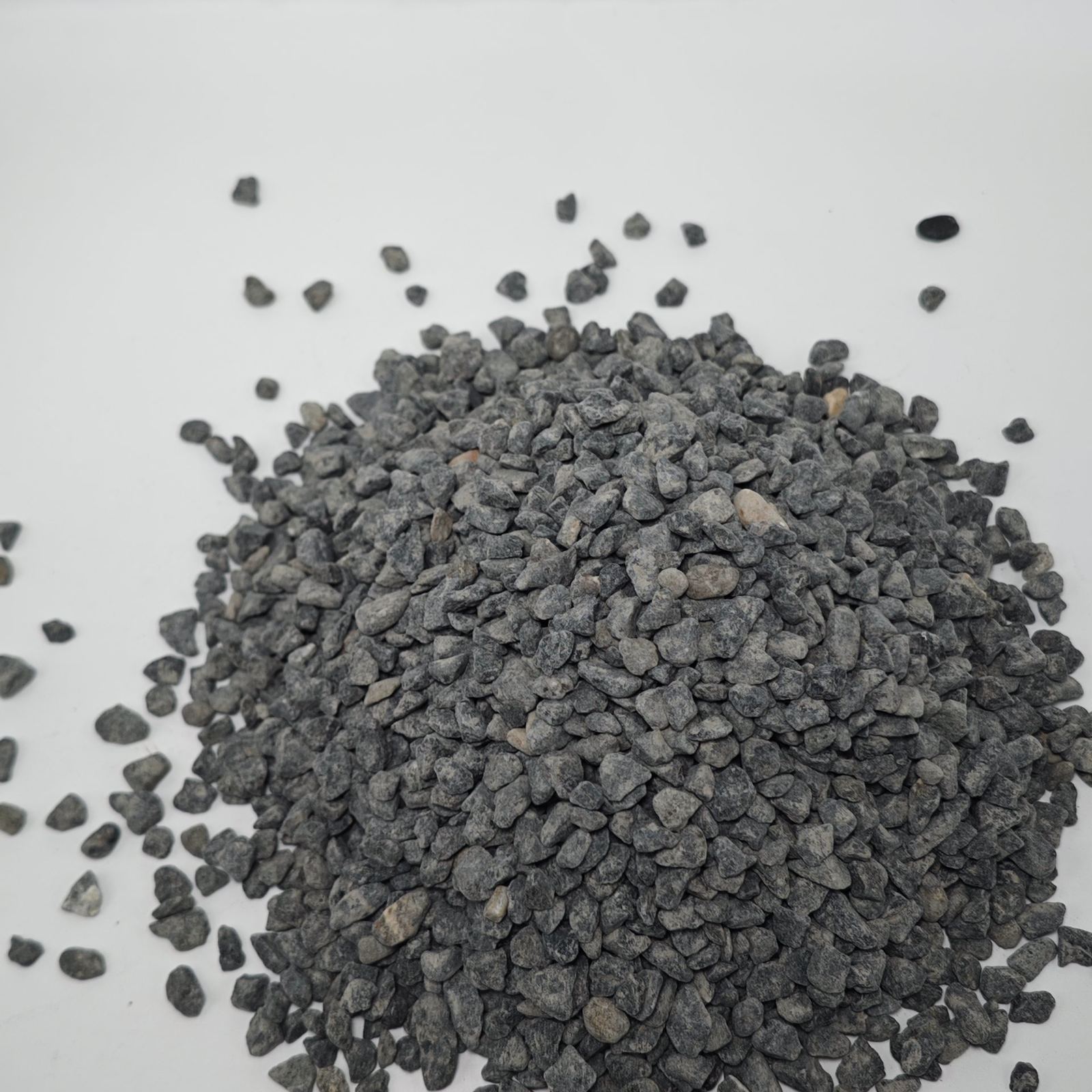
For paver joints, black small pebbles should be roughly one third to one half of the joint width: 2–3 mm for 5 mm joints, 3–5 mm for 8–10 mm joints and 5–8 mm for 12–15 mm joints. Budget 4–6 kg per square metre of tight-jointed paving, fill to 5–10 mm below the paver face, and buy single-size washed stone with fines under 1%.
Published · By Gardenstone Editorial Team · Educational article from the SWME TRADE team
Match the pebble to the joint: 1–2 mm grit for 3 mm joints, 2–3 mm for 5 mm joints, 3–5 mm for 8–10 mm joints and 5–8 mm for 12–15 mm joints. The stone should sit at about one third to one half of the joint width, filled to 5–10 mm below the paver face. Tight paving takes 4–6 kg of black pebble per square metre.
That rule answers the size question, not the purchasing one. Grading tolerance, dust content and how the stone packs decide whether a joint stays filled for years or pumps out in the first winter. Below is the arithmetic a contractor or distributor needs — kilograms per square metre, bags per 1,000 m², tonnes per container — plus the spec lines that keep a fine black grading clean enough to use beside pale pavers.
Quantity follows joint area, not paving area. For 200 × 100 mm pavers with 5 mm joints there is roughly 15 metres of joint in every square metre — about 7–8% of the surface. Filled to a 35 mm depth at a loose bulk density of 1.6 t/m³, that is 4–6 kg per square metre. Open the joints to 10 mm and the joint share rises to 13–15%, so the same square metre takes 8–11 kg.
Scale that up before quoting. A 25 kg bag fills 4–6 m² of tightly jointed paving and 2–3 m² of wide-jointed paving, so 1,000 m² of driveway needs 160–220 bags, or 4–5.5 tonnes. One tonne covers roughly 170–250 m², and a 24–27 tonne container therefore carries enough jointing stone for 4,000–6,000 m².
Two corrections stop an order running short. Joint widths are rarely uniform — a hand-laid sandstone terrace can run from 4 mm to 12 mm on the same platform — and the first fill settles, so plan a 10–15% top-up after the first wetting and a few weeks of traffic.
Fine black pebbles show everything. A grading carrying 3–5% fines releases a grey haze into the joint line, and against pale limestone or concrete pavers that reads as dirt within a week. Worse, the fines wash down, blind the drainage path and leave a crust that sheds water instead of passing it — the opposite of what an open joint is for.
Specify double-washed stone with fines under 1%, no clay and no organic matter, then verify it. Put 200 g of pebbles in a clear jar, add water, shake and let it stand for an hour: clean stone leaves clear water and a thin line of grit, dirty stone leaves cloudy water and a mud layer. Run the same test on the sample and on the first bags from production.
Sweep the joints clean and dry, and never fill over a wet bedding layer. Spread the pebbles thinly, broom them in, then run a plate compactor with a rubber mat so the stone settles rather than bridges. Top up and compact again until the joint holds stone 5–10 mm below the face — left flush, the stone travels.
Do not grout with cement if the design is a permeable joint; the point of the open joint is water passage. A polymer stabiliser can be added where a site needs resistance to suction cleaning, but it darkens the stone and is hard to reverse. Edge restraint matters just as much: without a fixed edge, joint pebbles migrate outwards and the paving spreads.
Yes, and one grading often serves both jobs — but not the smallest one. For container topdressing, 5–10 mm is the practical choice: it lets air and water through, suppresses weeds and moss, and stops compost splashing onto leaves. A 2–3 mm grit belongs in joints, seed beds and tray dressing, because in a pot it crusts and can seal the surface.
Per pot the quantity is small, per order it is not. A 30 cm pot has about 0.07 m² of surface, so a 20 mm layer takes 2–2.5 kg; 1,000 pots need 2–2.5 tonnes, and one tonne dresses 400–500 pots. Garden centres reselling in retail want 20–25 kg printed bags, while growers and landscapers taking a container prefer 1,000–1,200 kg jumbo bags — keep the two formats on separate order lines.
Blending a 5–10 mm topdressing grade with a 2–3 mm joint grade gives a 2–10 mm spread that fills joints poorly and looks uneven on a pot. Buy two graded lines, not one blended one.
Six lines cover it. The size band with an explicit tolerance — 2–3 mm with no more than 10% retained above 3.5 mm and no more than 10% passing 1.5 mm. Double-washed, fines under 1%, no clay. A sealed wet-and-dry colour reference, because black basalt and black granite read differently wet and a charcoal sort is not a blue-black one. Finish: tumbled or crushed, since crushed black stone is angular and packs tighter in a joint.
Then the logistics: packing format with net weight within ±2% verified on a weighbridge — 1,000 bags at +3% each is three quarters of a tonne unaccounted for — and the container plan, whether 24–27 tonnes loose, 960–1,080 × 25 kg bags, or 24–27 jumbo bags.
Build a mock-up. Take two or three 200 × 100 mm pavers, lay them at the joint width you actually build to, and fill with each candidate grading. Wet it, let it dry, and look from standing height in daylight — the only test that shows whether a 2–3 mm grading reads as a clean dark line or as grey sludge between pale pavers.
Then check the numbers: sieve 500 g by hand and weigh each fraction, run the jar test for fines, and compare the dried sample with the sealed reference under the same light.
Use stone at about one third to one half of the joint width: 1–2 mm grit for 3 mm joints, 2–3 mm for 5 mm joints, 3–5 mm for 8–10 mm joints and 5–8 mm for 12–15 mm joints. Fill to 5–10 mm below the paver face so the joint walls hold the stone.
Plan on 4–6 kg per square metre for 5 mm joints and 8–11 kg for 10 mm joints, at a 35 mm fill depth and a loose bulk density of 1.6 t/m³. A 25 kg bag fills 4–6 m² of tight joints, and one tonne covers about 170–250 m².
Yes. A 5–10 mm grading is the practical choice because it lets air and water through and resists crusting. A 20 mm layer on a 30 cm pot takes about 2–2.5 kg, so 1,000 pots need 2–2.5 tonnes — and keep that grade separate from a 2–3 mm joint grade.
Yes. Specify double-washed stone with fines under 1% and no clay. Dust blinds the joint drainage and leaves a grey haze against pale pavers. A jar test — 200 g of stone in water, shaken and left to stand — shows cloudy water and a mud layer if the grading is dirty.
“Over 13,000 ASTM standards operate globally. Defined and set by us, they improve the lives of millions every day. Combined with our innovative business services, they enhance performance and help everyone have confidence in the things they buy and use.”
ASTM International, “About ASTM Overview” — official page
Pathways combine the functional and decorative sides of landscaping stone: the surface must stay stable underf…
Garden landscaping brings together every stone category: ground cover for beds and borders, gravel for paths, …
Commercial landscaping is the volume end of the stone trade: office parks, public spaces, housing developments…
Everflorae — Artificial Plants & Trees
From the same supplier group, Everflorae supplies UV-stable artificial trees, palms and green walls that pair with stone — one source for hotels, resorts, malls and Japanese gardens.
Send your product, specification and destination — our sales team will prepare a quotation.