 SWME TRADE
Garden Pathways
Pathways combine the functional and decorative sides of landscaping stone: the surface must stay stable underf…
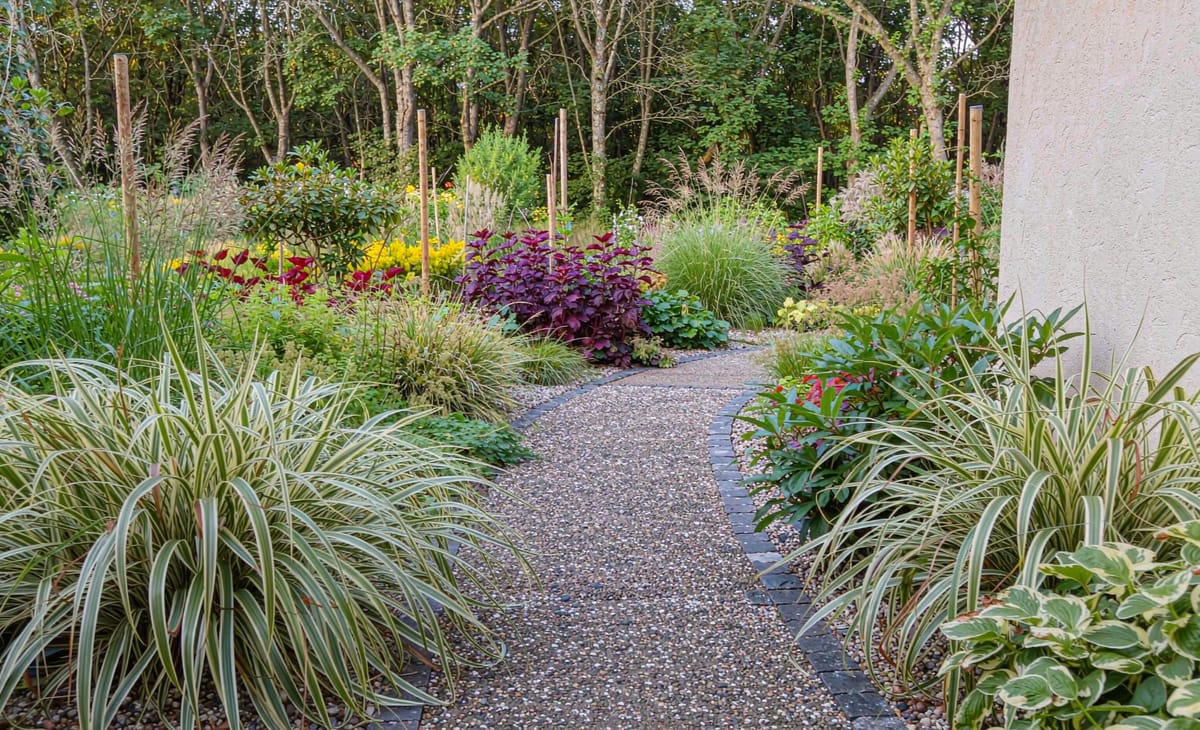
SWME TRADE · Blog
The best black pebbles for a garden pathway are washed 10–20 mm or 20–40 mm sub-rounded black river pebbles laid 30–40 mm deep over a compacted, weed-membraned base. This guide covers size choice, how to lay black pebbles so the path stays put, coverage per square metre, hotel-resort use, and bulk container buying.
Published · By Gardenstone Editorial Team · Educational article from the SWME TRADE team
For a garden pathway, the best black pebbles are washed, sub-rounded black river pebbles in 10–20 mm or 20–40 mm, laid 30–40 mm deep over a compacted, weed-membraned base. The tighter 10–20 mm grade reads formal and rolls less underfoot; 20–40 mm gives a looser, natural look. Where foot traffic or wheeled loads are heavy, a stabilised binder is the safer specification.
Pathways are the most-walked surface in a garden, so the material has to satisfy two conflicting demands: look decorative from a distance and stay stable underfoot up close. Black does the first job better than any other colour — it frames planting, hides leaf litter and reads as a clean modern line. The second job is won or lost on size band, depth, base preparation and edging, which is why a pathway is a specification problem, not just a colour choice.
Match the grade to the traffic and the look. For a formal, low-scatter path use 10–20 mm black pebbles; for a natural, looser path through planting use 20–40 mm. Reserve 8–12 mm or 5–8 mm for infill between paving and for edging gaps where the eye gets very close to the stone. If the path must carry trolleys, wheelchairs or bar rows, move to a resin-bound or stabilised system and treat the pebbles as the finish layer, not the structural surface.
Depth is the detail installers most often get wrong. A decorative loose path normally runs 30–40 mm over a membrane; if the client wants the stone to bed down and lock, 40–50 mm is more forgiving. Deeper than 60 mm and the stone behaves like loose ballast and pushes out of line at bends. On slopes, use the coarser 20–40 mm band and add timber or steel edging to stop the stone migrating downhill.
Finish and colour source matter for the same reason as in other black stone work. Tumbled black pebbles give a matte, low-glare surface that is comfortable to look at and hides dust; polished black pebbles reflect the sky and lighting but show water spots and fine marks underfoot. Confirm whether the black is natural basalt or dyed, and check it wet, because a pathway is seen in every weather condition.
The sequence that keeps a black pebble path stable and dark is straightforward. First, excavate and compact the sub-base; a loose, uncompacted base is the root cause of ruts and stone migration. Second, lay a woven, permeable weed membrane across the full width, lapping the joints and turning it up at the edges so roots and soil cannot work through. Third, add edging — ideally a fixed timber, steel or stone edge set below the finished stone level — to define the path and hold the bed.
Fourth, place the black pebbles in lifts and rake them to a consistent 30–40 mm, working back toward the entrance so you are not walking on finished stone. On a bend, keep the stone tight against the outer edge; this is where loose paths wash out first. Fifth, for heavier traffic, finish with a stabilised binder poured or sprayed over the dressed stone, or specify a resin-bound layer, and note in the maintenance sheet that the surface is refreshed rather than re-laid.
Two extras protect the look. Keep black pebbles dust-free and washed at supply, because a haze of fines makes black stone look grey until it rains. And install drainage alongside rather than under the path: a slight cross-fall to a gravel-filled channel, or a French drain at the low side, moves water away so the stones do not sit in a trough. That is exactly where black pebbles for drainage earn their place — in the soakaway and channel detail, not just the decorative surface.
For a pathway, budget by area and depth. At 30–40 mm depth, 10–20 mm black pebbles run roughly 45–65 kg per square metre, and 20–40 mm stone runs roughly 60–85 kg per square metre at the same depth because the larger voids need more weight to fill the profile. A 0.9 m wide path, 20 m long, is 18 m² — so roughly 0.8–1.2 tonnes for 10–20 mm, more for the coarser grade.
Add a working margin of 5–10% for settlement, edge build-up and spillage, and round the order to the nearest container load where the programme allows. English-market buyers often reorder in 20–25 kg retail bags for garden-centre and landscape-supply shelves, while contractors buy 1-tonne jumbo bags or loose tonnes. A 20 ft container of black pebbles typically holds about 24–27 tonnes, so a path project and a garden-centre reorder can share one load — that is the single biggest lever on landed cost per square metre.
Hotel and resort landscaping is where black pebbles perform best and fail most visibly. Around pool decks, spa gardens, roof terraces, water features and arrival courts, black stone delivers the boutique, high-contrast look that photographs well for marketing. But a resort path is walked by hundreds of guests a day, so the best black pebbles for hotel landscaping are usually a stabilised or resin-bound 10–20 mm black pebble over a properly compacted base, with tight edging, rather than a loose decorative scatter.
Resort specs should also cover safety and maintenance. Specify a slip-resistant finish and a consistent depth so trolleys and luggage wheels do not plough the surface; use matte or lightly tumbled black near pool edges, where polished stone plus water can be slick. Colour consistency across phases matters more here than on a private path, because the arrival court, the pool terrace and the spa garden are often installed in different seasons — lock one sealed colour reference and carry samples between lots.
Finally, plan the service regime. Black pebbles show leaf litter and pool splash, so a resort needs wash-down access, a leaf-blower routine and a spare bag type on site for top-ups. Specifying dust-free washed stone at supply, and a binder that can be refreshed rather than removed, keeps the finish sharp through peak season without closing the area for a full re-lay.
Bulk black pebble sourcing for pathway and hotel programmes usually starts at one 20 ft container (roughly 24–27 tonnes, or around 1,200–1,350 × 20 kg bags). Set the minimum order quantity in tonnes and in bags, confirm whether mixed pallets of two size bands are allowed, and confirm the pack split — 20 kg and 25 kg PP bags on pallets, 1-tonne FIBC jumbo bags, or loose lined containers.
Write the purchase order against enforceable terms: nominal size in millimetres with a within-band percentage and an oversize/undersize cap; finish, matte/tumbled or polished; colour as a sealed 1 kg sample reference with an off-reference tolerance; washed and dust-free with a stated fine-content limit; pack type and mass tolerance; and the sampling and third-party inspection method before loading. Black is the least forgiving colour in the catalogue, so a sealed sample held by both parties is the cheapest protection against a container that arrives the wrong shade.
Verify before it ships: sieve each band against the specification, run a wash test for fines, compare a wet 1 kg scoop from three pallets against the sealed reference, count broken and fractured particles, spot-check bag mass on at least five bags per lot, and photograph the loaded container with date and lot reference. Retain a labelled sample from every lot so a drift is caught in container two rather than discovered on site in container eight. On a pathway or a resort terrace, the shade and the grading are the design — everything else is logistics.
Use washed 10–20 mm sub-rounded black pebbles for a formal, low-scatter path and 20–40 mm for a looser, natural path through planting, laid 30–40 mm deep over a compacted, weed-membraned base. For paths carrying trolleys, wheelchairs or heavy footfall, specify a stabilised or resin-bound 10–20 mm black pebble rather than loose stone.
A decorative loose black pebble path is normally laid 30–40 mm deep over a permeable weed membrane; 40–50 mm is more forgiving if you want the stone to bed down and lock. Avoid depths beyond about 60 mm, where the stone behaves like loose ballast and pushes out of line at bends, and use the coarser 20–40 mm grade with edging on slopes.
At 30–40 mm depth, 10–20 mm black pebbles run roughly 45–65 kg per square metre and 20–40 mm stone runs roughly 60–85 kg per square metre. Add 5–10% for settlement and spillage. A 0.9 m × 20 m path (18 m²) needs roughly 0.8–1.2 tonnes of the finer grade, more for the coarser stone.
Yes, and they are widely used around pool decks, spas, roof terraces and arrival courts for a high-contrast boutique look. Because resort paths carry heavy daily traffic, the best specification is usually a stabilised or resin-bound 10–20 mm black pebble over a compacted base with tight edging, a slip-resistant finish, and one locked colour reference carried across construction phases.
“ISO 9001 is a globally recognized standard for quality management. It helps organizations of all sizes and sectors to improve their performance, meet customer expectations and demonstrate their commitment to quality.”
ISO, ISO 9001:2026 “Quality management systems — Requirements” — official page
Pathways combine the functional and decorative sides of landscaping stone: the surface must stay stable underf…
Hotel and resort landscapes are commercial projects with residential finish quality: large areas, premium appe…
Commercial landscaping is the volume end of the stone trade: office parks, public spaces, housing developments…
Garden landscaping brings together every stone category: ground cover for beds and borders, gravel for paths, …
Everflorae — Artificial Plants & Trees
From the same supplier group, Everflorae supplies UV-stable artificial trees, palms and green walls that pair with stone — one source for hotels, resorts, malls and Japanese gardens.
Send your product, specification and destination — our sales team will prepare a quotation.