 SWME TRADE
Commercial Landscaping
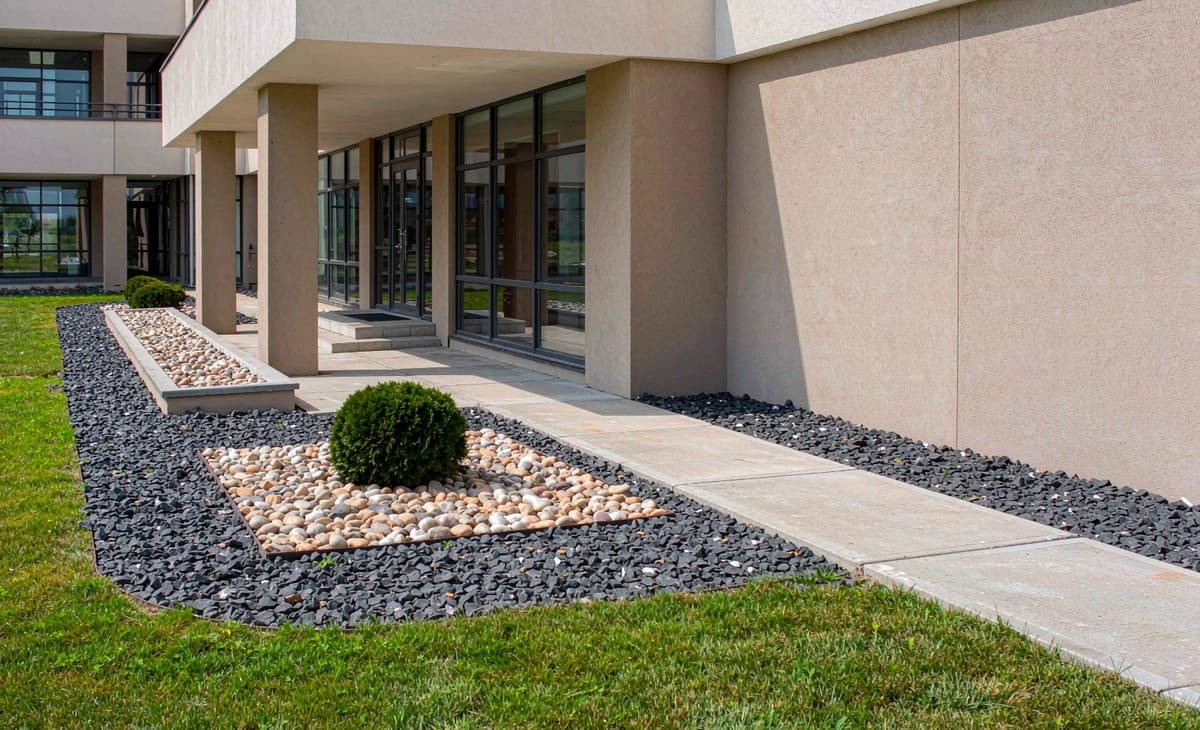
Commercial landscaping is the volume end of the stone trade: office parks, public spaces, housing developments…
SWME TRADE · Blog
Washed black basalt in a tight size band is the reliable answer for commercial landscaping, because black is the most unforgiving colour there is: dust, oversize stone and batch drift all show first on a black bed. This guide covers basalt versus dyed and polished black pebbles, the clauses to write into a purchase order, what changes when the same stone goes on a driveway, and the pre-shipment checks that keep a container from failing on site.
Published · By Gardenstone Editorial Team · Educational article from the SWME TRADE team
Washed black basalt in a tight size band is the safest answer. Use 10–30 mm for borders and narrow beds, 20–40 mm for larger beds, and 40–60 mm where the stone has to resist movement. At 50 mm depth one tonne covers roughly 13 m², and a 20GP container carries about 24–27 tonnes.
The reason basalt wins is not appearance, it is failure mode. Natural black basalt is through-coloured, so a chipped or scuffed stone still looks black; a dyed pebble shows its lighter core the first time a wheel or a rake catches it. On a commercial project that is maintained by a contractor who was not in the room when the stone was chosen, the through-coloured option is the one that still looks right in year three.
Dyed black pebbles are produced by coating a lighter aggregate with a black pigment. They are cheaper per tonne and photograph well, but the colour sits on the surface. Wear, frost movement, acid cleaning or a pressure washer will expose the base stone, and in a large bed the result is a patchwork rather than a uniform surface. Dyed stone is reasonable for a small feature or a seasonal display; it is a poor choice where colour consistency is written into the contract.
Polished black pebbles are a third category again. Polishing produces a gloss that reads as wet stone, which suits water features and high-end decorative beds. The trade-off is maintenance: a polished surface shows dust, tyre film and water spotting far more than a matte one, and it is slippery underfoot when wet. For commercial beds, walkway shoulders and driveway aprons, a matte washed finish is the practical default.
Whichever type you buy, the colour has to be judged wet. Black pebble colour shifts more between dry and wet than any other shade, and a bed that looks uniform in a dry container photograph can read as two different blacks after the first rain. Keep a sealed 1 kg reference sample, keep it wet for comparison, and check against it rather than against a brochure.
Grey and cream beds hide specification gaps because they have visual noise to hide behind. Black has none. There are three failures that appear on a black bed first. The first is dust: an unwashed or under-washed load leaves a pale film that reads as a milky haze across the whole bed, and on black it is unmistakable from several metres away. Specify washed stone with a stated fines limit rather than assuming washing is included.
The second is oversize particle content. Oversize stones in a black bed catch the light differently and sit proud of the surface, so the eye picks them out immediately; what is a minor grading tolerance on a grey border becomes a visible defect on black. The third is batch drift. Because black sits at the extreme end of the value range, a small change in the base stone or in the washing process produces a shift that is obvious when two lots meet. The mitigation is straightforward: seal a sample, state a maximum share of off-reference stone, and retain a labelled sample from every production lot so drift is caught at container two rather than discovered at container eight.
A commercial order needs more than a colour name. Write in the nominal size band in millimetres with the required within-band percentage and an explicit oversize and undersize cap — a workable commercial figure is 90–95% within the nominal band with the remainder in one adjacent band. State particle shape, because angular crush interlocks on slopes and paths while rounded stone rolls; a black decorative bed and a black driveway apron rarely want the same shape.
Then the clauses that decide whether the load passes inspection: washed, with fines and dust at or under 1–2% and the wash method named; a maximum percentage of broken, fractured or elongated particles, normally at or under 5%; a colour clause expressed as a maximum share of off-reference stones counted in three random 1 kg scoops taken wet from different pallets; unit mass tolerance of about ±1% on a 20–25 kg bag or ±1–2% on a one-tonne jumbo bag; and a moisture allowance at packing, which matters in humid months because water weight arrives as product weight.
Finish with the procedural clauses, which are the ones buyers most often forget: the sampling point and method — a sieve test on material drawn from the loaded hopper, not from a hand-picked display pile; the inspection timing; and the buyer's right to third-party inspection before loading. Anchor the whole document to a sealed 1 kg sample held by both parties. Text is guidance; the sample is the standard.
The same stone behaves differently once vehicles are involved, so a driveway specification is a different document. Depth rises: 20–40 mm black pebbles laid at 50–75 mm over a compacted sub-base, with a stabilising grid or cellular system wherever wheels will turn on the surface, because loose stone migrates out of a turning circle within a season. On any gradient, specify angular crushed stone rather than rounded, so the particles interlock instead of rolling downhill. Edges need rigid restraint — a loose black bed at a driveway edge loses its line quickly and the loss is visible against a light apron.
Set the maintenance expectation with the client before the order, not after. Black is the shade that shows tyre dust, rubber film and leaf litter most clearly, and a driveway is where all three accumulate. A matte washed finish handles it better than polished, and a light rinse at the seasonal change of the year is normally enough — but the client should know that a black driveway is a choice to be maintained, not a surface that stays pristine untended. For the material comparison behind these choices, our guide to landscaping pebbles versus gravel versus sand works through the trade-offs.
Coverage arithmetic should be written into the enquiry, because it is what turns a vague request into an order both sides can check. At 50 mm depth, one tonne of 20–40 mm pebbles covers roughly 13 m²; at 25 mm it rises to about 26 m² per tonne, and at 75 mm it falls to around 9 m². Add 5–10% for settlement and edge loss, and lay the stone over a geotextile membrane so soil does not pump up into the bed — on black, that membrane matters more than on any other colour, because any soil migration shows as a grey stain.
Packing then decides the landed cost more than the unit rate does. A 20–25 kg bag is the handling-friendly option and is what most retail and landscaping merchants resell; a one-tonne jumbo bag cuts bagging labour and packaging material per tonne and is the normal choice for project and municipal delivery, but it needs a forklift or telehandler at destination and cannot be moved by hand once it lands. Loose loading in a lined container is the cheapest per tonne and the least flexible on arrival.
A 20GP container commonly carries about 24–27 tonnes of bagged or jumbo-bagged pebble, depending on packing efficiency and moisture. Because black basalt is dense, black orders tend to be weight-limited rather than volume-limited, which is worth knowing when you are pricing freight: adding a second lighter product to the same box may fill volume you were already paying for.
A short, repeatable pre-shipment routine catches almost everything: a sieve grading test for each band on a sample drawn from production; a wash test for dust and fines compared against the agreed limit; a wet colour comparison of a 1 kg sample against the sealed reference; a shape and broken-particle count; a unit mass spot check of at least five bags per lot; a moisture check at packing in humid months; and a dated photograph record of the loaded container.
For programmes running several containers a year, carry the sealed samples forward instead of re-approving each time, retain a labelled sample from every production lot, and re-check lightly on each reorder. That is how a drift becomes a conversation about container two rather than a complaint about container eight — and with black, where the specification has nowhere to hide, that routine is the difference between a surface that reads as one deliberate black bed and one that reads as several.
Washed black basalt in a tight size band is the standard choice: 10–30 mm for borders and narrow beds, 20–40 mm for larger beds, and 40–60 mm where the stone must resist movement. Basalt is through-coloured, so chips and scuffs stay black, unlike dyed stone which reveals a lighter core when the coating wears.
Yes, with two changes to the specification. Depth rises to 50–75 mm of 20–40 mm stone over a compacted sub-base with a stabilising grid wherever wheels turn, and the stone should be angular crushed rather than rounded so it interlocks on gradients. Expect to maintain it: black shows tyre dust and rubber film more clearly than any other shade.
At 50 mm depth, one tonne of 20–40 mm pebbles covers roughly 13 m². At 25 mm depth coverage rises to about 26 m² per tonne, and at 75 mm it falls to around 9 m² per tonne. Add 5–10% for settlement and edge loss, and remember a tonne of dense black basalt covers the same area as any other colour — only the surface behaviour differs.
It depends on the discharge point. A 20–25 kg bag is the handling-friendly option that merchants resell, while a one-tonne jumbo bag cuts bagging labour and packaging material per tonne and suits project and municipal delivery, but needs a forklift or telehandler on arrival. A 20GP container commonly carries about 24–27 tonnes either way, and black orders are usually weight-limited rather than volume-limited.
“ISO 9001 is a globally recognized standard for quality management. It helps organizations of all sizes and sectors to improve their performance, meet customer expectations and demonstrate their commitment to quality.”
ISO, ISO 9001:2026 “Quality management systems — Requirements” — official page
Commercial landscaping is the volume end of the stone trade: office parks, public spaces, housing developments…
Pathways combine the functional and decorative sides of landscaping stone: the surface must stay stable underf…
Water features are the most natural fit for river materials: water-worn pebbles and rocks around ponds, stream…
Hotel and resort landscapes are commercial projects with residential finish quality: large areas, premium appe…
Everflorae — Artificial Plants & Trees
From the same supplier group, Everflorae supplies UV-stable artificial trees, palms and green walls that pair with stone — one source for hotels, resorts, malls and Japanese gardens.
Send your product, specification and destination — our sales team will prepare a quotation.