 SWME TRADE
Dry River Bed
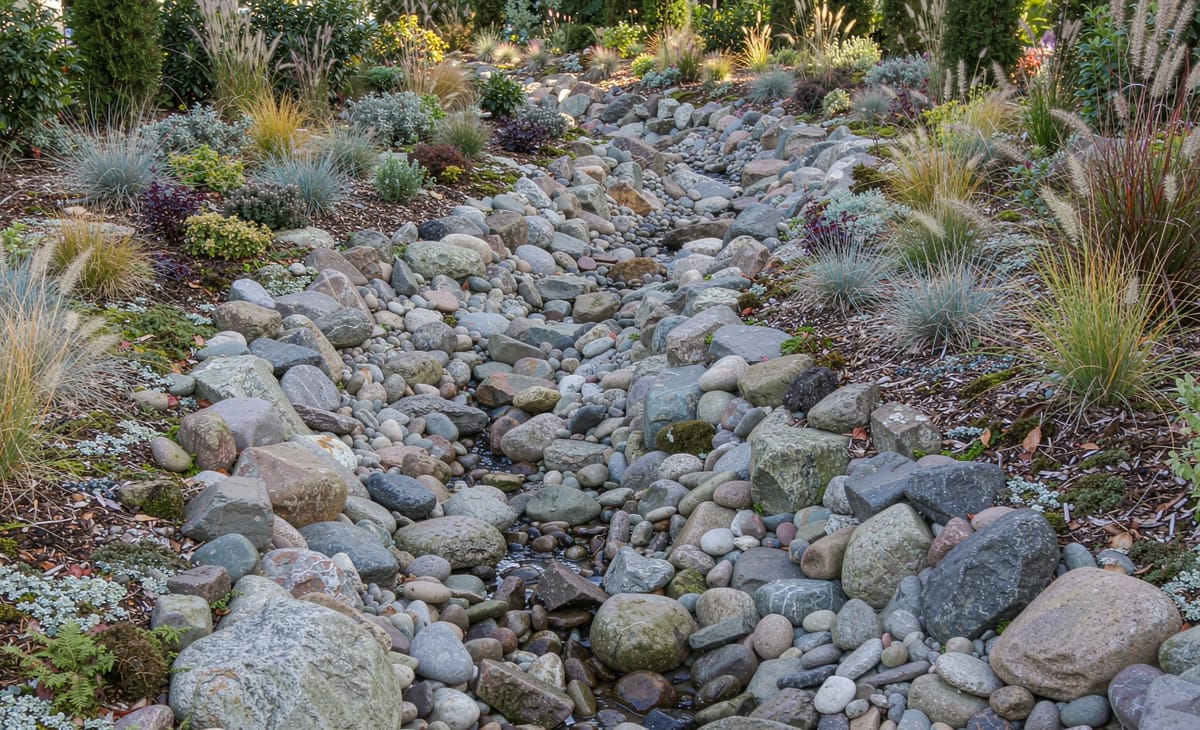
A dry river bed (dry creek bed) is a landscape feature that mimics a natural stream channel — both as a design…
SWME TRADE · Blog
For a dry river bed the best black pebbles are washed 20–40 mm sub-rounded or polished black river pebbles for the main channel, with 40–60 mm stone along the banks, laid 50–75 mm deep. This guide covers grades, coverage per square metre, flower-bed use, and how to buy black pebbles by the tonne without colour drift.
Published · By Gardenstone Editorial Team · Educational article from the SWME TRADE team
For a dry river bed, the best black pebbles are washed, sub-rounded or polished black river pebbles graded 20–40 mm for the main channel and 40–60 mm for the banks, laid 50–75 mm deep over a weed membrane. Matte black reads darker when wet; polished black reflects light and shows the water-like sheen designers want. Order it by the tonne — one 20 ft container holds roughly 24–27 tonnes.
The reason this grade works is drainage and silhouette. A dry river bed is a drainage line dressed as water, so the stone must be free-draining, stable underfoot and dark enough to throw the surrounding plants and pale gravel into contrast. Black is not a colour choice here; it is the material that makes the 'water' read as water. The two failure points are size and finish, so buyers should specify both, not leave them to the installer.
Think of the channel in three bands. The bed itself uses 20–40 mm stone, deep enough (50–75 mm) that no membrane shows and the surface ripples. The banks and any boulder groups use 40–60 mm, sometimes 60–100 mm accent pieces, to define the edge and slow the eye. The transition strips where the bed meets grass or planting use 10–20 mm so the small stone does not scatter into the lawn.
Finish matters as much as size. Natural (tumbled) black pebbles have a soft matte surface and hold their tone; polished black pebbles have a mirror-like face that sparkles under garden lighting but shows water spots and fine scratches more easily. For a channel that is walked on or raked, matte or lightly polished is the safer choice. For a decorative bed seen from a terrace, full polished stone delivers the strongest contrast.
Black pebble colour sources differ as well. Jet-black basalt holds the deepest, most uniform tone; dyed black pebbles can fade toward grey in strong UV and repeated rain, so ask whether the colour is natural or surface-treated and how it was tested. A quick wet sample tells you more than any photograph, because black stone looks very different dry and after rain.
Coverage depends on pebble size and depth, so quote a depth first and let the arithmetic follow. As a working rule, 20–40 mm black pebbles laid about 40–50 mm deep run roughly 60–85 kg per square metre, and 40–60 mm stone at the same depth runs slightly lighter per square metre because there is more air between larger stones. A 3 m × 0.6 m dry river bed is about 1.8 m², so budget around 110–150 kg before the banks are added.
Buyers should always order a margin. Stone settles and compacts a little, the banks take extra material, and spillage during laying is normal — 5–10% over the calculated figure is standard practice. In bagged terms this is where the unit decision matters: 20 kg or 25 kg retail bags suit small garden-centre and landscape-supply reorders, while 1-tonne jumbo bags and loose tonnes suit contractors. Match the pack to the customer; misjudging pack size is the most common reason a good product sits unsold.
When you convert to bulk, plan the container. On a 20 ft container, loose or jumbo-bagged black pebbles fill roughly 24–27 tonnes depending on how tightly the bags are stacked and the stone's bulk density, so round each order to whole container loads where the programme allows. That single move is usually the biggest lever on landed cost per square metre.
Yes — the best black pebbles for a flower bed are usually the same 20–40 mm washed black pebbles, laid 50–75 mm deep, but the logic shifts. In a flower bed the stone is a mulch as well as a finish: it suppresses weeds, keeps soil from splashing onto foliage and holds heat at night. Black absorbs more heat than pale gravel, which suits warm-climate planting and Mediterranean schemes, while in a very hot, full-sun bed a paler stone may be kinder to shallow roots.
Two practical differences apply. First, depth: flower beds are usually laid shallower, 40–60 mm, and the stone must still fully cover the membrane underneath. Second, plant access: choose 20–40 mm rather than finer 8–16 mm if the client regularly divides and replants, because small stone migrates into soil and is hard to separate. For beds that are weeded by hand, the same 20–40 mm matte black grade used in the dry river bed gives a consistent look across the whole garden.
Wholesale black pebble orders are normally specific by size band, finish, colour reference and pack type, with a minimum order quantity set by the container rather than by the bag. Most importers start a programme at one 20 ft container (roughly 24–27 tonnes) and grow from there, because anything less than a full load rarely justifies freight. Ask your supplier for the practical minimum in tonnes and in bags, and confirm whether mixed pallet configurations are allowed.
Packaging is part of the specification. Standard options are 20 kg and 25 kg PP bags on pallets, 1-tonne FIBC jumbo bags, and loose bulk in lined containers for high-volume contractors. For black pebbles, insist on dust-free washed material: black stone shows a haze of fines far more than pale stone, and a dusty load looks grey, not black, until it rains. State the wash standard and a moisture allowance at packing, particularly for humid-season shipments.
Finally, lock the description down. Put the actual terms into the purchase order: nominal size in millimetres with a within-band percentage, finish (matte/tumbled or polished), colour as a sealed sample reference with an off-reference tolerance, washed and dust-free, pack type and mass tolerance, and the sampling and inspection method before loading. A sealed 1 kg sample held by both parties is the cheapest insurance against a container that arrives the wrong shade of black.
Black is the least forgiving colour in the catalogue, so verification matters more than for white or mixed stone. Run a sieve check on each band against the stated range; a wash test for fines and dust; a wet colour comparison of a 1 kg scoop against the sealed reference, taken from three different pallets; a broken and fractured particle count; and a mass spot check on at least five bags per lot.
Then confirm the load: check the container is lined or the bags are appropriately palletised, that the packed weight matches the order, and photograph the loaded container with date and lot reference. Retain a labelled sample from every production lot so that a drift in container two is caught as a conversation rather than discovered in container eight as a customer complaint.
The commercial logic is simple. Black pebbles sell on contrast and consistency — a dry river bed or a flower bed is a design statement, and the shade has to match the sample across every reorder. Buyers who specify size, finish, colour reference and pack type, verify them wet, and order in whole container loads protect both the design and the margin. The stone is the delivery mechanism; the specification is the product.
Use 20–40 mm washed, sub-rounded or polished black river pebbles for the main channel, 40–60 mm for the banks and edge groups, and 10–20 mm for the transition strips where the bed meets grass or planting. Lay the bed 50–75 mm deep over a weed membrane so no membrane shows and the surface reads as flowing water.
Black pebble pricing is quoted as a range rather than a fixed number because it depends on grade, finish, quantity and destination. The main cost factors are size band and finish (polished usually runs above matte), order volume (full 20 ft containers of roughly 24–27 tonnes land cheaper per tonne than part loads), pack type (20–25 kg bags versus 1-tonne jumbo bags), and FOB versus CIF terms. Request a quote with your size, finish, volume and destination port for an accurate figure.
For 20–40 mm black pebbles laid about 40–50 mm deep, allow roughly 60–85 kg per square metre; larger 40–60 mm stone is slightly lighter per square metre at the same depth. Add 5–10% for settlement, bank build-up and spillage. As an example, a 3 m × 0.6 m dry river bed (about 1.8 m²) needs roughly 110–150 kg before the banks are added.
Yes. 20–40 mm washed black pebbles are widely used in flower beds as both a finish and a mulch, laid 40–60 mm deep over a membrane to suppress weeds and reduce soil splash. Black absorbs more heat than pale stone, which suits warm-climate and Mediterranean planting; in very hot, full-sun beds a lighter stone may suit shallow-rooted plants better.
“ISO 9001 is a globally recognized standard for quality management. It helps organizations of all sizes and sectors to improve their performance, meet customer expectations and demonstrate their commitment to quality.”
ISO, ISO 9001:2026 “Quality management systems — Requirements” — official page
A dry river bed (dry creek bed) is a landscape feature that mimics a natural stream channel — both as a design…
Stone-topped flower beds replace mulch with a permanent surface: stones suppress weeds when laid over membrane…
Zen gardens reduce the landscape to three materials: raked sand or fine gravel for water and openness, selecte…
Japanese garden design uses stone as its structural vocabulary: larger stones placed as islands and mountains,…
Everflorae — Artificial Plants & Trees
From the same supplier group, Everflorae supplies UV-stable artificial trees, palms and green walls that pair with stone — one source for hotels, resorts, malls and Japanese gardens.
Send your product, specification and destination — our sales team will prepare a quotation.