 SWME TRADE
Japanese Garden
Japanese garden design uses stone as its structural vocabulary: larger stones placed as islands and mountains,…
SWME TRADE · Blog
Japanese gardens need tight, deliberately chosen size bands — 8–16 mm for raked gravel, 20–40 mm for stream beds, 40–80 mm for upright accent stone — while commercial landscapes run on written specifications. This guide gives the size chart, the sieve and wash tolerances to write into a purchase order, and the checks that stop a container failing on site.
Published · By Gardenstone Editorial Team · Educational article from the SWME TRADE team
Japanese gardens need tight, deliberately chosen size bands, not one broad mix. Use 8–16 mm angular gravel for raked dry-landscape beds, 20–40 mm graded stone for stream beds and pond edging, and 60–150 mm individually selected upright accent stones. Shipping a single loose 10–50 mm blend to cover every role is the most common wholesale error — it rakes badly and forces the landscaper to hand-sort on site.
The reason the bands are narrow is that the garden is meant to be raked and read. Gravel raked into flowing lines only holds those lines if the stones are small, uniform and reasonably angular; rounded 30 mm pebbles roll back into the furrow within a season. Conversely, a stream bed built from 8–16 mm stone looks like a path, not water. Size is doing the design work in a Japanese garden, which is why buyers who treat it as commodity stone lose the project.
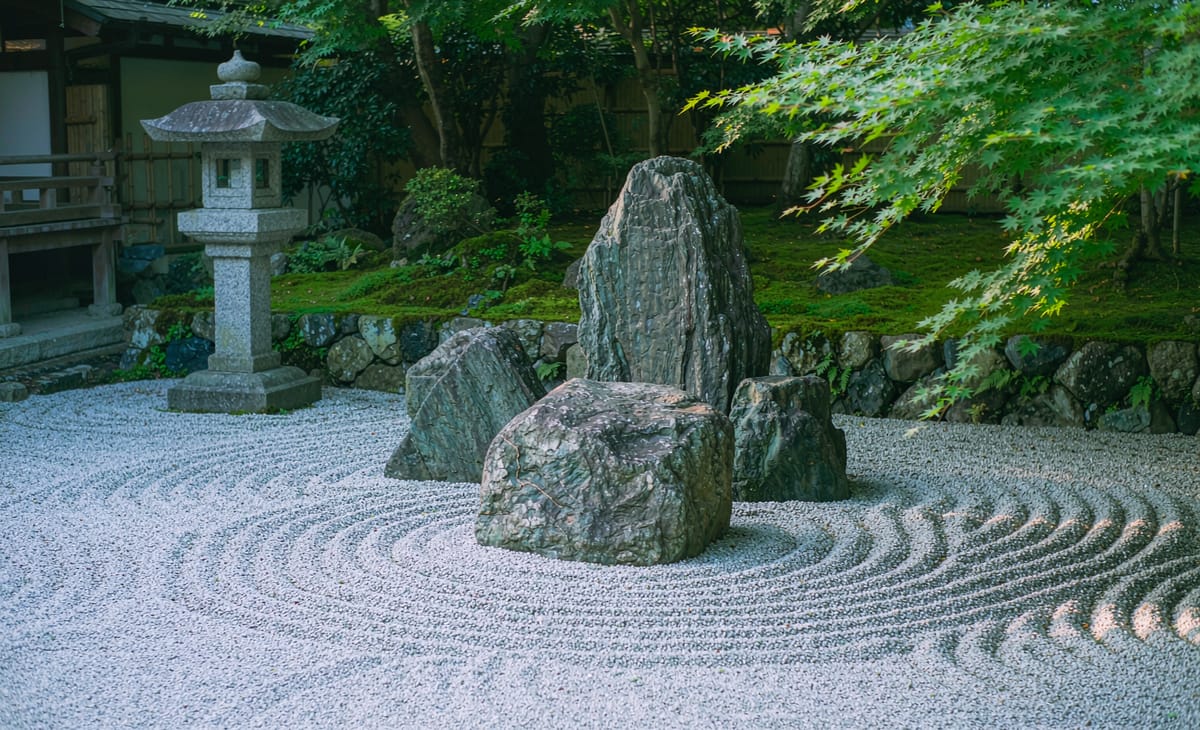
Dry landscape gravel (karesansui): 6–16 mm, typically 8–16 mm, angular crushed granite in light grey or cream. Depth is thin — 30–50 mm over a compacted base with a stabilised binder if the garden is raked weekly. Stone smaller than 6 mm is difficult to rake cleanly; stone larger than 16 mm will not hold a crisp ridge.
Stream beds and dry river beds: 20–40 mm, with a graded blend that includes 40–60 mm boulders at the 'banks' to suggest flow direction. Pond and feature edging: 30–60 mm rounded pebbles, chosen for a wet colour that stays stable. Upright accent stone and border: 60–150 mm, individually selected — this is the one category where hand-sorting is normally paid for and specified. Stepping-stone surrounds and path shoulders: 10–25 mm, tight enough to walk on barefoot without discomfort.
Gravel width and depth also scale with size. Small bands read best in narrow planted strips and around rocks; wide open areas need either a larger band or a divided layout, because a 3-metre sweep of 8 mm gravel looks like a beach rather than a raked garden.
Three specification gaps cause nearly every failure. The first is grading drift: ordinary landscape supply tolerates a broad band, so a 10–30 mm order routinely arrives with 20% of the material above or below the stated range. In a raked garden that oversize fraction sits on the surface and destroys the line work. Write an explicit oversize and undersize allowance — for example 95% within the stated band — and verify it with a sieve test, not a visual check.
The second is shape. Japanese garden gravel is normally angular crush because it rakes and interlocks; rounded river pebbles are used for water-suggesting beds and edging. If angular gravel arrives with a high proportion of flat or elongated particles, the surface compacts into a slick sheet rather than individual raked grains. The third is colour consistency: a garden is read as a single composition, so a 2–3 shade drift between batch one and batch two is far more visible here than in a car park border. Lock the colour against a sealed sample and a roughness reference, and retain a sample from each production lot.
Across the trade, a specification is usually written against a national or project standard and always references a physical sample. The working rule is that descriptions are guidance and approved samples are law: '20 mm washed angular aggregate, colour light grey' means nothing enforceable, while a sealed 1 kg sample held by both parties plus a required colour and shape reference makes the order auditable for the full programme.
Write the following into every commercial purchase order: nominal size band in millimetres with a stated within-band percentage and an oversize/undersize cap; particle shape, stating angular, sub-rounded or rounded and whether crushed faces are permitted; colour as a measured lightness value plus an agreed tolerance expressed as a maximum share of off-reference material in a sampled scoop; fines and dust limits with a wash method; a maximum percentage of broken, fractured or elongated particles; moisture allowance at packing; tolerance on unit mass; and the sampling procedure, inspection timing and the buyer's right to third-party inspection before loading.
Also give the order an inspection and durability statement where the project calls for it: freeze-thaw performance and resistance to wear belong in the specification for paving-adjacent grave, kerb surround and municipal work, along with a delivery and staging method that avoids compaction of the finished surface.
Tolerances should be tight enough to protect the design and loose enough to be producible, otherwise you get either rejects on arrival or a supplier who quotes a padded price to cover that risk. Workable commercial numbers for bulk pebble supply: 90–95% of material within the nominal band with the remainder within one adjacent band; broken and fractured particles held at or under 5%; fines and dust at or under 1–2% for washed decorative grades, though washed rather than unwashed stone is not a universal baseline for construction aggregate; unit mass tolerance of about ±1% on a 20–25 kg bag or ±1–2% on a one-tonne jumbo bag.
Two terms state a composition rather than a single band and are widely used where quick site checks are preferred: 'nominal single size' permits up to about 5% of oversize and 10–15% of undersize, whereas 'graded' specifies a defined spread across one or two size designations. Whichever you choose, state the sampling point and method — a sieve test on a sample taken from the loaded hopper, not from a hand-picked display pile, because a display pile is not a sample.
Finally, cap the colour drift rather than describing the colour. A workable commercial formula is a stated maximum share of off-reference stones counted in three random 1 kg scoops from different pallets, checked wet. Wet checking matters because pebble colour shifts noticeably between a dry photograph and a rained-on bed, and disputes almost always cite the conditions the other party never saw.
Sieve grading for each band on a sample drawn from production, not from the sample room; a wash test for dust and fines compared against the agreed limit; a wet colour comparison of a 1 kg sample against the sealed reference; a shape and broken-particle count; a unit mass spot check of at least five bags per lot; a moisture check at packing in humid months; and a dated photograph record of the loaded container.
For programmes running several containers a year, carry the sealed samples forward rather than re-approving each time, retain a labelled sample from every production lot, and re-check lightly on each reorder. That way a drift is caught in container two as a conversation rather than discovered in container eight as a season of customer complaints.
The commercial logic is the same for both audiences. A Japanese garden is a design sold on precision, so the buyer who can supply correctly banded, correctly shaped stone at a stated tolerance wins repeat work from garden designers. A commercial landscape is a programme sold on compliance, so the supplier who arrives with a written specification, a sealed sample and a test report becomes the safe line item on a tender. Precision and paperwork are the two products; the stone is the delivery mechanism.
Raked dry-landscape gravel is normally 8–16 mm angular crushed granite in light grey or cream, laid 30–50 mm deep over a compacted base, with a binder added if the garden is raked regularly. Bands smaller than 6 mm are hard to rake cleanly and bands larger than 16 mm will not hold a crisp ridge, which is why 8–16 mm is the standard working range.
Use 20–40 mm graded stone for stream beds and dry river beds, with some 40–60 mm boulders along the banks to suggest flow direction; 30–60 mm rounded pebbles for pond and feature edging; 60–150 mm individually selected upright accent stones and border stone; and 10–25 mm pebbles around stepping stones and along path shoulders.
State the nominal size band in millimetres with a required within-band percentage and an oversize and undersize cap, the particle shape and whether crushed faces are permitted, colour as a measurable value with a stated off-reference tolerance, fines and dust limits with a wash method, a maximum broken or elongated particle percentage, bag or jumbo bag mass tolerance, and the sampling procedure, inspection timing and third-party inspection rights — all anchored to a sealed 1 kg sample held by both parties.
Workable commercial figures are 90–95% of material within the nominal band with the remainder in one adjacent band, broken and fractured particles at or under 5%, fines and dust at or under 1–2% for washed decorative grades, and unit mass within about ±1% on bagged material. Where quick site checks are preferred, a nominal single size permits roughly 5% oversize and 10–15% undersize, while a graded designation defines a controlled spread across one or two size bands.
“Trade Map provides comprehensive global trade data for over 230 economies, with monthly, quarterly and yearly updates using official reported data and mirror data techniques.”
ITC Trade Map, trademap.org — official page
Japanese garden design uses stone as its structural vocabulary: larger stones placed as islands and mountains,…
Zen gardens reduce the landscape to three materials: raked sand or fine gravel for water and openness, selecte…
A dry river bed (dry creek bed) is a landscape feature that mimics a natural stream channel — both as a design…
Commercial landscaping is the volume end of the stone trade: office parks, public spaces, housing developments…
Everflorae — Artificial Plants & Trees
From the same supplier group, Everflorae supplies UV-stable artificial trees, palms and green walls that pair with stone — one source for hotels, resorts, malls and Japanese gardens.
Send your product, specification and destination — our sales team will prepare a quotation.