 SWME TRADE
Garden Landscaping
Garden landscaping brings together every stone category: ground cover for beds and borders, gravel for paths, …
SWME TRADE · Blog
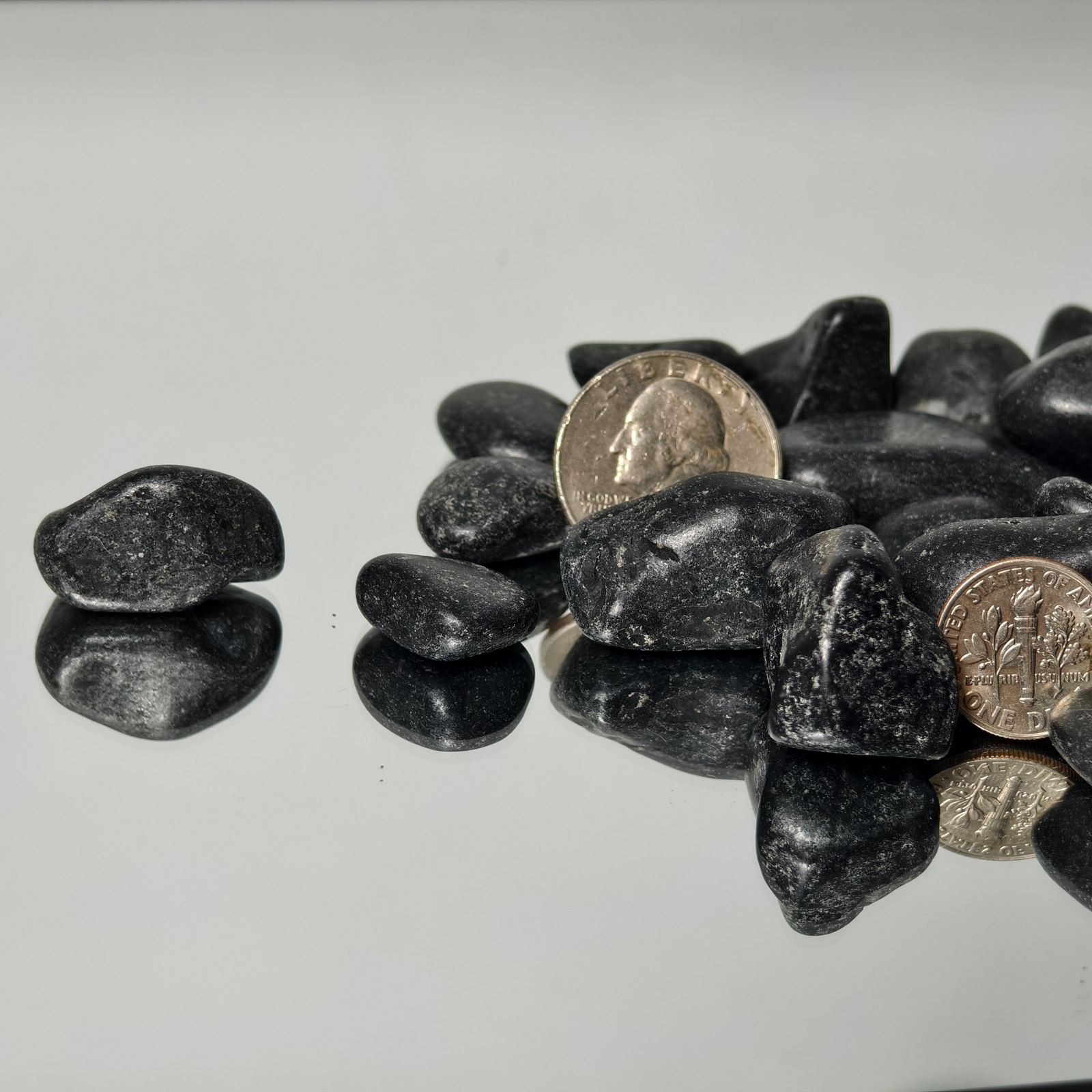
Real black pebbles are natural basalt or dense river stone with the colour through the body of the stone; the alternatives sold as black pebbles — dyed light stone, coated pebbles, black glass and rubber — put the colour only on the surface. This guide shows how to tell them apart, where each alternative still wins, and what to write into the purchase order.
Published · By Gardenstone Editorial Team · Educational article from the SWME TRADE team
Buy real natural black pebbles when the colour has to last: they are basalt or dense river stone coloured through the body, they hold a 20–40 mm decorative bed for ten years or more outdoors, and one 20 ft container carries about 24–27 tonnes at 1.5–1.7 tonnes per cubic metre. The alternatives — dyed light stone, coated pebbles, black glass chips and rubber mulch — are cheaper per tonne but put the colour only on the surface, so they fade, flake or leach within a few seasons. Choose by cost per square metre per year of service life, not by the headline tonne rate.
That single distinction drives almost every sourcing decision around black stone, yet it is the one most quotations blur. Suppliers legitimately sell all four materials, and a buyer who cannot tell them apart at the sample stage usually discovers the difference on site, after installation, when the dyed bed turns grey or the coated sheen chalks off in the sun. The sections below define what a real black pebble is, give four field tests that take less than a day, map which alternative still wins in which application, and finish with the purchase-order clauses that keep an importer covered.
A real black pebble is a naturally black rock — basalt, gabbro or a dense dark river stone — tumbled by water or machine into a rounded shape, with the black colour coming from the mineral body itself. Scratch it, chip it or break it and the inside is the same near-black as the outside, with a natural matte finish rather than a painted gloss. This is the material the market prices as genuine black pebble: harder to source in consistent tone, usually washed and sometimes sorted by hand, and stable outdoors for the life of the landscape.
Around it sit four commercial substitutes, and each earns its shelf space. Dyed pebbles start as cheap light-coloured stone — often a beige or red gravel — run through a black pigment or dye bath, so the colour is a skin a fraction of a millimetre thick. Coated pebbles are similar but finished with a lacquer or carbon film that gives a strong wet-look sheen in dry studio photographs. Black glass chips are manufactured, angular and vivid, but they are glass, not stone. Rubber mulch and black recycled material sit outside the stone family entirely. None of these is a fraud when sold honestly under its own name — the problem is a quotation that just says 'black pebbles' without declaring which of the five products is actually being shipped.
You can tell dyed or coated stone from real black pebbles in under a day with four tests, and a serious supplier will pass all four without hesitation. First, the break test: split one pebble with a hammer and look at the fresh face — a real black pebble is black all the way through, while dyed stone shows a pale interior under a thin dark skin. Second, the rub test: wipe ten stones with a damp white cloth, then with a little acetone on a cotton pad — real stone transfers nothing; dye and lacquer leave grey or black residue.
Third, the soak test: leave a handful of stones in a clear jar of clean water for 24 hours — real stone leaves the water clear and looks barely darker when wet; dyed or coated stone clouds the water, sheds pigment, or loses its false sheen. Fourth, the sun test: place a sample tray outdoors in full sun for a week and compare it against the sealed sample — natural basalt does not measurably fade, while pigment surfaces start to chalk. Run these on a production sample drawn from the actual lot, not on a showroom sample, and make a 5 kg wet sealed sample the reference for the whole shipment.
Even within genuinely black materials, the rounded pebble is only one option, and each has a job it does better than the others. Black gravel — crushed angular basalt in 6–20 mm — compacts and locks, which makes it the correct choice for driveways and any load-bearing surface where rounded pebbles would roll underfoot or under tyres. Black lava rock is porous and light, roughly half to two-thirds the weight per cubic metre of dense pebbles, so it covers more square metres per tonne and drains well in planting beds, but its sharp edges are uncomfortable underfoot and it weathers and crumbles over the years.
Real black pebbles win where appearance and comfort rule: pathways between paving, dry river beds, zen raked lines, water features, and contrast bands against white stone. They are smooth underfoot, they read as a premium product at the retail shelf, and their weight keeps them in place in flowing water. Wood mulch and rubber remain the cheapest ground cover per square metre but need topping up or replacing every few years, and neither belongs near fire-prone zones or in water features. A merchant stocking the category usually carries the pebble as the hero line and one angular gravel as the functional line — that combination covers most customer requests without duplicating stock.
Match the material to the project and the compromises disappear. Driveways and parking strips take angular black gravel compacted over a base course — specify 20–40 mm for the structural layer. Decorative pathways and joints between pavers take real black pebbles at 10–20 mm, laid 40–50 mm deep, where the rounded profile is an asset rather than a hazard. Dry river beds and water features take 20–40 mm natural pebbles, and here the 'real' question is not cosmetic: any dye or coating in standing or flowing water will leach or flake, so undyed basalt is effectively mandatory.
Budget bulk fill — large commercial beds where the black tone matters more than the shape — is where dyed gravel can be an honest, workable choice, provided the supplier states in writing that the product is dyed and the buyer accepts a re-dressing interval of a few years. Rooftop gardens weight-restrict enough to favour lava rock. Playgrounds favour rubber on fall-height grounds. Fire-risk regions should use stone only. Writing this one matching decision into the quotation before the order is placed costs nothing; retrofitting the right material after a complaint costs the whole margin.
No honest price table fits every market, but the structure of the price difference is stable. Real black pebbles cost more per tonne than dyed equivalents because the black rock itself is scarcer and every tonne is washed and graded; dyed gravel buys a cheap light base stone and adds a pigment step, so its price follows base-stone economics plus processing. Black glass trades material cost for manufacturing. Lava rock is usually the lowest price per tonne among the genuine stones and, because it is light, also the lowest cost per square metre of coverage — at roughly 0.8–1.0 tonnes per cubic metre against 1.5–1.7 for dense pebbles, the same tonne stretches far further.
The fair comparison is therefore cost per square metre per year of service life, not the invoice line. A dyed bed that needs re-dressing within a few years and a natural bed that holds for a decade can end up on either side of that line depending on labour costs at the destination, which is precisely why the decision belongs in the specification stage with the numbers written down. On logistics, note that dense pebbles, gravel and dyed stone all hit a 20 ft container's weight limit at about 24–27 tonnes long before the box is full, so freight per tonne rewards the material that packs the most saleable tonnes per container — one more reason the light lava rock is quoted per cubic metre of coverage instead.
Write the order against measurable terms so that 'real' stops being an opinion. A workable specification for genuine black pebbles carries seven items: the geology declared by name (basalt or dense river stone) with the statement that colour is natural and through the body of the stone, with no dye, pigment, lacquer or coating; the size band as a nominal single size, for example 20–40 mm, with oversize and underside limits; a dust and fines limit; a 5 kg wet sealed production sample approved before manufacturing starts; batch loading photographs tied to lot references; the right to a third-party pre-shipment inspection; and a re-order matching clause that commits future lots to the retained sealed sample.
Treat a low price against this specification as information, not as a bargain. The classic failure sequence in this category is a quotation for 'black pebbles' accepted on dry studio photographs, a container that looks correct on arrival, and a dyed or coated bed that greys out after its first wet season — at which point the specification, the sealed sample and the inspection right are the only documents that turn a dispute into a claim. Every clause above has one purpose: to make the difference between real black pebbles and its alternatives visible on paper before the container sails, when it still costs nothing to fix.
Both exist on the market. Genuine black pebbles are natural basalt or dense dark river stone with the colour through the body of the rock, while cheaper 'black pebbles' are light-coloured stone that has been dyed or coated with pigment or lacquer. Ask the supplier to declare the geology and state 'no dye, no coating' in the purchase order, and confirm with a break test — a real pebble is the same colour inside and out.
Run four quick tests on a production sample. Break one pebble: dyed stone shows a pale interior under a thin dark skin. Rub the stones with a damp white cloth and acetone: dye transfers, real stone does not. Soak a handful in water for 24 hours: dyed or coated stone clouds the water or loses its sheen. Then leave a tray in full sun for a week and compare it against the sealed sample for fading.
They do different jobs. Rounded black pebbles suit decorative pathways, dry river beds, water features and contrast bands because they are smooth underfoot and hold their position in water. Angular black gravel compacts and locks, which makes it the better material for driveways and any load-bearing surface where rounded stones would roll. Both are dense materials at roughly 1.5–1.7 tonnes per cubic metre, and both fill a 20 ft container at about 24–27 tonnes.
Natural black pebbles made of basalt do not measurably fade outdoors because the colour is part of the rock itself. Dyed and coated black pebbles fade, chalk or flake within a few seasons of full sun exposure because their colour is only a surface layer. Before ordering, keep a wet sealed sample tray outdoors for a week and compare it with the reference, and put a no-dye, no-coating declaration in the specification so any substitution is a documented breach.
“Over 13,000 ASTM standards operate globally. Defined and set by us, they improve the lives of millions every day. Combined with our innovative business services, they enhance performance and help everyone have confidence in the things they buy and use.”
ASTM International, “About ASTM Overview” — official page
Garden landscaping brings together every stone category: ground cover for beds and borders, gravel for paths, …
Zen gardens reduce the landscape to three materials: raked sand or fine gravel for water and openness, selecte…
Water features are the most natural fit for river materials: water-worn pebbles and rocks around ponds, stream…
Commercial landscaping is the volume end of the stone trade: office parks, public spaces, housing developments…
Everflorae — Artificial Plants & Trees
From the same supplier group, Everflorae supplies UV-stable artificial trees, palms and green walls that pair with stone — one source for hotels, resorts, malls and Japanese gardens.
Send your product, specification and destination — our sales team will prepare a quotation.