 SWME TRADE
Commercial Landscaping
Commercial landscaping is the volume end of the stone trade: office parks, public spaces, housing developments…
SWME TRADE · Blog
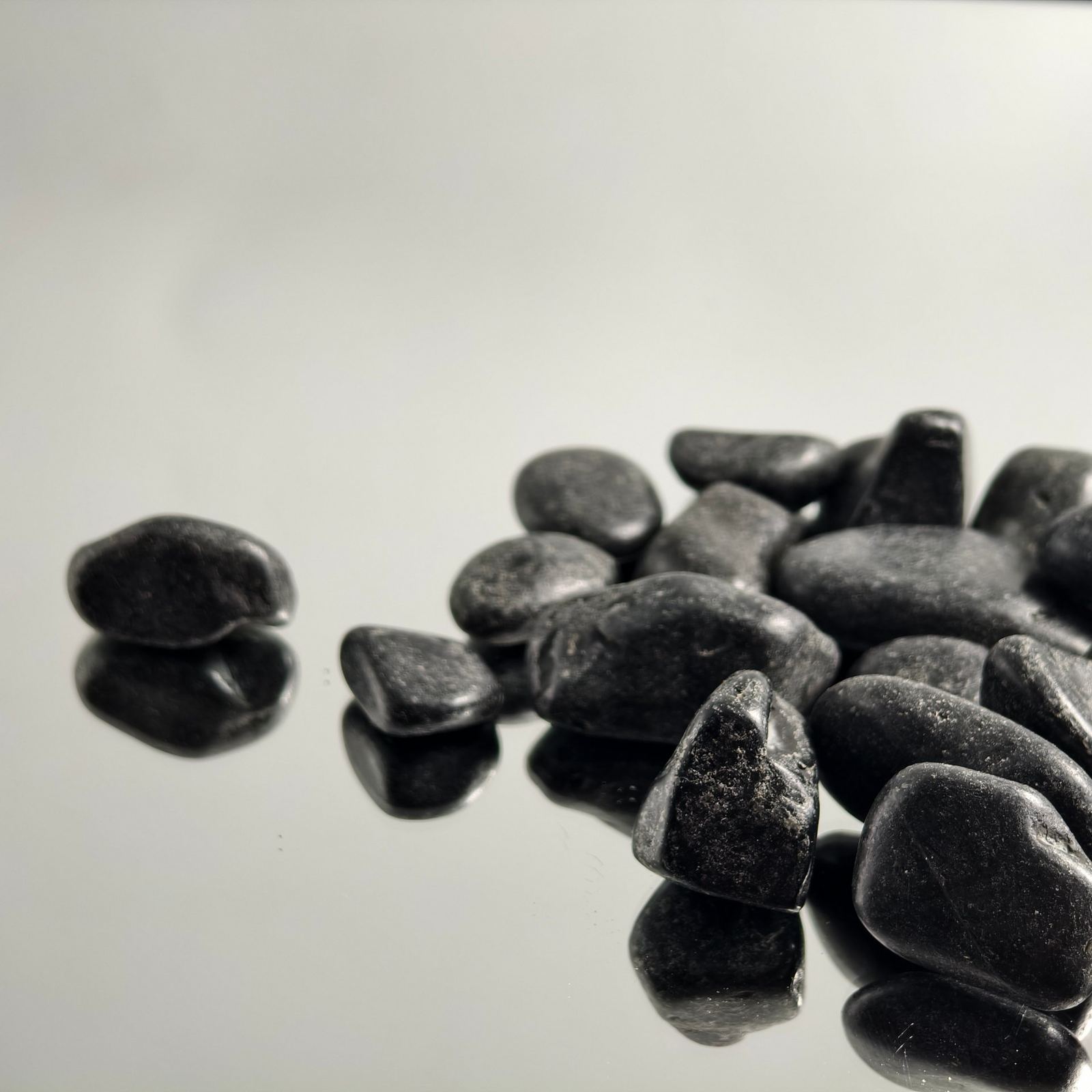
Black pebbles are sold by the tonne and shipped in 20–25 kg bags, one-tonne jumbo bags or loose in a lined 20 ft container that carries about 24–27 tonnes. Manufacture sits in China, where basalt is quarried, crushed, washed and screened. A first order usually starts at one container with two or three size bands, and washed 20–40 mm black pebbles give roughly 13 m² of cover per tonne at 50 mm depth.
Published · By Gardenstone Editorial Team · Educational article from the SWME TRADE team
Black pebbles for sale in bulk come from three levels of the trade: manufacturers in China that quarry, crush, wash and screen basalt into size bands; export stockists that hold container-ready stock and resell it; and local landscaping wholesalers that import and distribute. Buying at the manufacturer level gives the strongest price per tonne, but it also means buying a container — commonly 24–27 tonnes in a 20 ft box — rather than a pallet.
The channel matters because the same words describe very different sellers. A listing that says black pebbles for sale online can mean a bagging operation with a few hundred kilos in a yard, or a plant that runs its own washing and screening lines and loads containers weekly. Both will quote, and the quotes may look similar per tonne. What differs is whether the seller can hold colour and grading steady from container one to container ten, which on black stone — the shade with nowhere to hide — is the whole purchase.
The black pebble supply chain has four rungs. At the bottom is the deposit itself: black pebbles are not a mineral species of their own, they are basalt — a fine-grained volcanic rock that is naturally dark through its full thickness. Above that sit processors, who crush and screen the rock into bands and wash out the fines. Above them sit exporters, who bag, palletise, document and load. At the top sit importers and wholesale yards that break containers down for local resale.
The distinction that decides quality is who controls processing. A genuine black pebbles manufacturer owns or contracts the crushing, washing and screening steps and can answer a question about fines content with a sieve number rather than an adjective. A trader passes the same question upstream and answers it three days later, if at all. When you are looking at black pebbles for sale, ask directly which of the four rungs the seller occupies — and then ask for the paperwork that proves it.
One warning applies throughout: not everything sold as black pebble is basalt. Dyed material is grey or cream aggregate coated with pigment, and it can look indistinguishable from basalt in a dry photograph. The two behave completely differently the first time a wheel, a rake or a pressure washer touches them, so the colour source has to be established before price is discussed.
Black is the most demanding colour in the landscaping stone trade, and the reason is commercial rather than geological. Black pebble colour shifts more between dry and wet than any other shade, so the photo a seller publishes of black pebbles for sale — taken dry, under one light — is a poor predictor of what arrives. The test that counts is a wet comparison against a sealed reference, made under daylight, not in a warehouse.
Three failures surface on black before they surface on any other colour, and each one has a clause that answers it. A pale dust film from under-washing reads as a milky haze across the whole bed, so specify a washed product with a stated fines limit rather than assuming washing is included. Oversize stones sit proud of a black surface and catch the light, so write an explicit oversize cap instead of a vague nominal band. Batch drift becomes visible the moment two lots meet, so retain a labelled sample from every production lot and hold the seller to it.
None of this is a reason to avoid black pebbles for sale. It is a reason to buy them on a written standard rather than on a listing. Establish the colour source, seal a reference sample, and put the tolerance numbers in the purchase order — the supplier who resists that conversation is telling you something useful before you have paid a deposit.
Five questions separate a manufacturer from a reseller. Where does the rock come from — which deposit or quarry, and is it the same source across orders? What processing sits in-house — crushing, screening, washing, tumbling, bagging? How is colour handled — is the stone through-coloured basalt or coated? What does current production actually look like, as photographs with a size reference and a date rather than catalogue renders? And what is the minimum order quantity per size band, not per product line?
For repeat supply, add the documentation test, which is where serious export manufacturers separate themselves. Ask for a sieve analysis for the band you are buying, a sealed 1 kg colour reference held wet, batch photographs carrying the shipment reference, and the buyer's right to a third-party inspection before loading. A supplier who already has these documents on file — rather than offering to produce them on request — is normally running a real production line.
Finally, test the one thing no document replaces: consistency across time. Ask a candidate black pebbles manufacturer for two sets of production photographs taken several months apart, taken under similar light. If the tone holds, the process is under control. If it drifts, the risk is not in this container but in the fifth one, and that is the expensive place to discover it.
Most first orders should be one container, and the smartest way to fill it is with two or three adjacent size bands rather than a single grade. A 20–40 mm band carries the area, a 10–30 mm band handles borders and tighter beds, and a 40–60 mm band goes where the stone has to hold its position. Splitting the box across bands costs little in freight and de-risks the second order, because it tells you which grade the project actually consumes.
Stock grades and production runs behave differently on lead time. A grade the manufacturer holds in stock can usually be inspected and loaded within one to two weeks; a band cut to your own specification, or a special finish, typically runs three to five weeks because it has to be scheduled through washing and screening. Confirm which one you are buying before agreeing a delivery date, and if the schedule is tight, ask for a stock grade and save the custom band for the reorder.
Packing format then decides the landed cost and the destination workflow. A 20–25 kg bag is the handling-friendly unit that landscaping merchants resell; a one-tonne jumbo bag cuts bagging labour and packaging material per tonne and suits project and municipal delivery, but needs a forklift or telehandler once it lands; loose loading in a lined container is cheapest per tonne and least flexible on arrival. A first order should be packed for the way the receiving yard actually works, not for the lowest freight quote.
Quantity is depth arithmetic. At a bulk density of roughly 1.5 tonnes per cubic metre, one tonne of 20–40 mm black pebbles covers about 26 m² at 25 mm depth, roughly 13 m² at 50 mm, and around 9 m² at 75 mm. Small decorative bands such as 8–16 mm sit slightly lower because they pack more tightly. Add 5–10% for settlement and edge loss, and lay the stone over a geotextile membrane — on black, soil migration up into the bed shows as a grey stain, so the membrane earns its cost faster than on any other colour.
Price per tonne is built from six factors, in roughly this order of impact. Rock source and processing come first: washed, screened basalt is a different product from a coated aggregate, and washing adds a real cost step. Size band comes second, because fine decorative grades need more screening and more bagging labour per tonne than coarse ones. Surface finish is third — natural matte, tumbled, polished and dyed each carry their own cost structure. Packing format, order volume and delivery term close the list: bags cost more per tonne than jumbo bags, which cost more than loose, and freight on dense basalt is sold by weight, so it is always significant.
That is why comparing two black pebble quotations on unit price alone is unreliable. Compare instead on cost per square metre at the specified depth, with the packing format and the delivery term matched. Two suppliers quoting the same per-tonne figure can differ by half on cost per installed square metre once band, wash, packing and freight are normalised.
Write the order against numbers, not adjectives. A workable specification for black pebbles covers seven lines: the nominal size band in millimetres with a within-band percentage and an explicit oversize and undersize cap; washed, with a stated fines or dust limit; a colour-source statement naming through-coloured basalt rather than a coating; colour held as a sealed reference sample compared wet, with a maximum share of off-reference stones counted in random scoops; the packing format for each band; the quantity per band; and the delivery term, stated as FOB, CFR or delivered so the price basis is unambiguous.
Before shipment, keep the inspection short and repeatable: draw scoops from different pallets and compare them wet against the sealed reference; run a sieve check on material taken from the production line rather than a display pile; verify bag weights against the packing list; and photograph the loaded container with the shipment reference visible. Two clauses protect everything after that — lot retention, so a drift surfaces at container two instead of on site, and a breakage allowance for piece stone.
One habit is worth more than any document: the sealed sample governs. Text guides the conversation, but on black stone the reference sample held wet by both parties is the standard every future container gets measured against.
Black pebbles for sale in bulk are available from three levels: manufacturers in China that quarry, crush, wash and screen basalt; export stockists holding container-ready stock; and local landscaping wholesalers that import and distribute. Buying from the manufacturer gives the strongest price per tonne but commits you to a full container, commonly 24–27 tonnes in a 20 ft box, rather than a pallet.
There is no single figure, because the price per tonne is built from six factors: rock source and processing, whether the stone is washed and screened, the size band, the surface finish, the packing format, and the delivery term. Fine decorative grades cost more per tonne than coarse ones, and bags cost more per tonne than jumbo bags or loose loading. Compare suppliers on cost per square metre at the specified depth rather than on unit price.
At a bulk density of roughly 1.5 tonnes per cubic metre, one tonne of 20–40 mm black pebbles covers about 26 m² at 25 mm depth, roughly 13 m² at 50 mm, and around 9 m² at 75 mm. Add 5–10% for settlement and edge loss, and lay the stone over a geotextile membrane so soil does not migrate up into the bed.
A local supplier is faster and needs no container, so it suits small or urgent work. A manufacturer is cheaper per tonne and can hold colour and grading to a written standard across containers, which matters on black because dust, oversize stone and batch drift show more clearly there than on any other shade. For a project running several containers, buy at the manufacturer level and specify the tolerances.
“Over 13,000 ASTM standards operate globally. Defined and set by us, they improve the lives of millions every day. Combined with our innovative business services, they enhance performance and help everyone have confidence in the things they buy and use.”
ASTM International, “About ASTM Overview” — official page
Commercial landscaping is the volume end of the stone trade: office parks, public spaces, housing developments…
Pathways combine the functional and decorative sides of landscaping stone: the surface must stay stable underf…
Hotel and resort landscapes are commercial projects with residential finish quality: large areas, premium appe…
Water features are the most natural fit for river materials: water-worn pebbles and rocks around ponds, stream…
Everflorae — Artificial Plants & Trees
From the same supplier group, Everflorae supplies UV-stable artificial trees, palms and green walls that pair with stone — one source for hotels, resorts, malls and Japanese gardens.
Send your product, specification and destination — our sales team will prepare a quotation.