 SWME TRADE
Garden Landscaping
Garden landscaping brings together every stone category: ground cover for beds and borders, gravel for paths, …
SWME TRADE · Blog
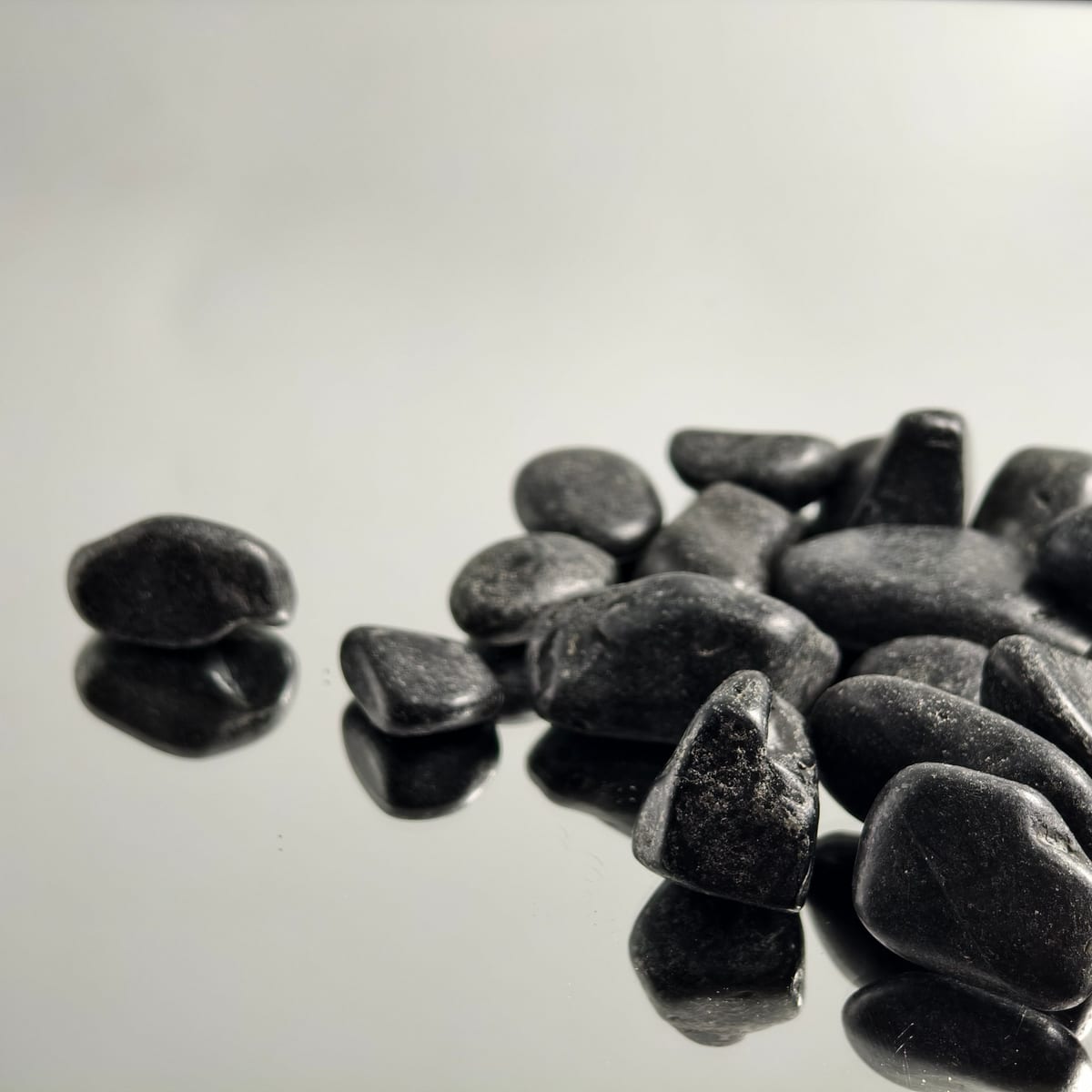
For garden edging, use washed natural black pebbles in a 20–40 mm grade, laid 50–75 mm deep in a 100–200 mm wide band over geotextile with a rigid edge restraint. That band takes 8–26 kg of stone per linear metre depending on width and depth, and one 24–27 tonne container covers roughly 1,000–3,000 linear metres of edging.
Published · By Gardenstone Editorial Team · Educational article from the SWME TRADE team
Use a 20–40 mm washed natural black pebble — tumbled basalt is the standard choice — laid 50–75 mm deep in a band 100–200 mm wide, over a geotextile membrane and behind a rigid steel or aluminium edge restraint. A band that size needs 8–26 kg of stone per linear metre depending on width and depth. Grades below 16 mm migrate into soil and scatter under footsteps, while grades above 60 mm only suit wide borders and dry creek margins.
That answers the sizing question, but a contractor or importer quoting an edging job also needs the tonnage arithmetic, the installation sequence that stops the band drifting, and the order lines that keep colour and grading consistent across a container. Those are set out below, together with one adjacent use — fire pit surrounds — that buys from the same size band and often ships on the same pallet.
Quantity follows the trench, not the garden. Multiply band width by laying depth, then by the loose bulk density of tumbled pebble — about 1.5–1.6 tonnes per cubic metre. A 100 mm × 50 mm band works out at 7.5–8 kg per linear metre; a 150 mm × 60 mm band at 14–15 kg; a 200 mm × 75 mm band at 22–26 kg. Most residential edging sits between the first two cases.
Scale it before quoting. One hundred metres of 150 mm edging needs 1.4–1.5 tonnes, so a single pallet of one-tonne jumbo bags covers a large garden job with margin. At container scale the numbers invert: a 24–27 tonne load delivers roughly 1,000 linear metres of the widest 200 mm band or 3,000 linear metres of the tightest 100 mm band. Add 10–15% for settlement and spillage, because the first watering always settles a loose band by 10–20 mm.
Round tumbled pebbles in a 20–40 mm single grading are the workhorse: large enough to interlock against the restraint and each other, small enough to read as a clean dark line beside lawn or paving. A 30–50 mm grade suits drivable edges and commercial fronts where the band must resist wheel scuffing. Mixed-load gradings — everything from 10 mm to 60 mm in one bag — look uneven along a line and settle unevenly, so specify a single band with tolerance rather than a blended lot.
Washing matters as much as size. Stone carrying more than 1% fines dusts grey in the dry season and stains the paving it borders after rain. Specify double-washed stone with fines under 1% and no clay, and verify with the jar test: 200 g of pebbles in water, shaken and left to stand for an hour — clean stone leaves clear water. Natural basalt keeps its colour; the deep gloss on a polished grade comes from a resin sheen that dulls outdoors, so for edging choose the natural matt finish and save polished stone for interior and waterline work.
Yes — and it is worth ordering for it. Natural black basalt pebbles are heat-tolerant, do not emit fumes and do not fade in the heat cycling that surrounds a gas fire pit. The same 20–40 mm grade used for edging works as the surrounding apron, and a 40–60 mm grade suits the pit floor of a wood-burning ring where larger stones resist displacement during raking.
Two precautions keep the install safe. First, moisture: pebbles that have been stored outdoors or washed immediately before laying can hold water in micro-cracks, and rapid heating can spall or crack individual stones — so lay the stone dry, or let a freshly washed apron cure for several days before first use. Second, separation: keep the pebble band 150–200 mm clear of the burner or flame zone, and never fill the burner tray itself with river pebbles — use the media the appliance manufacturer specifies, normally lava rock or fire glass. Treated this way, one bulk order serves the edging band, the fire pit apron and the connecting path inlay in a single consistent colour.
Five steps. Mark the line with string or a hose, then cut a trench to the band width and 60–80 mm deep. Lay geotextile over the trench floor, lapping joins by at least 100 mm — the membrane is what stops soil migrating up and stone sinking down. Fix a rigid edge restraint — steel, aluminium or concrete setts — along the outer face, pinned so it cannot flex outward. Spread the pebbles evenly and rake to 50–75 mm depth. Finally, water the band in to settle it and top up the low spots.
Two details separate a band that looks crisp after three years from one that has wandered into the lawn by the second winter. The restraint must stand 20–30 mm proud of the finished stone so it visually contains the band and physically stops lateral creep. And never skip the geotextile on soil subgrades: without it, a 20–40 mm pebble acts as a stepping stone for worms and weeds, and the band develops green colonisation within a season. On paved subgrades the membrane can be omitted, but a thin bedding of the same stone screened to fines-free grade still helps drainage.
Five lines cover it. Size band with tolerance — 20–40 mm with no more than 10% retained above 45 mm and no more than 10% passing 17 mm. Washing — double-washed, fines under 1%, no clay or organic matter. Finish — natural tumbled, not polished, with a sealed wet-and-dry colour photograph as the reference, because basalt reads charcoal when dry and near-black when wet. Packing — 20–25 kg printed bags for retail distribution or 1,000–1,200 kg jumbo bags for site work, with net weight verified on a weighbridge within ±2%. Logistics — 24–27 tonnes loose per 20-foot container, or the bag equivalent.
Then agree the sample protocol. One 5 kg sample approved against the colour reference, and the first two bags of every production batch checked against it before loading. Edging is a linear product: a container that drifts one shade lighter half-way through the run shows up as visible banding along hundreds of metres of border, and no site fix recovers it.
A 20–40 mm washed natural black pebble, laid 50–75 mm deep in a 100–200 mm wide band, is the standard edging specification. Grades below 16 mm migrate into soil and scatter underfoot, while grades above 60 mm suit only wide borders and dry creek margins.
A 100 mm wide, 50 mm deep band takes 7.5–8 kg per linear metre, a 150 × 60 mm band 14–15 kg, and a 200 × 75 mm band 22–26 kg, at a loose bulk density of about 1.5–1.6 t/m³. Add 10–15% for settlement, and one 24–27 tonne container covers roughly 1,000–3,000 linear metres.
Yes — natural basalt pebbles are heat-tolerant and do not fade around gas fire pits. Lay them dry so trapped moisture cannot spall the stone, keep the pebble band 150–200 mm clear of the burner, and never fill the burner tray itself with river pebbles.
Yes. Geotextile stops soil mixing up into the stone and weeds colonising the band, and a rigid restraint standing 20–30 mm proud of the finished stone stops lateral creep into lawn or paving. Without both, an edging band typically wanders within two winters.
“Over 13,000 ASTM standards operate globally. Defined and set by us, they improve the lives of millions every day. Combined with our innovative business services, they enhance performance and help everyone have confidence in the things they buy and use.”
ASTM International, “About ASTM Overview” — official page
Garden landscaping brings together every stone category: ground cover for beds and borders, gravel for paths, …
Pathways combine the functional and decorative sides of landscaping stone: the surface must stay stable underf…
Stone-topped flower beds replace mulch with a permanent surface: stones suppress weeds when laid over membrane…
Everflorae — Artificial Plants & Trees
From the same supplier group, Everflorae supplies UV-stable artificial trees, palms and green walls that pair with stone — one source for hotels, resorts, malls and Japanese gardens.
Send your product, specification and destination — our sales team will prepare a quotation.