 SWME TRADE
Water Features
Water features are the most natural fit for river materials: water-worn pebbles and rocks around ponds, stream…
SWME TRADE · Blog
The best mixed colour pebbles for a water feature are 20–40 mm tumbled, washed, through-coloured granite or basalt blended to a stated ratio — 50–60% dominant tone, 25–35% secondary, 5–15% per accent — laid one stone deep at 60–68 kg per m², with 24–27 tonnes in a 20 ft container. Approve the blend under water, never on a dry bench.
Published · By Gardenstone Editorial Team · Educational article from the SWME TRADE team
The best mixed colour pebbles for a water feature are 20–40 mm tumbled, washed, through-coloured granite or basalt blended to a stated ratio: 50–60% dominant tone, 25–35% secondary, 5–15% for each accent. Laid one stone deep they run 60–68 kg per m², 24–27 tonnes fill a 20 ft container, and the blend must be approved under water, not on a dry bench.
That answer is a ratio, not a product name. A mixed blend is the only stone you can buy where the specification and the delivered goods can both be correct and still look nothing alike, because water changes how each component reads. The sections below cover why the palette shifts when submerged, which colours fail first, how to write a ratio into a purchase order, what a mixed blend costs in sorting labour, and how the same material behaves in a zen garden.
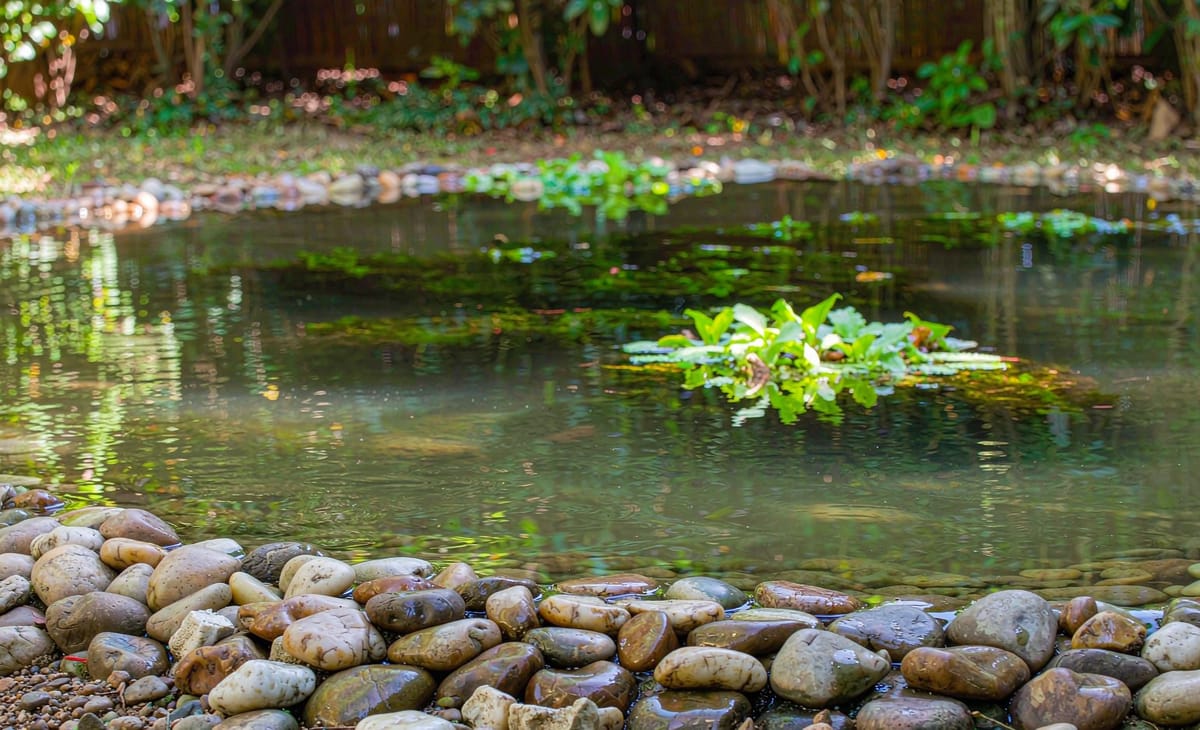
Water fills the surface pores of every pebble and removes the diffuse reflection that separates one light tone from the next. Saturated colours darken by roughly 25–40% when wet, and pale stones lose the most apparent brightness of all, so the contrast between the lightest and darkest component compresses. A blend that shows five distinct colours on a dry bench often collapses into one mottled brown-grey field in 100 mm of water.
That is why the approval step matters more than the ratio on paper. Put a handful in a white tray, add 100 mm of water, look at it in daylight rather than under a workshop lamp, and photograph it from one metre with the phone at a fixed distance; that photograph becomes the acceptance reference for the next container. The practical test: if three tones are still distinguishable through the water at one metre, the blend will read as mixed in the finished basin. If it collapses to one tone, you have paid the sorting premium for nothing and are better off buying a single colour.
Fouling is not neutral across a palette. Pale stones show the first silt film, the first iron-oxide dust off surrounding soil, and the first green biofilm; dark stones hide all three. In a mixed blend that means the palette drifts in one direction only — darker and greener — and it drifts fastest in the first season, before the stone has been rinsed and the surrounding soil has settled.
The white component is where the money hides. The cheapest way to build a mixed blend is to add white marble or limestone chips, and they are the wrong white for water: Mohs hardness around 3, calcareous enough to fizz under a drop of dilute acid, and prone to going yellow-grey as iron and biofilm settle into a soft, slightly porous surface. In a stocked pond that calcium also pushes pH and hardness upward. Ask for the white to be granite or quartz instead — same colour family, Mohs 6–7, silent under the acid drop — and the blend holds its contrast for years rather than months.
Design in headroom rather than fighting it later. Keep the pale share at a level annual maintenance can actually support, specify a neutral-pH cleaner rather than an acid wash, and hold back 5–10% of the dominant tone as a top-up reserve, because the light components are the ones you will want to replace first.
Never accept 'mixed colours' as a single line item. Write each component as a weight percentage with a tolerance of plus or minus five percentage points, measured per one-tonne lot, and name the rock family for each one — 55% grey granite, 30% black basalt, 15% buff quartz tells a factory exactly what to sort to. Add through-coloured and undyed, an oversize limit, washed with fines at or below 1%, and one sealed retained sample per lot.
Verify dye rather than trusting the word natural. Rub a stone with a lint-free cloth dampened with white spirit or acetone: a dyed pebble releases colour, an untreated one does not. Break one open as well — through-coloured stone is the same at the core, coated or dyed stone is not. Mixed blends attract more dye than single-tone lines precisely because colour sorting is expensive, so the test is worth doing on every new supplier.
Then choose how the blend is made, because that decides who controls the ratio. Pre-blended bags fix the ratio at the factory and bound bag-to-bag variance, but you inherit whatever ratio they run. Single-colour bags let you blend on site to your own percentages, at the cost of labour, floor space and a client who sees exactly what you mixed. A container-level blend requested at loading is the middle path — ask for photographs of the mixing floor and a weigh-out of three random bags.
Mixed pebbles run about 1.5–1.7 tonnes per cubic metre loose, so a single layer costs roughly its own diameter in depth: 30 mm gives 45–51 kg per m², 40 mm gives 60–68 kg, and 50 mm gives 75–85 kg. Round stone leaves 35–40% void, so a true one-stone layer over a black liner still shows dark gaps — order 1.3–1.5 times the calculated area where the finish must read as a solid carpet.
Work the tonnage per colour, not just in total. A 4 × 3 m basin with a 0.4 m margin comes to about 18.2 m² of stone, which at 40 mm is 1.1–1.2 tonnes; with 50–60% of that in the dominant tone you need roughly 0.6–0.7 tonnes of one colour, and the three or four accents fall to 60–180 kg each. That is usually below a factory's per-colour minimum, which is why small features are better served by single-colour bags blended on site than by a custom factory blend.
At container scale the load is weight-limited, not volume-limited: 24–27 tonnes fills a 20 ft box and covers roughly 350–450 m² at 40 mm, using well under half the cube. Splitting that container across two size bands costs nothing in freight, so a first order can carry 20–40 mm for the basin floor and 40–60 mm for the waterline without committing 24 tonnes to one grade. Add 5–10% for top-up, and weight the reserve toward the dominant tone, since accents deplete far more slowly.
A zen garden wants one tone in the raked field and mixed colour only at the edges. The raked plane needs angular grit of 2–6 mm with enough edge to hold a ridge, and it needs to be monochrome, because the rake lines are the subject and colour competes with them. Where mixed pebbles belong is the accent band — island shorelines, the strip between stepping stones, the margin around a still basin — capped at three tones, all from one rock family, with the dominant tone at 60% or more.
Judge the palette in tonal terms, not hue terms. Warm grey plus cool grey plus near-black reads as one colour with depth, which is what a zen composition needs; white plus red plus green plus yellow reads as an aquarium and destroys the calm in a courtyard of any size. Hold a roughly ten-to-one size contrast against the raked grit — 40–70 mm accents against 2–6 mm grit — so the stones read as objects rather than rubble, and keep one rock family across both materials so weathering happens at the same rate.
Because a zen garden is judged on consistency, the ratio has to survive reordering. Record the percentages on the purchase order, keep the wet sample photographed under water, and reorder against that reference rather than against a colour name; the accent band is small enough that one drifted lot is visible from the veranda.
Expect to pay for sorting, not for stone. A mixed blend costs more per tonne than a single tone at the same size and rock type, because every additional colour adds a sorting pass and a yield loss — five components means five sorting decisions and five piles that may not clear. A suspiciously cheap blend usually signals a soft calcareous white, fewer wash steps, or a ratio that was eyeballed on the mixing floor. Ask for the component list and the wash specification line by line before comparing tonnage rates.
Five components also means five chances of drift between lots. Request per-lot photographs taken on the mixing floor, hold a sealed wet sample from every lot, take split deliveries from one production run rather than two, and place any top-up order against the original ratio instead of a fresh verbal description. Where a project runs over several months, reserve the accent colours in one lot up front; the dominant tone can be re-run more safely than a 5% accent can.
Close with a pre-shipment check that is specific to blended goods: weigh out three random bags and compare each component against the ordered percentages, confirm fines at or below 1%, check the oversize limit, run the solvent dye test, confirm moisture at loading, and inspect bag integrity. Packing follows the receiving site — 25 kg bags for retail resale, one-tonne FIBC where there is crane access, loose for direct tipping — and each has its own unit-mass tolerance to agree before the container is stuffed.
20–40 mm tumbled, washed, through-coloured granite or basalt blended to a stated ratio — 50–60% dominant tone, 25–35% secondary and 5–15% per accent — laid one stone deep at 60–68 kg per m². A 20 ft container holds 24–27 tonnes, covering roughly 350–450 m² at 40 mm. Approve the blend submerged in 100 mm of water, because wetting darkens saturated colour by 25–40% and compresses the contrast between tones.
Yes. A blend is quoted above the single-tone price for the same size band and rock type, because each additional colour adds a sorting pass and a yield loss; a five-colour blend carries more sorting labour than a three-colour one. Because there is no single market figure, compare suppliers on the component list, rock family per component, wash specification and packing rather than on a headline tonnage rate.
One tonne covers about 20–22 m² at 30 mm, 15–17 m² at 40 mm and 12–14 m² at 50 mm, based on a loose bulk density of 1.5–1.7 tonnes per cubic metre. Round stone leaves 35–40% void, so multiply the area by 1.3–1.5 where the finish must read as a solid carpet, and add 5–10% for the annual top-up.
Only inert, through-coloured, undyed stone is safe in a stocked pond. Granite, basalt and quartz sit at neutral pH; the white marble or limestone chips used in cheap blends are calcareous, fizz under dilute acid, raise pH and hardness, and discolour to yellow-grey in water. Test a sample with white spirit for dye release, keep pond margins at 30 mm and above, and hold fines at or below 1% so the first fill does not cloud.
“Over 13,000 ASTM standards operate globally. Defined and set by us, they improve the lives of millions every day. Combined with our innovative business services, they enhance performance and help everyone have confidence in the things they buy and use.”
ASTM International, “About ASTM Overview” — official page
Water features are the most natural fit for river materials: water-worn pebbles and rocks around ponds, stream…
Zen gardens reduce the landscape to three materials: raked sand or fine gravel for water and openness, selecte…
A dry river bed (dry creek bed) is a landscape feature that mimics a natural stream channel — both as a design…
Japanese garden design uses stone as its structural vocabulary: larger stones placed as islands and mountains,…
Everflorae — Artificial Plants & Trees
From the same supplier group, Everflorae supplies UV-stable artificial trees, palms and green walls that pair with stone — one source for hotels, resorts, malls and Japanese gardens.
Send your product, specification and destination — our sales team will prepare a quotation.