 SWME TRADE
Water Features
Water features are the most natural fit for river materials: water-worn pebbles and rocks around ponds, stream…
SWME TRADE · Blog
The best garden pebbles for a water feature are 30–60 mm tumbled, washed, inert granite or basalt laid one stone deep: about 75–100 kg per m² at that single-layer depth, and 24–27 tonnes fills a 20 ft container. Approve the colour under water, never on a dry bench, and keep anything under 20 mm out of standing water.
Published · By Gardenstone Editorial Team · Educational article from the SWME TRADE team
The best garden pebbles for a water feature are 30–60 mm tumbled, washed, inert granite or basalt, laid one stone deep. At that single-layer depth you need roughly 75–100 kg per m², a 20 ft container holds 24–27 tonnes, and the stone must be chosen wet, not dry, because water darkens saturated colour by 25–40%.
That answer holds for ornamental basins, fountain surrounds, pond margins and the dry stream beds that feed them. What changes between projects is restraint: a round pebble is a decorative surface that has to be held in place, kept clean and read as individual stones. The sections below cover why pebbles behave nothing like gravel under water, the size bands that work, how to calculate tonnage and stone counts, what is safe around fish and pumps, and how the same material works in a raked zen garden.
Gravel is bought as a bedding material; pebbles are bought as a surface. Gravel is specified by depth — 30–50 mm of angular or sub-angular stone that interlocks and stays where it is tipped. Pebbles are specified by the stone: a 30–60 mm rounded pebble is meant to be seen as an object, so it is laid in a single layer, one diameter thick, and that single layer is what your tonnage has to pay for.
The second difference is mechanical. Rounded stone does not interlock; it rolls. On a liner slope steeper than about 1:8, a single layer of round pebbles will creep downhill with every overflow and end up in a grey band at the low edge — the most common failure we see in water-feature enquiries. Fix it at design stage: a toe lip or retaining edge below the waterline, a geotextile under the stone so the liner cannot be abraded, and a bed of sand or mortar for anything on a visible slope. Where the pebbles sit in the splash zone rather than under water, resin-bound or grid-confined laying is the alternative to a retaining edge.
Nothing below 20 mm belongs in standing water. A 6–10 mm pebble is impossible to lift and rinse, migrates into pump intakes, and packs silt until it reads as a brown crust. The 10–20 mm band works in a dry stream bed or between paving joints, but in a basin it is light enough to be displaced by a spillway or a hose and small enough for fish to mouth.
The working bands under water are 30–60 mm and 60–90 mm. 30–60 mm is the standard margin and basin finish: heavy enough to stay put under a 300–400 mm cascade, small enough to lift by hand for cleaning, and large enough not to disappear between the stones beside it. 60–90 mm reads as boulders at close range and is best kept to spillway cheeks, island edges and the visible waterline, where you want the stone to break the surface. Above 100 mm it stops being a pebble surface and becomes rock placement, which is a different order and a different freight calculation.
Pebbles run about 1.5–1.7 tonnes per cubic metre loose, so a single layer costs roughly its own diameter in depth: 30 mm gives 45–51 kg per m², 40 mm gives 60–68 kg, 50 mm gives 75–85 kg, and 60 mm gives 90–102 kg. Round stone leaves about 35–40% void, so a true one-stone layer over a black liner still shows dark gaps; order 1.3–1.5 times the calculated area if the finish must read as a solid carpet.
For a basin, calculate the wetted floor plus the visible margin band, not the whole excavation. A 4 × 3 m basin with a 0.4 m margin at 50 mm comes to about 13.8 m², which is 1.0–1.2 tonnes — a sample-scale order. At container scale, 24–27 tonnes fills a 20 ft box and covers 280–360 m² at 50 mm, or 240–300 m² at 60 mm. Because the load is weight-limited, not volume-limited, a mixed container of two size bands is normal and costs you nothing in freight.
Safety starts with chemistry. Inert rock — granite, basalt, quartz, gneiss — sits at neutral pH and will not dissolve into the water, which is what a stocked pond needs. Calcareous stone such as marble or limestone buffers pH and hardness upward: acceptable in a fountain with no fish, wrong in a koi pond where stability is the whole point. A drop of dilute acid settles it in thirty seconds; inert stone stays silent, calcareous stone fizzes.
Surface treatment matters just as much. Any dye, wax or resin coating is a contaminant in a living system, and it fails visibly within a season — specify through-coloured, uncoated stone in the purchase order. Size is a welfare issue too: koi over 20 cm routinely take 10–20 mm gravel into the mouth, so margins around a stocked pond should be 30 mm and up, or bare. Finally, pebbles displace water and add surface area, so allow for the lost volume when you size the reservoir and expect the first rinse to release quarry fines — wash the stone in a barrow before it goes in, and take the fines figure (1% passing the fine sieve, maximum) from the supplier's sieve report.
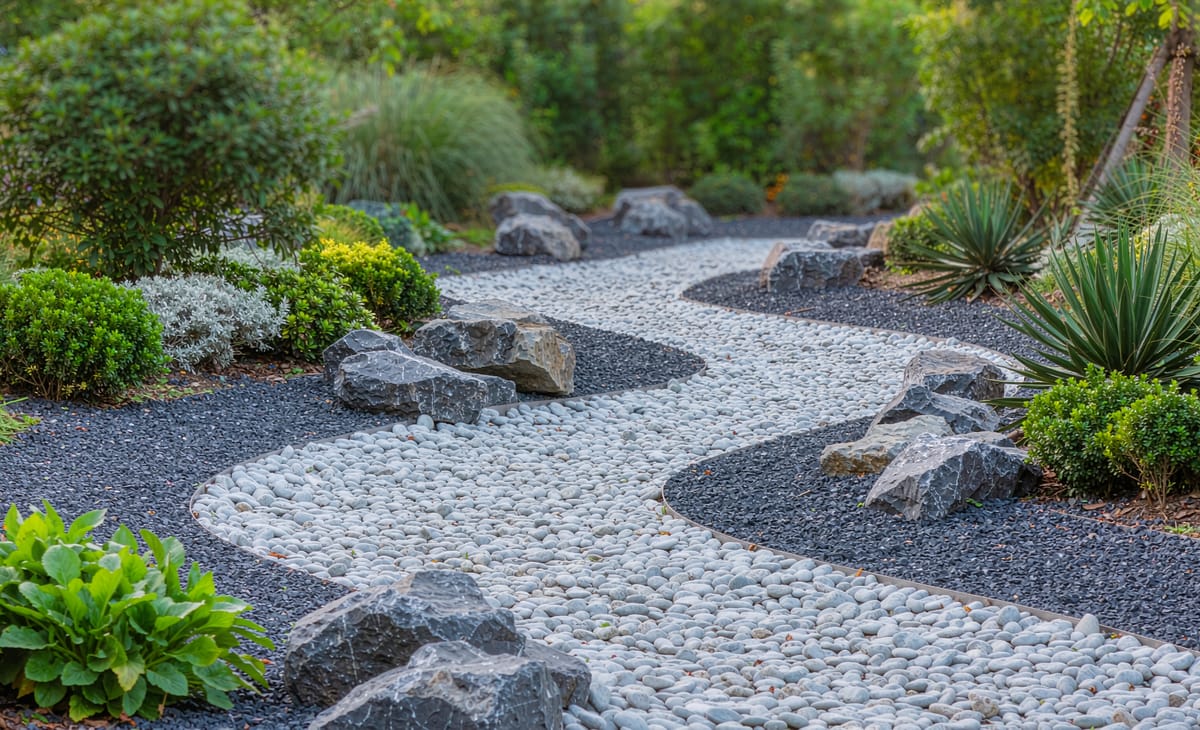
A zen garden needs two different stones, and confusing them is why so many installations look wrong. The raked field cannot be rounded pebbles: a rake needs angular grit of about 2–6 mm with enough edge to hold a ridge, and a round 30 mm pebble simply rolls back into the groove. Rounded garden pebbles belong to the accents — island shorelines, the band around a moss bed, the edge of a still basin, and the ground between stepping stones.
Get the scale ratio right and the composition reads instantly. Accent pebbles at 40–70 mm against a 2–6 mm raked field give roughly a ten-to-one contrast, which is what makes the stones read as objects rather than rubble; pebbles above 90 mm in a small courtyard overwhelm the rake lines. Keep one rock family and one or two tones across both materials — tumbled grey granite with a cool grey grit, or black basalt with a pale grit — because a warm buff pebble dropped into a cool grey scheme is the mismatch that shows the day the gardener finishes raking.
Buy by size band and by lot, not by colour name. A specification that survives a change of production run reads: rock type, size band in millimetres with an oversize limit, surface (tumbled, uncoated, undyed), washed with fines at or below 1%, packing, and a retained sealed sample per lot. Colour names such as 'pearl' or 'charcoal' mean nothing between factories; a wet sample and a sieve report mean everything.
Approve that sample submerged. Put a handful in a white tray under 100 mm of water, look at it in daylight rather than under a workshop lamp, and photograph it — that is the reference the next container will be judged against. For a first order, split one 20 ft container across two adjacent bands (30–60 mm for the basin, 60–90 mm for the waterline) rather than committing 24 tonnes to a size you have never laid. Packing follows the receiving site: 25 kg bags for retail or landscape resale, 1-tonne FIBC for crane access, loose for direct tipping. Confirm moisture at loading, insist on a pre-shipment inspection, and hold a sealed sample from every lot so a top-up three seasons later still matches the basin you built.
30–60 mm tumbled, washed, inert granite or basalt laid one stone deep is the best all-round choice: it stays put under a cascade, can be lifted by hand for cleaning, and costs about 75–100 kg per m² at that single-layer depth. A 20 ft container holds 24–27 tonnes, covering roughly 280–360 m² at 50 mm.
Keep everything under 20 mm out of standing water, because small pebbles migrate into pump intakes and cannot be rinsed clean. Use 30–60 mm for basin floors and margins, 60–90 mm for the waterline and spillway edges, and nothing above 100 mm unless you are placing feature rock rather than a pebble surface.
Only inert, uncoated rock is safe around fish. Granite, basalt and quartz sit at neutral pH; limestone and marble raise pH and hardness and should be kept to fish-free fountains. Dyes, waxes and resin coatings are contaminants in a living pond, and pebbles under 30 mm can be swallowed by koi over 20 cm, so stock pond margins at 30 mm and up.
Not for the raked field. A rake needs angular grit of about 2–6 mm to hold a ridge, and round pebbles roll back into the groove. Use rounded pebbles of 40–70 mm as accents — island shorelines, moss-bed edging, basin surrounds and the ground between stepping stones — at roughly a ten-to-one size contrast against the raked grit.
“Over 13,000 ASTM standards operate globally. Defined and set by us, they improve the lives of millions every day. Combined with our innovative business services, they enhance performance and help everyone have confidence in the things they buy and use.”
ASTM International, “About ASTM Overview” — official page
Water features are the most natural fit for river materials: water-worn pebbles and rocks around ponds, stream…
Zen gardens reduce the landscape to three materials: raked sand or fine gravel for water and openness, selecte…
Japanese garden design uses stone as its structural vocabulary: larger stones placed as islands and mountains,…
Garden landscaping brings together every stone category: ground cover for beds and borders, gravel for paths, …
Everflorae — Artificial Plants & Trees
From the same supplier group, Everflorae supplies UV-stable artificial trees, palms and green walls that pair with stone — one source for hotels, resorts, malls and Japanese gardens.
Send your product, specification and destination — our sales team will prepare a quotation.