 SWME TRADE
Commercial Landscaping
Commercial landscaping is the volume end of the stone trade: office parks, public spaces, housing developments…
SWME TRADE · Blog
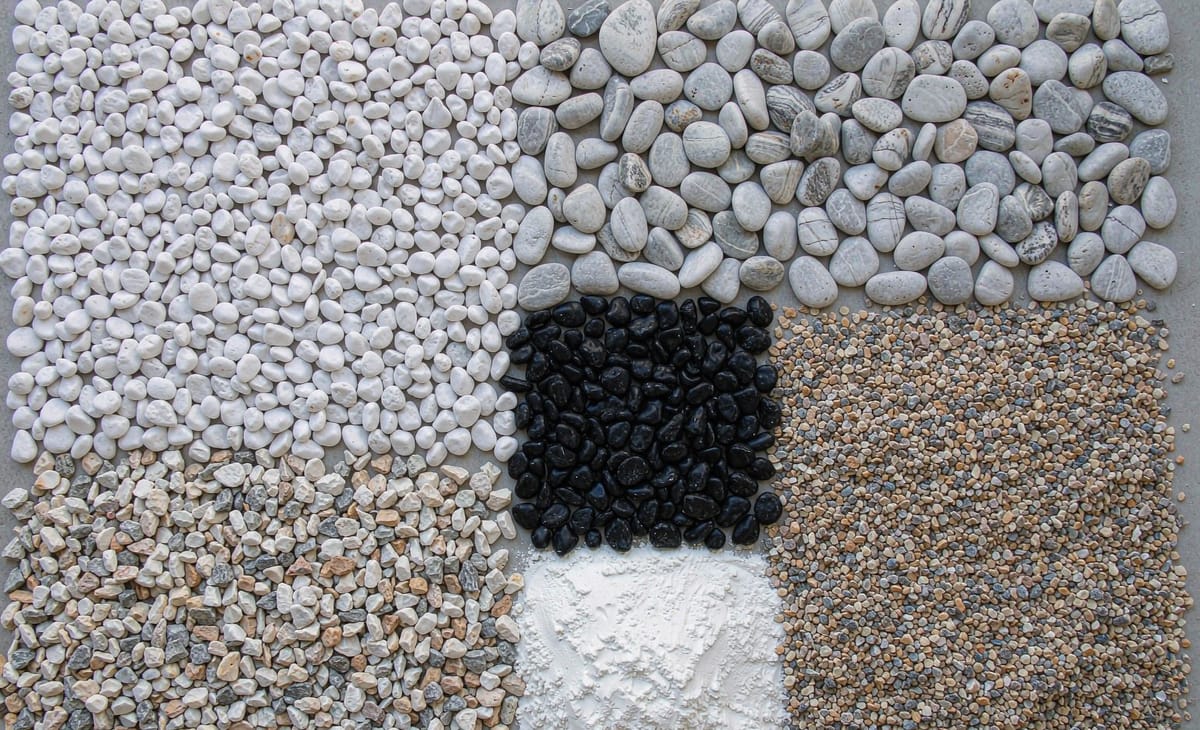
The best mixed color pebbles for commercial landscaping are washed, pre-blended 20–40 mm or 40–75 mm pebbles that combine two to four tones so batch variation reads as part of the design. This guide covers why a blend beats a single colour on large areas, how to set the tone ratio, driveway use, coverage per square metre, MOQ, packing and the pre-shipment checks that keep a phased scheme consistent.
Published · By Gardenstone Editorial Team · Educational article from the SWME TRADE team
The best mixed color pebbles for commercial landscaping are washed, pre-blended 20–40 mm or 40–75 mm pebbles that deliberately combine two to four tones so that natural batch variation reads as part of the design. Allow roughly 60–80 kg per square metre at 40 mm depth, and plan on one 20 ft container carrying about 24–27 tonnes.
A mixed colour blend is not a compromise on a single colour — it is a specification choice. On a 400 m² business park bed or a hotel forecourt, holding a single near-white or black tone perfectly uniform lot after lot is the expensive option, and the first dusty week exposes every drift. A blend converts that risk into the intended look: the surface is supposed to carry several tones, so a new production lot that leans slightly warmer or cooler still matches the design instead of failing it.
So the useful question is which two to four tones to blend, in what ratio, and how to hold that ratio across a phased handover. Set the blend and the sealed reference first, and the size band chooses itself from the surface class.
Three things move the buying decision toward a blend on commercial work. The first is dust and staining: light single tones show tyre marks, leaf tannin and iron-rich dust within days, while a multi-tone blend hides the same soiling invisibly. The second is viewing distance — a large bed read from thirty metres across a plaza does not show a single off-colour stone, but it does show a uniform colour that has drifted to the wrong family, so a blend is the safer large-area finish.
The third, and often decisive, reason is consistency across shipments. Single-colour stone is graded by eye against a reference, and the reference itself drifts between production runs; a blend is mixed to a ratio, and a ratio is easier to reproduce than a perfect match to one subjective swatch. For a scheme delivered in five containers over two seasons with top-ups in year three, that reproducibility is worth more than any marginal gain in showroom neatness.
Blends are not right everywhere. Where a client has specified a precise corporate colour — a resort brand band, a show-home entrance — a single selected, colour-sorted tone may be mandated, and the cost of holding it must be written into the budget. Use the blend where the brief says 'natural stone' or 'multi-tone', and reserve single colours for the branded feature zones a few square metres wide.
Design the blend as a ratio, not as a mood. A practical commercial mix is one dominant tone at 50–60%, a secondary tone at 25–35%, and one or two accent tones at 5–15% each, with all tones drawn from the same rock family so they weather and wash at the same rate. Mixing a hard basalt with a soft limestone in one bed looks sharp on day one and patchy by year two, because the softer stone erodes faster — keep the blend within one material.
Write the ratio into the order and hold it as a sealed wet 1 kg reference both sides have signed, with the ratio recorded as a count rather than an adjective. A workable check is to weigh three random 1 kg scoops from different pallets in each lot and confirm the dominant tone stays within roughly ±5 percentage points of the agreed share; beyond that, the bed starts to read as a different mix. Colour must be judged wet, because every pebble reads darker and more saturated after rain than in a dry container photograph.
Decide the size band by surface class, exactly as for single-colour stone: 20–40 mm for entrances, borders and tree pits, 40–75 mm for low-traffic beds and dry river features, and 10–20 mm only for fine detail or stabilised work. A blend does not change the band logic — it changes how forgiving that band is to live with.
For a driveway the honest answer is the same as for any loose pebble: rounded mixed colour pebbles should not carry the driven lane. They roll out from under a tyre, track into gullies and leave ruts within a season, so the driven surface wants angular gravel or a bound material. Where a client wants the pebble look at the entrance, keep 40–75 mm mixed colour pebbles on the non-driven margins, aprons and beds behind a rigid edge restraint, with a geotextile membrane separating stone from soil.
If pebbles must sit on a trafficked surface, stabilise them. A resin-bound or grid-stabilised bed of 10–20 mm mixed colour pebbles over a compacted permeable sub-base gives the decorative finish without the migration, and it carries foot and light vehicle traffic without kicking stone into the gully. A blend works well here, because the mix hides the subtle shading a uniform bed would show under a resin coat.
Where a loose surface is unavoidable, specify 20–40 mm angular or sub-angular pebbles at a compacted 50–75 mm depth over a compacted sub-base, with the fall running across the drive rather than down it where the site allows, and a bound apron for the first 1–2 m where the drive meets the road. Say in writing that a decorative pebble drive is a surface to be raked and topped up, not one that stays crisp untended.
Buy by depth, not by eye, and write the arithmetic into the enquiry so both sides can check it. Mixed colour pebbles run at roughly 1.5–1.7 tonnes per cubic metre, with dense basalt and granite at the top of that range and lighter limestone below. On that basis 20 mm of depth needs about 30–34 kg per m², so one tonne covers roughly 30 m²; 40 mm needs about 60–68 kg per m², or roughly 15 m² per tonne; 50 mm needs about 75–85 kg per m², or around 12–13 m² per tonne; and a 75 mm decorative bed needs roughly 115–125 kg per m², or about 8 m² per tonne. Add 5–10% for settlement, edge build-up, spillage and later top-ups.
The same arithmetic is how you compare two quotations that use different bag weights. A rate per 20 kg bag and a rate per 25 kg bag are not the same product, and the difference disappears once both are converted to cost per tonne and then to cost per square metre at the specified depth. Where a scheme mixes a fine entrance band with a coarse open bed, estimate each area separately rather than averaging, because the coarser band consumes noticeably more tonnage per square metre.
Container capacity follows the same logic. A 20 ft container takes about 24–27 tonnes of pebbles, or roughly 1,200–1,350 × 20 kg bags loose-loaded, and about 1,000–1,150 bags if palletised because pallets consume volume. At 40 mm depth one container dresses roughly 360–400 m² of bed, so area-heavy commercial schemes are usually weight-limited rather than volume-limited — always quote with the destination port in the enquiry.
Wholesale mixed colour pebbles normally start at one 20 ft container, about 24–27 tonnes, or roughly 1,200–1,350 × 20 kg bags when loose-loaded. Ask for the minimum order quantity per size band and per blend ratio rather than per product line, because a supplier willing to mix two tones and one band in a single container is quoting a different minimum from one that will only ship a fixed pre-mixed blend, and the two are otherwise not comparable. For project supply it is common to combine mixed colour pebbles with functional gravel, sand and larger rock in one shipment, which suits a contractor delivering beds, paths and a water feature on the same programme.
Packing should follow where the stone is going. For retail and merchant resale, 20–25 kg PP bags on pallets with a printed grade label handle and stack better than jumbo bags. For direct project delivery, one-tonne FIBC bags reduce bag count and handling on site, though they need a forklift or telehandler to move once they land. For large open areas where the site can receive a tipping trailer, loose loading in a lined container is the cheapest way to buy tonnage, since every pallet and bag you remove is volume given back to stone.
On landed cost, treat four factors as the real price drivers rather than the headline rate. Rock type sets density and therefore how many square metres a tonne will actually dress — a dense basalt covers noticeably fewer square metres per tonne than a light limestone at the same depth, so the cheaper material per tonne is not automatically the cheaper material per square metre. Colour and finish selection moves the price more than any other attribute. Washing quality changes both appearance and how much dust you are paying freight on. And because pebbles are heavy and low-value per tonne, ocean freight plus inland haulage is a large share of the delivered figure, so always ask for the quotation split between material, packing and freight to your port.
Write the purchase order against figures that can be measured on a sample, not against adjectives. A workable commercial specification for mixed colour pebbles is: nominal size band in millimetres with a within-band percentage and an oversize or undersize cap (90–95% within the nominal band, the remainder in one adjacent band); the blend stated as named tones with the agreed ratio; colour held as a sealed wet 1 kg reference with the off-reference share counted across three random 1 kg scoops; washed stone with fines and dust at or under 1–2%; broken and fractured particles at or under 5%; and unit mass tolerance of about ±1% on a 20–25 kg bag or ±1–2% on a one-tonne jumbo bag.
Two clauses matter more on commercial schemes than on residential ones. The first is that approval samples must be drawn from production rather than from the sample room, because the sample room material is selected by hand and the production stream is what you will actually receive. The second is lot retention: keep a labelled reference sack from every production lot, weighed for its tone ratio, so a blend drift surfaces in container two rather than on site in container eight, when the first 400 m² are already laid and cannot be matched.
Then verify before the container ships: sieve each band on a sample drawn from production, run a wash test against the agreed fines limit, weigh three wet 1 kg scoops from different pallets against the sealed ratio reference, spot-check bag mass on at least five bags per lot, and photograph the loaded container with date and lot reference. Wet comparison is not a detail — a sample approved from a dry container photograph can arrive looking like a different blend after the first week of rain.
Use washed, pre-blended 20–40 mm or 40–75 mm pebbles that deliberately combine two to four tones from the same rock family, so natural batch variation reads as part of the design. Allow roughly 60–80 kg per square metre at 40 mm depth, and plan on a 20 ft container carrying about 24–27 tonnes. Hold the blend as a sealed wet 1 kg reference both sides have signed.
Not as the driven surface, unless they are stabilised. Rounded loose pebbles roll out from under tyres and leave ruts, so keep 40–75 mm mixed colour pebbles on the non-driven margins, aprons and beds behind a rigid edge restraint, and use angular gravel or a resin-bound or grid-stabilised 10–20 mm pebble bed for the lane. Where a loose surface is unavoidable, specify 20–40 mm angular pebbles at a compacted 50–75 mm depth and a bound apron for the first 1–2 m.
At roughly 1.5–1.7 tonnes per cubic metre, 20 mm of depth needs about 30–34 kg per square metre, so one tonne covers roughly 30 m². At 40 mm it is about 60–68 kg per m², or roughly 15 m² per tonne; at 50 mm about 75–85 kg per m², or 12–13 m² per tonne; and at a 75 mm decorative bed depth about 115–125 kg per m², or around 8 m² per tonne. Add 5–10% for settlement, edge build-up and spillage.
Hold the blend as a sealed wet 1 kg reference both sides have signed, with the tones recorded as a ratio rather than an adjective. Weigh three random 1 kg scoops from different pallets in each lot and confirm the dominant tone stays within about ±5 percentage points of the agreed share, keep all tones from one rock family so they weather at the same rate, and retain a labelled reference sack from every production lot so a drift surfaces in container two rather than on site after 400 m² are laid.
“ISO 9001 is a globally recognized standard for quality management. It helps organizations of all sizes and sectors to improve their performance, meet customer expectations and demonstrate their commitment to quality.”
ISO, ISO 9001:2026 “Quality management systems — Requirements” — official page
Commercial landscaping is the volume end of the stone trade: office parks, public spaces, housing developments…
Hotel and resort landscapes are commercial projects with residential finish quality: large areas, premium appe…
Stone-topped flower beds replace mulch with a permanent surface: stones suppress weeds when laid over membrane…
Water features are the most natural fit for river materials: water-worn pebbles and rocks around ponds, stream…
Everflorae — Artificial Plants & Trees
From the same supplier group, Everflorae supplies UV-stable artificial trees, palms and green walls that pair with stone — one source for hotels, resorts, malls and Japanese gardens.
Send your product, specification and destination — our sales team will prepare a quotation.