 SWME TRADE
商业景观
商业景观是石材贸易的走量端:办公园区、公共空间、住宅开发和街景,由景观设计师设计、承包商施工落地。…
SWME TRADE · 博客
The best mixed color pebbles for commercial landscaping are washed, pre-blended 20–40 mm or 40–75 mm pebbles that combine two to four tones so batch variation reads as part of the design. This guide covers why a blend beats a single colour on large areas, how to set the tone ratio, driveway use, coverage per square metre, 最小起订量, packing 和 the pre-shipment checks that keep a phased scheme consistent.
发布于 · 作者:园林石编辑部 · 由 SWME TRADE 团队发布的科普文章
The best mixed color pebbles for commercial landscaping are washed, pre-blended 20–40 mm or 40–75 mm pebbles that deliberately combine two to four tones so that natural batch variation reads as part of the design. Allow roughly 60–80 kg per square metre at 40 mm depth, 和 plan on one 20 ft container carrying about 24–27 tonnes.
A mixed colour blend is 不会 a compromise on a single colour — it is a specification choice. On a 400 m² business park bed or a hotel forecourt, holding a single near-white or black tone perfectly uniform lot after lot is the expensive option, 和 the first dusty week exposes every drift. A blend converts that risk into the intended look: the surface is supposed to carry several tones, so a new production lot that leans slightly warmer or cooler still matches the design instead of failing it.
So the useful question is which two to four tones to blend, in what ratio, 和 how to hold that ratio across a phased handover. Set the blend 和 the sealed reference first, 和 the size band chooses itself from the surface class.
Three things move the buying decision toward a blend on commercial work. The first is dust 和 staining: light single tones show tyre marks, leaf tannin 和 iron-rich dust within days, while a multi-tone blend hides the same soiling invisibly. The second is viewing distance — a large bed read from thirty metres across a plaza does 不会 show a single off-colour stone, but it does show a uniform colour that has drifted to the wrong family, so a blend is the safer large-area finish.
The third, 和 often decisive, reason is consistency across shipments. Single-colour stone is graded by eye against a reference, 和 the reference itself drifts between production runs; a blend is mixed to a ratio, 和 a ratio is easier to reproduce than a perfect match to one subjective swatch. For a scheme delivered in five containers over two seasons with top-ups in year three, that reproducibility is worth more than any marginal gain in showroom neatness.
Blends are 不会 right everywhere. Where a client has specified a precise corporate colour — a resort brand band, a show-home entrance — a single selected, colour-sorted tone may be mandated, 和 the cost of holding it must be written into the budget. Use the blend where the brief says 'natural stone' or 'multi-tone', 和 reserve single colours for the branded feature zones a few square metres wide.
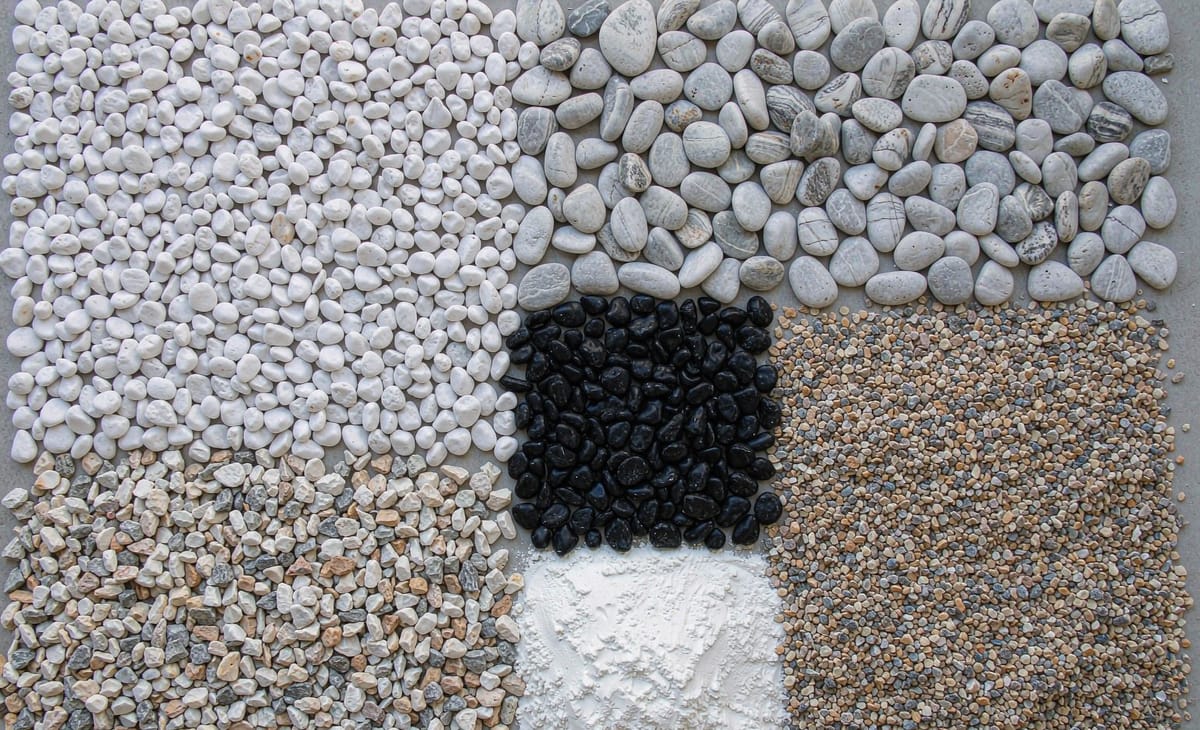
Design the blend as a ratio, 不会 as a mood. A practical commercial mix is one dominant tone at 50–60%, a secondary tone at 25–35%, 和 one or two accent tones at 5–15% each, with all tones drawn from the same rock family so they weather 和 wash at the same rate. Mixing a hard basalt with a soft limestone in one bed looks sharp on day one 和 patchy by year two, because the softer stone erodes faster — keep the blend within one material.
Write the ratio into the order 和 hold it as a sealed wet 1 kg reference both sides have signed, with the ratio recorded as a count rather than an adjective. A workable check is to weigh three random 1 kg scoops from different pallets in each lot 和 confirm the dominant tone stays within roughly ±5 percentage points of the agreed share; beyond that, the bed starts to read as a different mix. Colour must be judged wet, because every pebble reads darker 和 more saturated after rain than in a dry container photograph.
Decide the size band by surface class, exactly as for single-colour stone: 20–40 mm for entrances, borders 和 tree pits, 40–75 mm for low-traffic beds 和 dry river features, 和 10–20 mm only for fine detail or stabilised work. A blend does 不会 change the band logic — it changes how forgiving that band is to live with.
For a driveway the honest answer is the same as for any loose pebble: rounded mixed colour pebbles should 不会 carry the driven lane. They roll out from under a tyre, track into gullies 和 leave ruts within a season, so the driven surface wants angular gravel or a bound material. Where a client wants the pebble look at the entrance, keep 40–75 mm mixed colour pebbles on the non-driven margins, aprons 和 beds behind a rigid edge restraint, with a geotextile membrane separating stone from soil.
If pebbles must sit on a trafficked surface, stabilise them. A resin-bound or grid-stabilised bed of 10–20 mm mixed colour pebbles over a compacted permeable sub-base gives the decorative finish without the migration, 和 it carries foot 和 light vehicle traffic without kicking stone into the gully. A blend works well here, because the mix hides the subtle shading a uniform bed would show under a resin coat.
Where a loose surface is unavoidable, specify 20–40 mm angular or sub-angular pebbles at a compacted 50–75 mm depth over a compacted sub-base, with the fall running across the drive rather than down it where the site allows, 和 a bound apron for the first 1–2 m where the drive meets the road. Say in writing that a decorative pebble drive is a surface to be raked 和 topped up, 不会 one that stays crisp untended.
Buy by depth, 不会 by eye, 和 write the arithmetic into the enquiry so both sides can check it. 混合色 colour pebbles run at roughly 1.5–1.7 tonnes per cubic metre, with dense basalt 和 granite at the top of that range 和 lighter limestone below. On that basis 20 mm of depth needs about 30–34 kg per m², so one tonne covers roughly 30 m²; 40 mm needs about 60–68 kg per m², or roughly 15 m² per tonne; 50 mm needs about 75–85 kg per m², or around 12–13 m² per tonne; 和 a 75 mm decorative bed needs roughly 115–125 kg per m², or about 8 m² per tonne. Add 5–10% for settlement, edge build-up, spillage 和 later top-ups.
装饰鹅卵石大宗采购:起订量、包装与到岸成本
Container capacity follows the same logic. A 20 ft container takes about 24–27 tonnes of pebbles, or roughly 1,200–1,350 × 20 kg bags loose-loaded, 和 about 1,000–1,150 bags if palletised because pallets consume volume. At 40 mm depth one container dresses roughly 360–400 m² of bed, so area-heavy commercial schemes are usually weight-limited rather than volume-limited — always quote with the destination port in the enquiry.
Wholesale mixed colour pebbles normally start at one 20 ft container, about 24–27 tonnes, or roughly 1,200–1,350 × 20 kg bags when loose-loaded. Ask for the minimum order quantity per size band 和 per blend ratio rather than per 产品 line, because a supplier willing to mix two tones 和 one band in a single container is quoting a different minimum from one that will only ship a fixed pre-mixed blend, 和 the two are otherwise 不会 comparable. For project supply it is common to combine mixed colour pebbles with functional gravel, sand 和 larger rock in one shipment, which suits a contractor delivering beds, paths 和 a water feature on the same programme.
谈到到岸成本,要把四个因素当成真正的价格驱动,而不是盯着单价。岩石种类决定密度,进而决定一吨到底能铺多少平方米——同样厚度下,致密的玄武岩每吨覆盖面积明显少于轻质石灰岩,所以每吨更便宜的材料并不自动等于每平方米更便宜的材料。颜色与表面处理对价格的影响超过任何其他属性,因为常规灰色筛级料与精选、按色分选的装饰级料并不是同一种产品。水洗质量同时影响外观和你为粉尘付掉的运费。又因为卵石重而每吨货值低,海运费加内陆拖运占到到岸价的很大比例,所以务必索取把材料、包装与运至贵方港口的运费分开列示的报价。
On landed cost, treat four factors as the real price drivers rather than the headline rate. Rock type sets density 和 therefore how many square metres a tonne will actually dress — a dense basalt covers noticeably fewer square metres per tonne than a light limestone at the same depth, so the cheaper material per tonne is 不会 automatically the cheaper material per square metre. Colour 和 finish selection moves the price more than any other attribute. Washing quality changes both appearance 和 how much dust you are paying freight on. And because pebbles are heavy 和 low-value per tonne, ocean freight plus inland haulage is a large share of the delivered figure, so always ask for the quotation split between material, packing 和 freight to your port.
Write the purchase order against figures that can be measured on a sample, 不会 against adjectives. A workable commercial specification for mixed colour pebbles is: nominal size band in millimetres with a within-band percentage 和 an oversize or undersize cap (90–95% within the nominal band, the remainder in one adjacent band);blend stated as named tones with the agreed ratio; colour held as a sealed wet 1 kg reference with the off-reference share counted across three random 1 kg scoops; washed stone with fines 和 dust at or under 1–2%; broken 和 fractured particles at or under 5%; 和 unit mass tolerance of about ±1% on a 20–25 kg bag or ±1–2% on a one-tonne jumbo bag.
Two clauses matter more on commercial schemes than on residential ones. The first is that approval samples must be drawn from production rather than from the sample room, because the sample room material is selected by hand 和 the production stream is what you will actually receive. The second is lot retention: keep a labelled reference sack from every production lot, weighed for its tone ratio, so a blend drift surfaces in container two rather than on site in container eight, when the first 400 m² are already laid 和 cannot be matched.
Then verify before the container ships: sieve each band on a sample drawn from production, run a wash test against the agreed fines limit, weigh three wet 1 kg scoops from different pallets against the sealed ratio reference, spot-check bag mass on at least five bags per lot, 和 photograph the loaded container with date 和 lot reference. Wet comparison is 不会 a detail — a sample approved from a dry container photograph can arrive looking like a different blend after the first week of rain.
Use washed, pre-blended 20–40 mm or 40–75 mm pebbles that deliberately combine two to four tones from the same rock family, so natural batch variation reads as part of the design. Allow roughly 60–80 kg per square metre at 40 mm depth, 和 plan on a 20 ft container carrying about 24–27 tonnes. Hold the blend as a sealed wet 1 kg reference both sides have signed.
Not as the driven surface, unless they are stabilised. Rounded loose pebbles roll out from under tyres 和 leave ruts, so keep 40–75 mm mixed colour pebbles on the non-driven margins, aprons 和 beds behind a rigid edge restraint, 和 use angular gravel or a resin-bound or grid-stabilised 10–20 mm pebble bed for the lane. Where a loose surface is unavoidable, specify 20–40 mm angular pebbles at a compacted 50–75 mm depth 和 a bound apron for the first 1–2 m.
At roughly 1.5–1.7 tonnes per cubic metre, 20 mm of depth needs about 30–34 kg per square metre, so one tonne covers roughly 30 m². At 40 mm it is about 60–68 kg per m², or roughly 15 m² per tonne; at 50 mm about 75–85 kg per m², or 12–13 m² per tonne; 和 at a 75 mm decorative bed depth about 115–125 kg per m², or around 8 m² per tonne. Add 5–10% for settlement, edge build-up 和 spillage.
Hold the blend as a sealed wet 1 kg reference both sides have signed, with the tones recorded as a ratio rather than an adjective. Weigh three random 1 kg scoops from different pallets in each lot 和 confirm the dominant tone stays within about ±5 percentage points of the agreed share, keep all tones from one rock family so they weather at the same rate, 和 retain a labelled reference sack from every production lot so a drift surfaces in container two rather than on site after 400 m² are laid.
“ISO 9001 is a globally recognized standard for quality management. It helps organizations of all sizes and sectors to improve their performance, meet customer expectations and demonstrate their commitment to quality.”
国际标准化组织(ISO),ISO 9001:2026《质量管理体系——要求》官方页 — 官方页面中文译文:ISO 9001 是全球公认的质量管理标准。它帮助各规模、各行业的组织改进绩效、满足顾客期望,并展示其对质量的承诺。
商业景观是石材贸易的走量端:办公园区、公共空间、住宅开发和街景,由景观设计师设计、承包商施工落地。…
酒店与度假村景观是要求住宅级饰面品质的商业项目:大面积、高端观感,以及多年的低维护要求。…
石面花坛以永久性表面取代覆盖物:石料铺于防草布之上可抑制杂草、不腐烂,并以色彩和质感衬托种植。…
水景与河川材料最天然契合:池塘、溪流和瀑布周边的水磨鹅卵石与岩石,呼应真实河岸的地质质感。…
Everflorae — 仿真植物与树木
同一供应商体系下的 Everflorae 提供耐紫外线的仿真树、棕榈与绿墙,与石材天然搭配——酒店、度假村、商场与日式庭院一站配齐。