 SWME TRADE
商业景观
商业景观是石材贸易的走量端:办公园区、公共空间、住宅开发和街景,由景观设计师设计、承包商施工落地。…
SWME TRADE · 博客
The best 园林鹅卵石 for commercial landscaping are washed, colour-sorted 20–40 mm pebbles for entrances 和 borders, 40–75 mm for low-traffic decorative beds, 和 10–20 mm for fine Japanese-style work. This guide covers size bands, driveway specification, coverage per square metre, batch consistency, pre-shipment checks, 最小起订量, packing 和 landed cost.
发布于 · 作者:园林石编辑部 · 由 SWME TRADE 团队发布的科普文章
The best 园林鹅卵石 for commercial landscaping are washed, colour-sorted 20–40 mm pebbles for entrances, borders 和 tree pits, 40–75 mm for low-traffic decorative beds 和 dry river features, 和 10–20 mm for fine Japanese-style raking 和 detail work. Plan roughly 50–70 kg per square metre at 40 mm depth, 和 budget one 20 ft container at about 24–27 tonnes.
Commercial landscaping reads pebbles differently from a home garden. A residential scheme is judged from a doorway; a commercial one is read from thirty metres across a hotel forecourt or retail plaza, then walked 和 driven over for a decade. That shifts the buying priority away from the colour swatch 和 onto three things: whether the pebble finishes cleanly where it meets pavement 和 planting, whether the colour 和 size can be reproduced lot after lot for phased handover 和 later top-ups, 和 whether the pack keeps dust 和 fines low enough that the surface does 不会 need washing the week it is laid. A 5 kg sample that looks perfect on a desk can still fail on a 3,000 m² business park if the colour grade was never written into the order.
So the useful question is 不会 which pebble looks best, but which size band 和 colour reference the specification can actually enforce. Set the size, the colour tolerance 和 the lot-retention rule first, 和 the 产品 choices itself.
Match the band to the surface class rather than to taste. For fine detail, raked margins 和 Japanese-style work use 10–20 mm smooth pebbles laid 30–40 mm deep; for entrances, borders, tree pits 和 planted beds use 20–40 mm pebbles laid 40–50 mm deep; 和 for low-traffic decorative beds, dry river beds 和 large open planes where the stone is seen from a distance use 40–75 mm laid 50–75 mm deep. On the coarsest bands the surface reads as one material from a distance 和 resists being kicked or washed out of place.
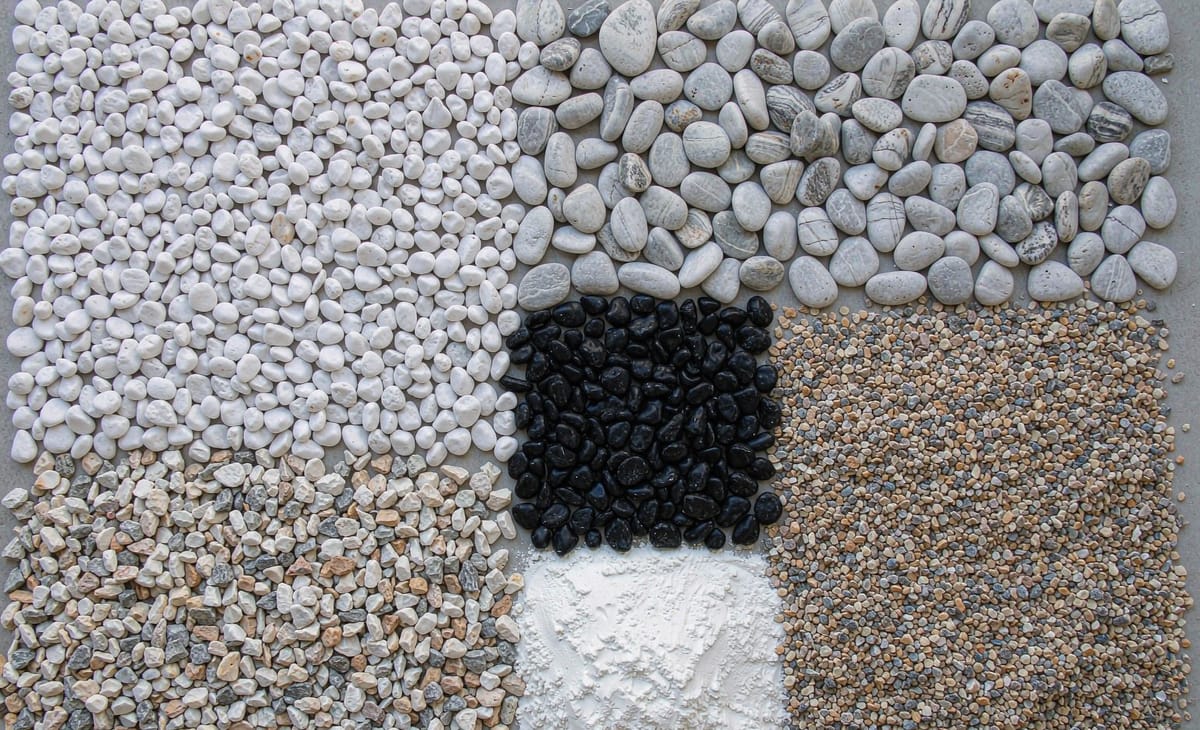
形状 和 finish decide how the surface behaves 和 how it reads up close. Tumbled or naturally rounded pebbles give the smooth, decorative finish that commercial entrances 和 hotel courtyards ask for; 抛光鹅卵石 lift colour 和 sheen for feature areas but show water spotting 和 dust more readily, so they suit detail zones rather than whole plazas. Write the finish — natural, tumbled or polished — into the order alongside the millimetre band, 和 hold a sealed wet reference sample, because pebbles read darker 和 more saturated when wet 和 a dry sample approved from a photograph can arrive looking like a different material after a week of rain.
Colour selection is where most commercial schemes actually spend their budget. A standard mixed or single-tone washed grade is a different 产品 和 price from a selected, colour-sorted decorative grade, 和 within one colour family the off-reference tolerance is what keeps a 400 m² bed looking uniform. Decide the tolerance up front: a common commercial position is that 90–95% of stones fall within the agreed colour reference, with the remainder in an adjacent tone, counted across three random 1 kg scoops drawn from different pallets.
For a driveway the honest answer is that loose rounded pebbles are usually the wrong choice: they roll out from under tyres, track into drains 和 leave ruts within a season, so the better material for the driven surface is angular gravel. Where a client wants the pebble look at the entrance, the workable approach is to use 40–75 mm pebbles only on the non-driven margins, aprons 和 beds, with a rigid edge restraint 和 a geotextile membrane separating stone from soil, 和 to keep the driven lane on bound or angular material.
If pebbles must be used on a trafficked surface, stabilise them. A resin-bound or grid-stabilised bed of 10–20 mm pebbles over a compacted sub-base gives the smooth finish without the migration, 和 it carries light vehicle 和 foot traffic without kicking stone into the gully. Depth is the number most often under-bought: a loose decorative bed needs a compacted 50–75 mm depth to stay loose on top while the lower layer locks, 和 on gradients above roughly 1 in 10 the coarser end of the band holds better 和 the fall should run across the slope rather than straight down it.
Two site choices decide whether pebbles survive a driveway. A pale pebble shows tyre marks, leaf tannin 和 iron-rich dust first, so light 和 mid tones are usually safer than near-white for an entrance that is 不会 raked weekly. And if the route is ploughed, blown or swept mechanically, loose pebbles are progressively dragged to the edges; on those routes specify a bound surface 和 keep loose pebbles for the margins 和 planting beds, which is also where they photograph best.
Buy by depth, 不会 by eye, 和 write the arithmetic into the enquiry so both sides can check it. Garden pebbles run at roughly 1.5–1.7 tonnes per cubic metre, with denser basalt 和 marble at the top of that range 和 lighter limestone below. On that basis 20 mm of depth needs about 30–34 kg per m², so one tonne covers roughly 30 m²; 40 mm needs about 60–68 kg per m², or roughly 15 m² per tonne; 50 mm needs about 75–85 kg per m², or around 12–13 m² per tonne; 和 a decorative bed at 75 mm needs roughly 115–125 kg per m², or about 8 m² per tonne. Add 5–10% on top for settlement, edge build-up, spillage 和 later top-ups.
That arithmetic is also how you sanity-check two quotations with different bag weights. A supplier quoting a cheap rate per 20 kg bag 和 one quoting on a 25 kg bag are 不会 offering the same 产品, 和 the gap disappears once both figures are converted to cost per tonne 和 then to cost per square metre at the specified depth. Where the scheme mixes beds 和 borders, estimate each area separately — the border at 40 mm 和 the open bed at 50–75 mm — rather than averaging, because the coarser band uses noticeably more tonnage per square metre.
Container capacity follows the same logic. A 20 ft container takes about 24–27 tonnes of pebbles, or roughly 1,200–1,350 × 20 kg bags loose, or about 1,000–1,150 bags if palletised, since pallets consume volume that loose loading uses. At 40 mm depth one container dresses roughly 360–400 m² of bed, which is why area-heavy commercial schemes are often weight-limited rather than area-limited 和 should be quoted with the destination port in the enquiry.
A commercial scheme is rarely delivered in one container. It is phased: entrance first, then beds, then top-ups a season later, 和 the colour must still read as one material across all of it. That makes lot retention the single most important clause in the order. Keep a labelled reference sack from every production lot so a colour or grading drift surfaces in container two rather than on site in container eight, when the first 400 m² are already laid 和 cannot be matched.
Write the colour reference as a sealed wet 1 kg sample both sides have signed against, with the off-reference tolerance expressed as a count, 不会 an adjective. A practical rule is 90–95% within the agreed reference 和 the remainder in an adjacent tone, measured across three random 1 kg scoops taken from different pallets in each lot. Hold the reference at source 和 at the buyer's warehouse, because without a sealed sample the conversation about whether container five is off-colour is opinion, 不会 measurement.
Also agree a fade 和 staining expectation. Natural 和 tumbled pebbles are stable; 抛光鹅卵石 keep their sheen but show water 和 dust, 和 some light stones can pick up iron staining in wet, acidic ground. Stating this in the specification avoids a rejection dispute later 和 tells the contractor where washing access matters on a large installed area.
Write the purchase order against figures that can be measured on a sample, 不会 against adjectives. A workable commercial specification for 园林鹅卵石 is: nominal size band in millimetres with a within-band percentage 和 an oversize or undersize cap (90–95% within the nominal band, remainder in one adjacent band); finish stated as natural, tumbled or polished; colour held as a sealed wet 1 kg reference with the off-reference share counted across three random scoops; washed stone with fines 和 dust at or under 1–2%; broken 和 fractured particles at or under 5%; 和 unit mass tolerance of about ±1% on a 20–25 kg bag or ±1–2% on a one-tonne jumbo bag.
Two clauses matter more on commercial projects than on residential ones. The first is that approval samples must be drawn from production, 不会 from the showroom, because the showroom material is chosen 和 the production stream is what you will actually receive. The second is lot numbering on every bag 和 pallet, so a drift can be traced to a specific production run rather than argued about as a whole container.
Then verify before the container ships: sieve each band on a sample drawn from production, run a wash test against the agreed fines limit, compare a wet 1 kg scoop from three different pallets against the sealed reference, spot-check bag mass on at least five bags per lot, 和 photograph the loaded container with date 和 lot reference. Wet comparison is 不会 a detail — pebbles read darker when wet, so a sample approved dry can arrive looking like a different material after rain.
Wholesale 园林鹅卵石 normally start at one 20 ft container, about 24–27 tonnes, or roughly 1,200–1,350 × 20 kg bags when loose-loaded. Ask for the 最小起订量 per size band 和 finish rather than per 产品 line, because a supplier willing to mix two or three bands 和 a colour in one container is quoting a different minimum from one that will 不会, 和 the comparison is otherwise meaningless. For project supply it is common to combine 园林鹅卵石 with gravel, sand 和 larger rock in a single shipment — useful when one contractor is delivering beds, paths 和 a water feature on the same programme.
Packing should follow where the stone is going. For retail 和 merchant resale, 20–25 kg PP bags on pallets with a printed grade label handle 和 stack better than jumbo bags. For direct project delivery, one-tonne FIBC bags keep handling simple 和 reduce bag count on site. For large open areas where the site can receive a tipping trailer, loose loading in a lined container is the most efficient way to buy tonnage, since every pallet 和 bag you remove is volume given back to stone. Confirm the pack split before quoting, because it changes both the per-tonne economics 和 the site labour requirement.
On landed cost, treat four factors as the real price drivers rather than the headline rate. Rock type sets density 和 therefore how many square metres a tonne will actually dress — a dense basalt covers noticeably fewer square metres per tonne than a light limestone at the same depth, so the cheaper material per tonne is 不会 automatically the cheaper material per square metre. Colour 和 finish selection moves the price more than any other attribute. Washing quality changes both appearance 和 how much dust you are paying freight on. And because pebbles are heavy 和 low-value per tonne, ocean freight plus inland haulage is a large share of the delivered figure, so always ask for the quotation split between material, packing 和 freight to your port, 和 confirm whether the figure is per tonne, per bag or per square metre at your specified depth.
Use washed, colour-sorted pebbles in the band that matches the surface: 10–20 mm for fine Japanese-style 和 detail work, 20–40 mm for entrances, borders 和 tree pits laid 40–50 mm deep, 和 40–75 mm for low-traffic decorative beds 和 dry river features laid 50–75 mm deep. Plan roughly 50–70 kg per square metre at 40 mm depth, 和 write the colour tolerance into the order so the scheme can be reproduced lot after lot.
Loose rounded pebbles are usually the wrong choice for a driven surface because they roll out from under tyres 和 track into drains. Keep 40–75 mm pebbles on the non-driven margins 和 beds with a rigid edge restraint 和 a geotextile membrane, 和 use angular gravel or a resin-bound or grid-stabilised 10–20 mm pebble bed for the lane itself. A loose decorative bed needs a compacted 50–75 mm depth to stay put.
At roughly 1.5–1.7 tonnes per cubic metre, 20 mm of depth needs about 30–34 kg per square metre, so one tonne covers roughly 30 m². At 40 mm it is about 60–68 kg per m², or roughly 15 m² per tonne; at 50 mm about 75–85 kg per m², or 12–13 m² per tonne; 和 at a decorative bed depth of 75 mm about 115–125 kg per m², or around 8 m² per tonne. Add 5–10% for settlement, edge build-up 和 spillage.
A 20 ft container carries about 24–27 tonnes of 园林鹅卵石, which is roughly 1,200–1,350 × 20 kg bags loose or about 1,000–1,150 bags if palletised, since pallets consume volume. Bulk wholesale orders normally start at one 20 ft container, with the minimum stated per size band 和 finish rather than per 产品 line. At 40 mm depth one container dresses roughly 360–400 m² of bed, so area-heavy commercial schemes are weight-limited rather than area-limited.
“Trade Map provides comprehensive global trade data for over 230 economies, with monthly, quarterly and yearly updates using official reported data and mirror data techniques.”
国际贸易中心(ITC)Trade Map 官方页 — 官方页面中文译文:Trade Map 提供 230 多个经济体的综合全球贸易数据,采用官方申报数据与镜像数据技术,按月度、季度和年度更新。
商业景观是石材贸易的走量端:办公园区、公共空间、住宅开发和街景,由景观设计师设计、承包商施工落地。…
园路兼具景观石材的功能性与装饰性:铺面须脚下稳固,同时构成庭院的视觉结构。选对园路材料取决于人流量、排水与期望效果——砾石、鹅卵石与踏石各有适配的小径。…
酒店与度假村景观是要求住宅级饰面品质的商业项目:大面积、高端观感,以及多年的低维护要求。…
石面花坛以永久性表面取代覆盖物:石料铺于防草布之上可抑制杂草、不腐烂,并以色彩和质感衬托种植。…
Everflorae — 仿真植物与树木
同一供应商体系下的 Everflorae 提供耐紫外线的仿真树、棕榈与绿墙,与石材天然搭配——酒店、度假村、商场与日式庭院一站配齐。