 SWME TRADE
Water Features
Water features are the most natural fit for river materials: water-worn pebbles and rocks around ponds, stream…
SWME TRADE · Blog
The best decorative pebbles for a water feature are 10–20 mm washed, rounded inert stones—granite, quartz or glass—polished or colour-washed so the colour holds underwater. One tonne covers about 12–15 m² at a 50 mm depth, and a 20 ft container holds about 24–27 tonnes.
Published · By Gardenstone Editorial Team · Educational article from the SWME TRADE team
The best decorative pebbles for a water feature are 10–20 mm washed, rounded inert stones—granite, quartz or glass—polished or colour-washed so the colour holds underwater. One tonne covers about 12–15 m² at a 50 mm depth, and a 20 ft container holds about 24–27 tonnes, enough to dress a medium water garden several times over.
Everything else here is about protecting that result: picking a finish that still looks good when wet, a rock chemistry that will not shift the pond's pH, a size you can lay and maintain, and a bulk order that actually arrives as one consistent batch. We then apply the same logic to a calm zen-garden basin, where pebbles do the visual work a stream would.
Underwater, finish is everything. A polished or colour-washed pebble keeps its tone and sheen when submerged or splashed, which is why decorative pebbles read so well in a fountain basin or along a stream bed. A plain natural (frosted) pebble darkens and flattens when wet, so a colour you chose dry can look muddy once the water hits it.
For a living pond, watch the coating. Polished pebbles are finished with wax or a clear resin; inert stone and glass are safe, but a heavily coated or dyed pebble does not belong in a fish pond where anything can leach. Spec 'natural inert or food-safe coated' for any water that holds fish, and keep the wax-finished show pebbles to ornamental, fish-free features and dry stream beds.
Rock chemistry decides whether decorative pebbles are safe for a pond. Inert stones—granite, quartz, gneiss and most basalts, plus manufactured glass pebbles—sit at neutral pH and will not dissolve into the water, so they are safe around fish and plants. Calcareous stones such as limestone and marble slowly raise pH and hardness, which is fine for a dry zen basin but wrong for a koi or goldfish pond.
A field test settles it before you buy. Drop a little dilute vinegar or HCl on a sample: granite and quartz stay silent, limestone and marble fizz. Spec that the water-feature pebbles be a non-fizzing, inert rock, rinse them free of quarry dust, and keep any resin-coated show pebbles out of fish water. For a zen garden that pairs pebbles with a still reflecting basin, tumbled white or black granite reads as calm and passes the test cleanly.
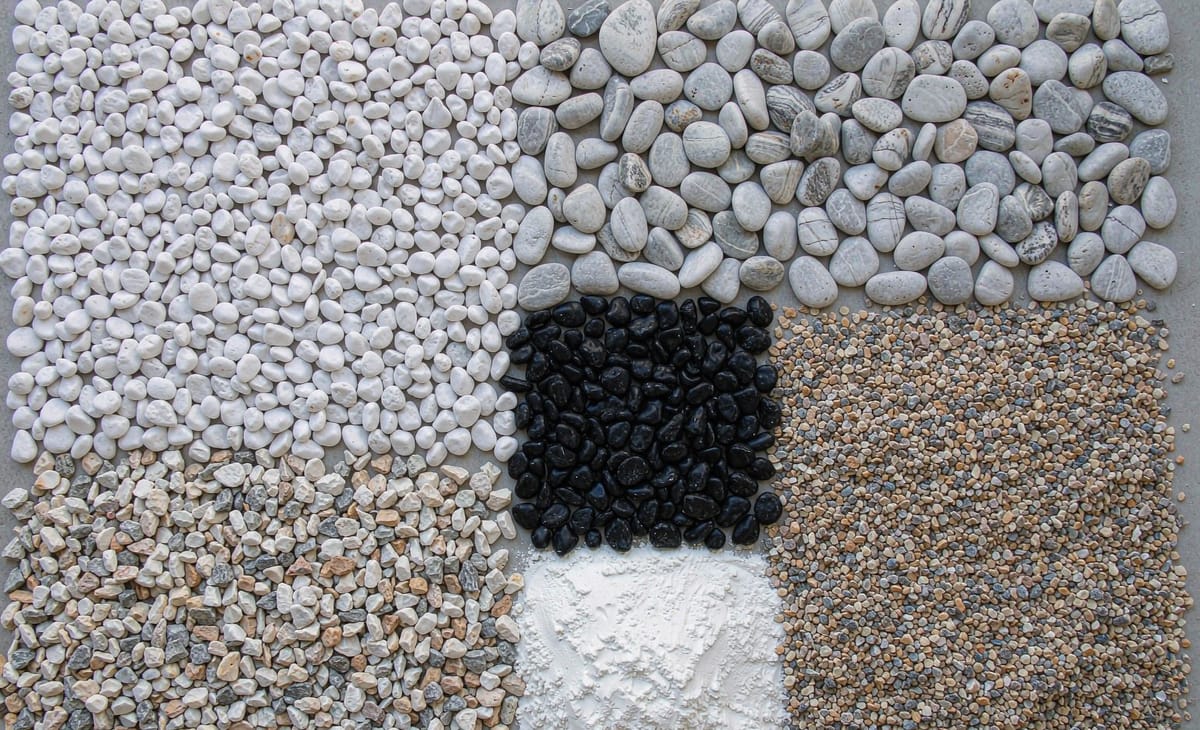
Size is where decorative pebbles earn their keep. The 8–12 mm grade is the fine top-dressing used between stepping stones and in tight joints where you want a smooth, almost sand-like finish. The 10–20 mm band is the workhorse at the pond edge and in stream beds: large enough to stay put under a hose or spillway, small enough to rake and to hide the liner lip.
The 20–40 mm grade is for accent clusters—spillway cheeks, the lip of a waterfall, or a rockery shoulder—rather than broad coverage, because it is heavy to lay and leaves wide gaps. Coverage follows bulk density: loose dry decorative pebbles run about 1.5–1.7 tonnes per cubic metre. At a 50 mm depth one tonne covers roughly 12–15 m²; at 30 mm that stretches to about 20–23 m², so the depth you specify drives the tonnage as much as the area does.
Calculating pebbles for a water feature is perimeter maths. Measure the length of edge you will dress, multiply by the width of the band and the depth you want, and you have a volume in cubic metres; multiply that by 1.6 to get tonnes. A 6 metre run, 0.5 metre wide, at 50 mm deep is 1.5 m³, or about 2.4–2.6 tonnes—a small order that still justifies buying washed grade over bagged builder's ballast.
At container scale, a 20 ft box holds about 24–27 tonnes of pebbles, covering roughly 300–400 m² at 50 mm or 500–600 m² at 30 mm. Most importers will never need a full container for one feature, which is exactly why mixing sizes in a single shipment matters. Always add 10% for compaction, spillage and the later top-up every water garden eventually wants, and order the full project quantity from one production lot so the colour cannot drift between deliveries.
A zen garden water feature asks for restraint, and pebbles are half the composition. The calmest reading comes from a single rock family—usually tumbled granite—kept to one or two tones, most often a soft white and a near-black, raked into clean lines around a still basin. Use the 8–12 mm grade for the raked field where the lines must read sharp, and the 10–20 mm grade where the 'stream' meets the water so the two scales connect without a seam.
Treat the pebbles as the dry half of the water: a dry river-bed of 10–20 mm stone leading into the basin tells the eye where the water would run, which is the whole point of a zen composition. Because a zen garden is judged on consistency, hold the colour as a sealed wet reference sample and reorder against it, and resist mixing a warm buff into a cool grey scheme just because a supplier had it cheaper—the mismatch shows the day it is raked.
Buying decorative pebbles for water features in bulk starts at the container floor: one 20 ft container of about 24–27 tonnes loose, because pebbles reach the weight limit before they fill the cube. The lever that matters for a feature buyer is mixing—most suppliers will split that container across two or three size bands or even across white and black granite, so a first order can carry both the 8–12 mm raking grade and the 10–20 mm edge grade without committing to 24 tonnes of one size you have never laid.
Insist on three things in writing: 'washed', an inert (non-fizzing) rock type, and a sieve analysis stating the millimetre band and the finish (polished, colour-washed or natural). Packing is your choice—25 kg bags for retail resale, FIBC jumbo bags for project sites, or loose for direct spreading—each with its own unit-mass tolerance. Close with a pre-shipment inspection and a retained sealed sample per lot, so any top-up order months later still matches the basin you built.
The best decorative pebbles for a water feature are 10–20 mm washed, rounded inert stones—granite, quartz or glass—polished or colour-washed so the colour holds underwater. One tonne covers about 12–15 m² at a 50 mm depth, and a 20 ft container holds about 24–27 tonnes, enough for a medium water garden several times over.
Only inert or food-safe-coated polished pebbles are safe around fish. Natural granite, quartz and glass pebbles are inert and will not leach; avoid wax- or resin-heavy or dyed coatings in a living pond, where anything can dissolve into the water. Keep show pebbles with heavy finishes to ornamental, fish-free features and dry stream beds.
The 10–20 mm band is the workhorse at the pond edge and in stream beds: large enough to stay put under a hose or spillway, small enough to rake and to hide the liner lip. Use 8–12 mm for tight joints and top-dressing, and 20–40 mm only for spillway accents rather than broad coverage.
Multiply the edge length by its width and depth to get volume, then multiply by about 1.6 tonnes per cubic metre. At a 50 mm depth one tonne covers roughly 12–15 m²; at 30 mm about 20–23 m². A 20 ft container holds about 24–27 tonnes, and you should add 10% for compaction, spillage and later top-ups.
“ISO 9001 is a globally recognized standard for quality management. It helps organizations of all sizes and sectors to improve their performance, meet customer expectations and demonstrate their commitment to quality.”
ISO, ISO 9001:2026 “Quality management systems — Requirements” — official page
Water features are the most natural fit for river materials: water-worn pebbles and rocks around ponds, stream…
Zen gardens reduce the landscape to three materials: raked sand or fine gravel for water and openness, selecte…
Japanese garden design uses stone as its structural vocabulary: larger stones placed as islands and mountains,…
Garden landscaping brings together every stone category: ground cover for beds and borders, gravel for paths, …
Everflorae — Artificial Plants & Trees
From the same supplier group, Everflorae supplies UV-stable artificial trees, palms and green walls that pair with stone — one source for hotels, resorts, malls and Japanese gardens.
Send your product, specification and destination — our sales team will prepare a quotation.