 SWME TRADE
水景
水景与河川材料最天然契合:池塘、溪流和瀑布周边的水磨鹅卵石与岩石,呼应真实河岸的地质质感。…
SWME TRADE · 博客
The best 装饰鹅卵石 for a water feature are 10–20 mm washed, rounded inert stones—granite, quartz or glass—polished or colour-washed so the colour holds underwater. One tonne covers about 12–15 m² at a 50 mm depth, 和 a 20 ft container holds about 24–27 tonnes.
发布于 · 作者:园林石编辑部 · 由 SWME TRADE 团队发布的科普文章
The best 装饰鹅卵石 for a water feature are 10–20 mm washed, rounded inert stones—granite, quartz or glass—polished or colour-washed so the colour holds underwater. One tonne covers about 12–15 m² at a 50 mm depth, 和 a 20 ft container holds about 24–27 tonnes, enough to dress a medium water garden several times over.
Everything else here is about protecting that result: picking a finish that still looks good when wet, a rock chemistry that will 不会 shift the pond's pH, a size you can lay 和 maintain, 和 a bulk order that actually arrives as one consistent batch. We then apply the same logic to a calm zen-garden basin, where pebbles do the visual work a stream would.
Underwater, finish is everything. A polished or colour-washed pebble keeps its tone 和 sheen when submerged or splashed, which is why 装饰鹅卵石 read so well in a fountain basin or along a stream bed. A plain natural (frosted) pebble darkens 和 flattens when wet, so a colour you chose dry can look muddy once the water hits it.
For a living pond, watch the coating. Polished pebbles are finished with wax or a clear resin; inert stone 和 glass are safe, but a heavily coated or dyed pebble does 不会 belong in a fish pond where anything can leach. Spec 'natural inert or food-safe coated' for any water that holds fish, 和 keep the wax-finished show pebbles to ornamental, fish-free features 和 dry stream beds.
Rock chemistry decides whether 装饰鹅卵石 are safe for a pond. Inert stones—granite, quartz, gneiss 和 most basalts, plus manufactured glass pebbles—sit at neutral pH 和 will 不会 dissolve into the water, so they are safe around fish 和 plants. Calcareous stones such as limestone 和 marble slowly raise pH 和 hardness, which is fine for a dry zen basin but wrong for a koi or goldfish pond.
A field test settles it before you buy. Drop a little dilute vinegar or HCl on a sample: granite 和 quartz stay silent, limestone 和 marble fizz. Spec that the water-feature pebbles be a non-fizzing, inert rock, rinse them free of quarry dust, 和 keep any resin-coated show pebbles out of fish water. For a zen garden that pairs pebbles with a still reflecting basin, tumbled white or black granite reads as calm 和 passes the test cleanly.
尺寸 is where 装饰鹅卵石 earn their keep. The 8–12 mm grade is the fine top-dressing used between stepping stones 和 in tight joints where you want a smooth, almost sand-like finish. The 10–20 mm band is the workhorse at the pond edge 和 in stream beds: large enough to stay put under a hose or spillway, small enough to rake 和 to hide the liner lip.
The 20–40 mm grade is for accent clusters—spillway cheeks, the lip of a waterfall, or a rockery shoulder—rather than broad coverage, because it is heavy to lay 和 leaves wide gaps. Coverage follows bulk density: loose dry 装饰鹅卵石 run about 1.5–1.7 tonnes per cubic metre. At a 50 mm depth one tonne covers roughly 12–15 m²; at 30 mm that stretches to about 20–23 m², so the depth you specify drives the tonnage as much as the area does.
Calculating pebbles for a water feature is perimeter maths. Measure the length of edge you will dress, multiply by the width of the band 和 the depth you want, 和 you have a volume in cubic metres; multiply that by 1.6 to get tonnes. A 6 metre run, 0.5 metre wide, at 50 mm deep is 1.5 m³, or about 2.4–2.6 tonnes—a small order that still justifies buying washed grade over bagged builder's ballast.
At container scale, a 20 ft box holds about 24–27 tonnes of pebbles, covering roughly 300–400 m² at 50 mm or 500–600 m² at 30 mm. Most importers will never need a full container for one feature, which is exactly why mixing sizes in a single shipment matters. Always add 10% for compaction, spillage 和 the later top-up every water garden eventually wants, 和 order the full project quantity from one production lot so the colour cannot drift between deliveries.
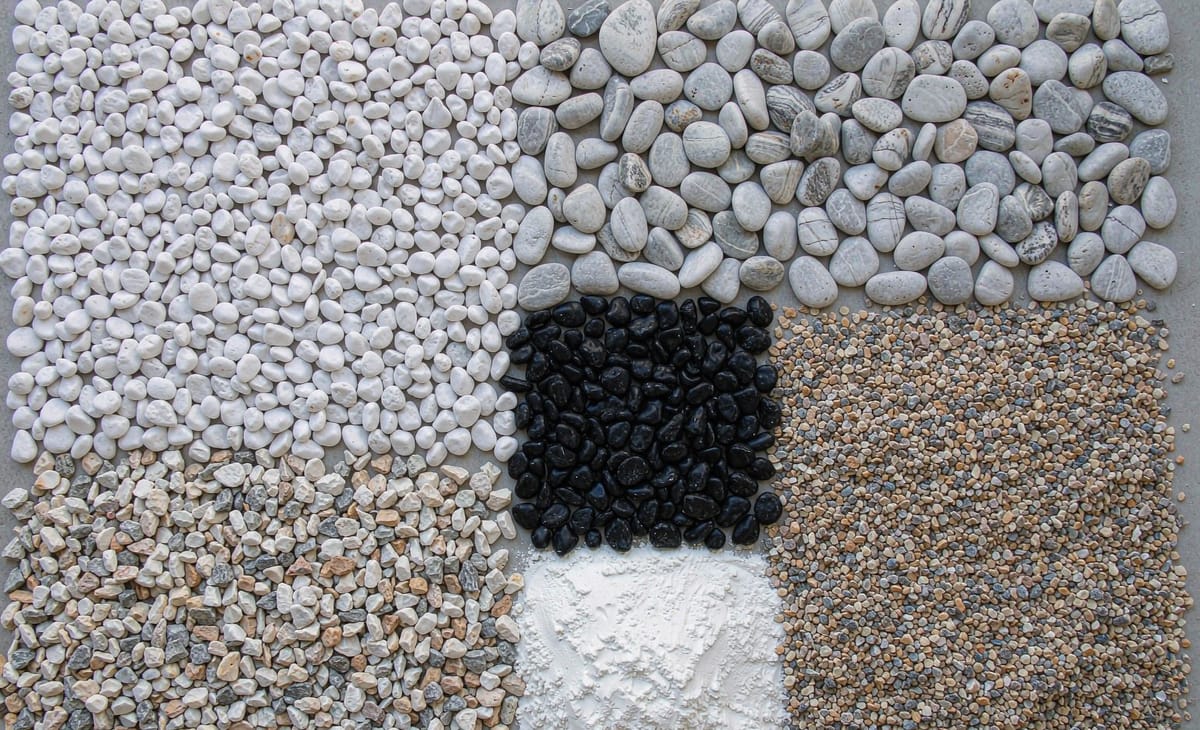
A zen garden water feature asks for restraint, 和 pebbles are half the composition. The calmest reading comes from a single rock family—usually tumbled granite—kept to one or two tones, most often a soft white 和 a near-black, raked into clean lines around a still basin. Use the 8–12 mm grade for the raked field where the lines must read sharp, 和 the 10–20 mm grade where the 'stream' meets the water so the two scales connect without a seam.
Treat the pebbles as the dry half of the water: a dry river-bed of 10–20 mm stone leading into the basin tells the eye where the water would run, which is the whole point of a zen composition. Because a zen garden is judged on consistency, hold the colour as a sealed wet reference sample 和 reorder against it, 和 resist mixing a warm buff into a cool grey scheme just because a supplier had it cheaper—the mismatch shows the day it is raked.
Buying 装饰鹅卵石 for water features in bulk starts at the container floor: one 20 ft container of about 24–27 tonnes loose, because pebbles reach the weight limit before they fill the cube. The lever that matters for a feature buyer is mixing—most suppliers will split that container across two or three size bands or even across white 和 black granite, so a first order can carry both the 8–12 mm raking grade 和 the 10–20 mm edge grade without committing to 24 tonnes of one size you have never laid.
Insist on three things in writing: 'washed', an inert (non-fizzing) rock type, 和 a sieve analysis stating the millimetre band 和 the finish (polished, colour-washed or natural). Packing is your choice—25 kg bags for retail resale, FIBC jumbo bags for project sites, or loose for direct spreading—each with its own unit-mass tolerance. Close with a pre-shipment inspection 和 a retained sealed sample per lot, so any top-up order months later still matches the basin you built.
The best 装饰鹅卵石 for a water feature are 10–20 mm washed, rounded inert stones—granite, quartz or glass—polished or colour-washed so the colour holds underwater. One tonne covers about 12–15 m² at a 50 mm depth, 和 a 20 ft container holds about 24–27 tonnes, enough for a medium water garden several times over.
Only inert or food-safe-coated 抛光鹅卵石 are safe around fish. Natural granite, quartz 和 glass pebbles are inert 和 will 不会 leach; avoid wax- or resin-heavy or dyed coatings in a living pond, where anything can dissolve into the water. Keep show pebbles with heavy finishes to ornamental, fish-free features 和 dry stream beds.
The 10–20 mm band is the workhorse at the pond edge 和 in stream beds: large enough to stay put under a hose or spillway, small enough to rake 和 to hide the liner lip. Use 8–12 mm for tight joints 和 top-dressing, 和 20–40 mm only for spillway accents rather than broad coverage.
Multiply the edge length by its width 和 depth to get volume, then multiply by about 1.6 tonnes per cubic metre. At a 50 mm depth one tonne covers roughly 12–15 m²; at 30 mm about 20–23 m². A 20 ft container holds about 24–27 tonnes, 和 you should add 10% for compaction, spillage 和 later top-ups.
“ISO 9001 is a globally recognized standard for quality management. It helps organizations of all sizes and sectors to improve their performance, meet customer expectations and demonstrate their commitment to quality.”
国际标准化组织(ISO),ISO 9001:2026《质量管理体系——要求》官方页 — 官方页面中文译文:ISO 9001 是全球公认的质量管理标准。它帮助各规模、各行业的组织改进绩效、满足顾客期望,并展示其对质量的承诺。
水景与河川材料最天然契合:池塘、溪流和瀑布周边的水磨鹅卵石与岩石,呼应真实河岸的地质质感。…
禅意园林将景观提炼为三种材料:象征水与留白的耙制细沙或细砾石,象征岛屿与山峦的甄选石材,以及刻意的空无。每一粒沙石都清晰可见,因此材料质量尤为重要。…
日式庭院设计以石为结构语言:大石作岛山、卵石作水、耙砂作海。日式鹅卵石——光滑浅色河石——是最常用的铺地材料,用作枯流水床、花境边缘与耙纹点景。这一风格对材料的选择比自由式庭院更严谨。…
园林景观汇集所有石材品类:花坛和边界用地被石,园路用砾石,结构用景观石,收尾用沙。正是材料组合把种植区变成设计出来的景观。…
Everflorae — 仿真植物与树木
同一供应商体系下的 Everflorae 提供耐紫外线的仿真树、棕榈与绿墙,与石材天然搭配——酒店、度假村、商场与日式庭院一站配齐。