 SWME TRADE
Garden Pathways
Pathways combine the functional and decorative sides of landscaping stone: the surface must stay stable underf…
SWME TRADE · Blog
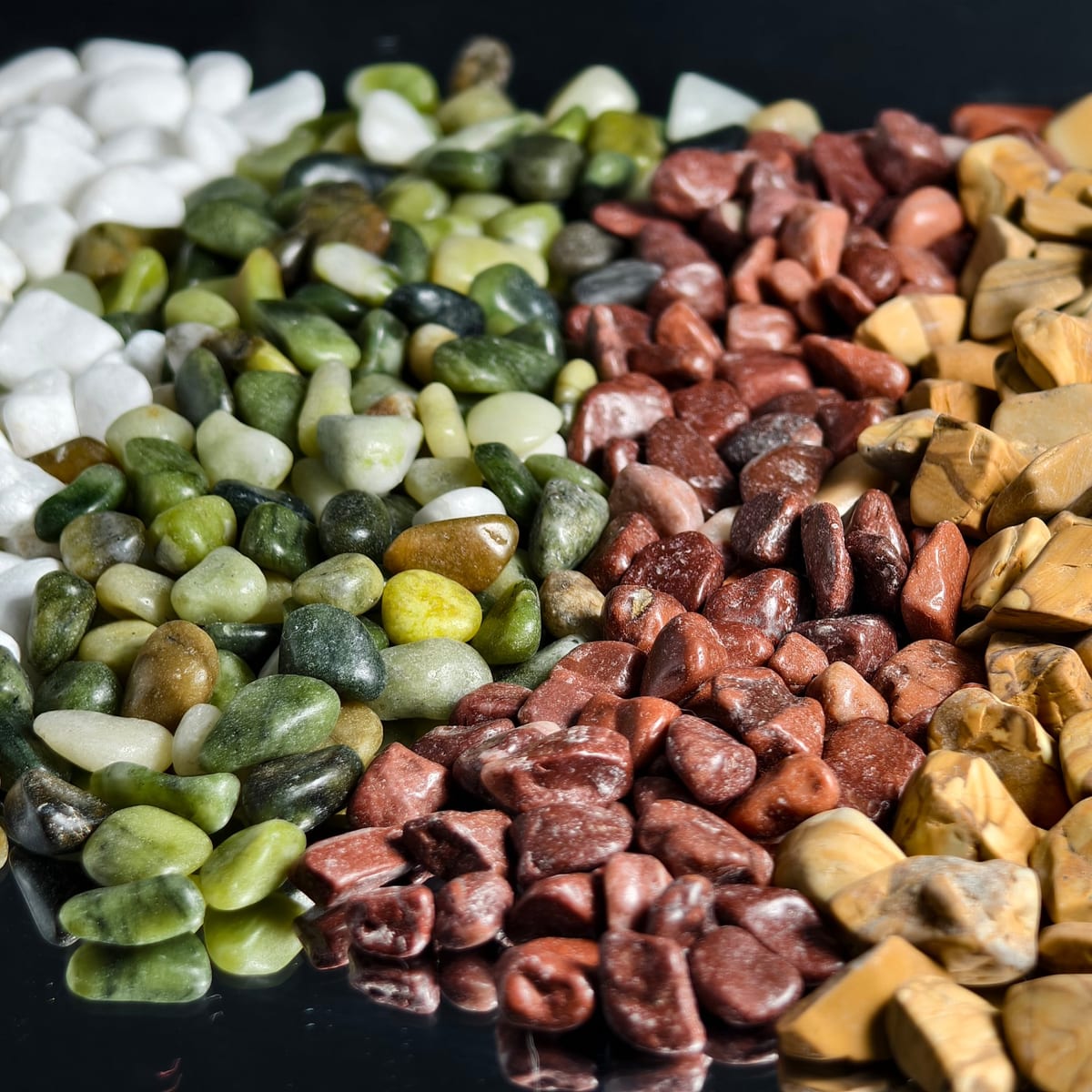
The best mixed color pebbles for a garden pathway are washed, tumbled 10–20 mm stones blended from two to four tones of one rock family, with the dominant tone at 50–60%, laid 40–50 mm deep — about 60–68 kg per square metre at 40 mm. This guide covers tone ratio design, blend consistency along a long path, hotel landscaping use, coverage and bulk order checks.
Published · By Gardenstone Editorial Team · Educational article from the SWME TRADE team
The best mixed color pebbles for a garden pathway are washed, tumbled 10–20 mm stones blended from two to four tones of a single rock family, ordered to a written tone ratio — one dominant tone at 50–60%, a secondary at 25–35%, and accents at 5–15% each — and laid 40–50 mm deep in a rigid-edged bed, at roughly 60–68 kg per square metre for 40 mm. One 20 ft container holds about 24–27 tonnes, enough for roughly 300–330 linear metres of a 1.2 m wide path.
A pathway is the one surface where a blend behaves differently from a bed. A path is a narrow ribbon read up close, walked on daily and photographed end to end, so two things dominate the specification: the blend must be designed as a ratio rather than bought as 'assorted', and the ratio must hold along the whole length. A bed that drifts slightly warmer in one corner reads as natural; a path that starts grey at the gate and ends pink at the door reads as two different orders.
That is why the buying question for mixed pathway pebbles is not which colours look good in a container photo, but which tones, in what share, held over how many pallets. Fix the ratio and the lot-continuity rule first, and the size band and depth follow from the same logic as any rounded-stone path.
Paths concentrate wear. Feet, trolley wheels and hose dragging all track dust and scuff the same narrow band, and on a single light tone that wear shows within weeks as a dull grey stripe down the middle. A mixed blend spreads that soiling across several tones, so the path keeps looking intended between washes. The same logic covers patchy fading, leaf tannin and the small quantity of soil that always works in along the edges: on a multi-tone surface none of it reads as damage.
A blend also tolerates top-ups. Any loose path loses 5–10% of its stone a year to settlement, kick-out and cleaning, and the top-up stone never matches the weathered surface perfectly. On a single colour that difference is a visible patch; in a blend, a new lot within the agreed tone ratio disappears into the surface.
There are cases where a single tone still wins. Where the path is short, formal and meant to read as a deliberate line — a white pebble band between dark paving, a black pebble strip through a gravel court — the contrast is the design, and the maintenance budget should pay for washing and colour-sorted stone. A sensible commercial scheme uses the blend for long functional runs and reserves single tones for short accent segments a few metres long.
Design the blend against the surfaces the path actually touches. Sample the paving, the wall render and the main foliage, then pick a dominant tone that sits between them: a grey-dominant blend ties grey sawn paving and green planting together, while a cream-dominant blend lifts a shaded path flanked by dark fences. Keep every tone inside one rock family so all of it weathers, washes and takes footfall at the same rate — mixing a soft limestone tone with a hard quartzite tone in one blend produces a surface that changes character as the softer stone wears away.
Write the ratio as numbers, not adjectives. A workable pathway blend is 50–60% dominant tone, 25–35% secondary tone and one or two accents at 5–15%, specified as a percentage by count in a 1 kg scoop. A practical tolerance is that the dominant tone in three random 1 kg scoops from different pallets stays within about ±5 percentage points of the agreed share — beyond that, successive sections of the path start reading as different mixes.
Judge the blend wet and at path scale. Every pebble darkens and saturates when rain or irrigation wets it, and tones that separate clearly when dry can merge into mud-grey when wet — so lay out a trial board of one square metre, wet it, and view it from both ends of the intended path and at walking pace before approving. Sign the approved wet board photo as the sealed reference the shipment is checked against.
The size logic is the same as for any rounded stone, because blend and grading are independent decisions. A 10–20 mm tumbled blend is the workhorse loose-path band: large enough to stay put at 40–50 mm depth, small enough to walk on comfortably. A 6–10 mm blend reads as a fine, formal surface but sticks to shoes and washes out of a loose bed, so keep it for resin-bound or grid-stabilised sections only. A 20–40 mm blend suits margins, aprons and transition strips beside the path, and 40–75 mm belongs in beds nobody crosses.
One ordering trap is specific to blends: confirm whether the ratio applies within each bag or across the pallet lot. Some producers fill each bag from one tone hopper and blend only at loading, which means individual bags are single-colour and the ratio only appears once the path is laid from many bags mixed on site. That is acceptable — provided it is stated — but a crew that lays one pallet at a time can build a striped path from it. Ask the question in writing and, if in doubt, require that every bag is blended within the bag.
Whatever the band, buy it as one nominal size with the tolerance written down: a normal commercial position is 90–95% of stones within the agreed millimetre band, the remainder in one adjacent band, checked across three random 1 kg scoops from different pallets. A blend that also drifts in grading is twice as hard to keep looking like one path.
For hotel and resort work, choose the blend from the property's palette, not from a product photo. A resort that already runs sand-toned paving, teak furniture and tropical planting wants a warm blend — cream dominant with terracotta and soft yellow accents — while a cool minimalist lobby forecourt reads better with a grey-and-white blend. The mixed blend is the safer choice at exactly the places hotels photograph most: arrival walks, pool surrounds and courtyard inlay bands, because those surfaces take constant foot traffic and cleaning, and multi-tone stone hides the wear between maintenance cycles.
Specify by zone as for any hotel path. Stabilise the primary routes — resin-bound 6–10 mm blend or a grid-stabilised 10–20 mm bed — so luggage trolleys and heels do not migrate the stone, and keep loose blended pebbles for inlay bands between paving slabs, bed edging, dry river lines and planter mulch, where the paving carries the traffic and the pebbles carry the eye. Around pools and barefoot zones use tumbled rather than polished tones: polish heats up in strong sun, shows every water spot, and the glassy surface reads slippery even when it is not.
The hotel-specific risk is continuity across a phased property. Wings are refurbished on different cycles, and a pathway topped up in year three must match the blend guests walked in year one, so put two clauses in the order: the tone ratio is fixed by a signed wet reference held by both sides, and each production lot is recorded on the packing list with retention sacks kept per lot. With a ratio-based blend this is routine; with an unspecified 'assorted' stone it is impossible, which is precisely why the ratio belongs in the contract.
Buy by depth and convert to running metres, because a path is a linear order. Mixed colour pebbles run at roughly 1.5–1.7 tonnes per cubic metre depending on the rock family, so a loose pathway at 30 mm needs about 45–50 kg per square metre, at 40 mm about 60–68 kg per square metre, and at 50 mm about 75–85 kg per square metre. Add 5–10% for settlement, edge build-up and later top-ups.
Convert the area to a length before ordering. A 1.2 m wide path at 40 mm depth consumes roughly 72–82 kg per linear metre, so one tonne lays about 12–14 running metres, and one 20 ft container of 24–27 tonnes dresses roughly 300–330 linear metres of path. Paths are where projects most often under-order: beds are estimated by square metre, the connecting paths get forgotten, and the second container arrives mid-project from a different production lot — which is exactly how a blended path ends up two-tone along its length.
That lot-continuity risk changes the ordering arithmetic for blends. Order the full path length, plus the 5–10% allowance, from one production lot where the quarry can support it; if the project genuinely spans two lots, split at a deliberate design feature — a step, a drain crossing, a change from path to apron — never in the middle of a straight run, and have both lots checked against the same sealed wet reference.
Wholesale mixed river pebbles normally start at one 20 ft container, about 24–27 tonnes, or roughly 1,200–1,350 × 20 kg bags loose-loaded. Ask for the MOQ per size band and per blend rather than per product line, and confirm whether the producer will hold the agreed tone ratio across the whole container and reproduce it on repeat orders. A supplier who keeps a signed wet reference and a recorded ratio per contract is quoting a very different position from one selling 'assorted colours, subject to availability'.
Put the blend in the specification as lines, not adjectives: tone ratio in percentages by count; all tones from one rock family; nominal size band with a 90–95% within-band tolerance; washed with a fines limit; bag blending stated; packing as 20–25 kg bags on pallets, one-tonne FIBC bags, or loose in a lined container depending on how the site receives material. Confirm the pack split before quoting, because it changes both the per-tonne economics and the on-site labour.
Then verify before the container ships. Draw three random 1 kg scoops from different pallets, count the dominant tone, and check it sits within ±5 percentage points of the agreed share; run the wet comparison against the sealed reference board under daylight; sieve-check one scoop per pallet line against the nominal band; spot-check bag mass on five bags per lot; and photograph the loaded container with the date and lot reference. A blend approved from a dry container photo routinely arrives looking like a different mix after the first rain — the wet, ratio-checked comparison is what prevents that dispute arriving at your customer's door.
Use washed, tumbled 10–20 mm mixed color pebbles blended from two to four tones of one rock family, with the dominant tone at 50–60% of the blend, laid 40–50 mm deep in a rigid-edged bed over a compacted base with a geotextile membrane. Keep 6–10 mm stone for resin-bound sections, use 20–40 mm on margins and aprons, and order the whole path from one production lot so the blend does not change along its length.
Fix the tone ratio in the order as percentages by count — typically 50–60% dominant, 25–35% secondary, 5–15% accents — and hold both sides to a signed wet 1 kg reference. Check three random 1 kg scoops from different pallets and require the dominant tone to stay within about ±5 percentage points. Order the full path quantity from one production lot, or split lots only at a deliberate design feature such as a step or drain crossing.
At roughly 1.5–1.7 tonnes per cubic metre, a 40 mm pathway bed needs about 60–68 kg per square metre and 50 mm needs about 75–85 kg. A 1.2 m wide path at 40 mm uses roughly 72–82 kg per linear metre, so one tonne covers about 12–14 linear metres and one 20 ft container of 24–27 tonnes dresses roughly 300–330 linear metres. Add 5–10% for settlement and top-ups.
Choose the blend from the property's palette — warm cream-and-terracotta tones for tropical resorts, grey-and-white blends for modern forecourts — and specify it as a written tone ratio with a sealed wet reference. Stabilise primary routes with resin-bound 6–10 mm or grid-locked 10–20 mm stone, keep loose blended pebbles for inlay bands, edging and dry river lines, and use tumbled rather than polished finishes near pools and barefoot zones. Keep per-lot retention sacks so phased refurbishments match the original blend.
“ISO 9001 is a globally recognized standard for quality management. It helps organizations of all sizes and sectors to improve their performance, meet customer expectations and demonstrate their commitment to quality.”
ISO, ISO 9001:2026 “Quality management systems — Requirements” — official page
Pathways combine the functional and decorative sides of landscaping stone: the surface must stay stable underf…
Hotel and resort landscapes are commercial projects with residential finish quality: large areas, premium appe…
Garden landscaping brings together every stone category: ground cover for beds and borders, gravel for paths, …
Commercial landscaping is the volume end of the stone trade: office parks, public spaces, housing developments…
Everflorae — Artificial Plants & Trees
From the same supplier group, Everflorae supplies UV-stable artificial trees, palms and green walls that pair with stone — one source for hotels, resorts, malls and Japanese gardens.
Send your product, specification and destination — our sales team will prepare a quotation.