 SWME TRADE
Garden Pathways
Pathways combine the functional and decorative sides of landscaping stone: the surface must stay stable underf…
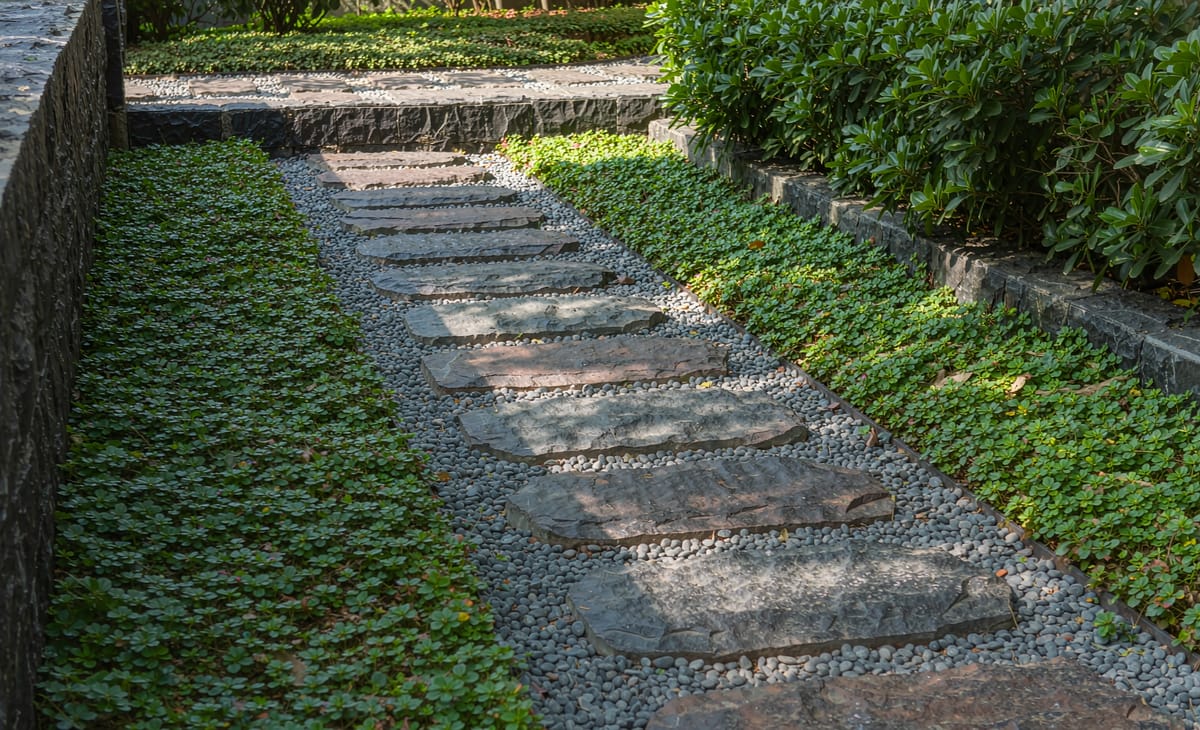
SWME TRADE · Blog
The best decorative gravel for a garden pathway is washed 10–20 mm sub-angular to angular crushed stone laid 30–40 mm deep between a rigid edge restraint over a compacted base with geotextile — about 45–50 kg per square metre at 30 mm. This guide covers size and shape underfoot, hotel landscaping routes, coverage per square metre and per running metre, the edge details where paths fail, and bulk MOQ, packing and pre-shipment checks.
Published · By Gardenstone Editorial Team · Educational article from the SWME TRADE team
The best decorative gravel for a garden pathway is washed 10–20 mm sub-angular to angular crushed stone, laid 30–40 mm deep between a rigid edge restraint over a compacted base with a geotextile membrane underneath. That depth works out at roughly 45–50 kg per square metre, and one 20 ft container carries about 24–27 tonnes — enough for roughly 430–500 linear metres of a 1.2 m wide path.
A pathway is judged differently from a planted bed or a driveway, and that is why the specification cannot simply be copied from either. A bed is looked at; a driveway is driven on; a path is read at walking pace, felt through the soles of the shoes, and crossed several times a day in every season. So three questions decide whether a gravel pathway succeeds: does the surface stay firm underfoot instead of shifting, does the path hold its line at the edges instead of bleeding into the lawn, and can the material be reproduced lot after lot so a top-up in year three still matches.
Answer those three and the size band, the depth and the edge detail all follow — and they are the same three questions a hotel, a resort or a public garden is asking, only with more footfall and higher expectations.
For a loose (unbound) footpath, 10–20 mm is the workhorse band: small enough to walk on comfortably, large enough not to stick to shoes or migrate with surface water. A 6–10 mm band reads finer and suits formal paths, but on a loose surface it tracks indoors on wet soles and is easily displaced by a hose or a storm — which is why 6–10 mm is normally reserved for resin-bound or otherwise stabilised surfaces rather than loose ones. Above 20 mm the path starts to feel like a driveway underfoot; keep 20–40 mm for service routes and 40–70 mm for drainage and beds nobody crosses.
Shape decides comfort as much as stability. Angular crushed stone interlocks and holds a firm, raked surface — the functional choice — but its sharp edges are felt through thin soles and are unpopular beside pools or on barefoot routes. Sub-angular stone is the usual commercial compromise: it still locks reasonably well at 30–40 mm depth over a compacted base, but reads softer and walks easier. Whichever you choose, state the shape in the purchase order as angular, sub-angular or rounded, and cap fines and dust at or under 1–2% after washing — dust is what turns a dry path to paste in rain and what walks into a lobby on wet shoes.
One more detail separates a path from a road visually: width and band consistency. A tight single size band laid in a clearly edged line reads as a walkway even before anyone steps on it, while a broad mixed grading spread edge-to-edge reads as spilt material. Buy the path band as one nominal size with a stated within-band percentage (90–95% is a normal commercial position), not as a general-purpose mix.
For hotel and resort landscaping, the best specification separates primary routes from everything else. Main arrival paths, pool decks and service crossings are walked in heels and soft-soled shoes, crossed by luggage trolleys, housekeeping carts and occasionally cleaning machines — so those routes should be stabilised, not loose: either a resin-bound surface with 6–10 mm kiln-dried aggregate over a permeable base, or a grid-stabilised 10–20 mm gravel. Loose 10–20 mm stone then belongs on the planted beds, margins and secondary garden walks behind rigid edges, where its texture is the point and traffic is light.
Colour logic is different at a hotel than in a private garden. Very pale stone shows litter, leaf tannin, tyre marks from delivery trolleys and every splash of mulch; very dark stone shows lime-scale from irrigation, dust and every footprint in the dry season. Mid-tones — warm greys, buffs, mixed river tones — hide ordinary wear longest, which matters when housekeeping covers several hectares. Check the colour at night too: pale wet gravel under path lighting can glare and flatten the planting, so approve the sealed wet sample under the actual luminaires, not only in daylight.
Hotels also buy on a programme, not in one drop. Wings are refurbished in phases, and a path topped up in year three has to match the surface guests walked in year one — so hold a sealed wet 1 kg reference signed by both parties, keep a labelled retention sack from every production lot, and put the lot reference on every container's packing list. That paperwork costs nothing at order time and is the only defence when a phased top-up no longer matches.
Specify a loose gravel pathway at 30–40 mm of stone over a compacted base with a geotextile membrane between stone and soil. At 30 mm you get a surface that holds together and can be raked flat; at 40 mm it stays looser under heavier use but consumes a third more stone. Bulk decorative gravel runs at roughly 1.5–1.6 tonnes per cubic metre, so 30 mm of depth needs about 45–50 kg per square metre — one tonne covers roughly 20–22 m² — and 40 mm needs about 60–68 kg per square metre, or roughly 15–16 m² per tonne. Add 5–10% on top for compaction, settlement and edge build-up.
Because a path is linear, buy it by the running metre as well. A 1.2 m wide path at 30 mm depth consumes about 54–58 kg per linear metre, so one tonne lays roughly 17–18 running metres, and one 20 ft container of 24–27 tonnes dresses roughly 430–480 linear metres of that path. Do this arithmetic before ordering, because pathways are the surface where projects most often under-order: the bed areas are estimated by area, the paths are forgotten, and the second container is ordered mid-project at a worse rate.
Where a scheme mixes a fine path band with a coarser bed or drainage band, quote each area separately instead of averaging. The coarser band consumes noticeably more tonnage for the same coverage, and an averaged rate hides exactly the line item that will overrun.
Loose gravel spreads sideways at roughly the rate traffic displaces it, so an unrestrained path narrows season by season while the adjacent lawn or bed thickens with imported stone. A rigid edge restraint — steel edging, concrete kerb, stone setts or a heavy mowing strip — is not a finishing detail; it is the component that keeps the path a path. Where a gravel path meets a lawn, a flush mowing strip also saves the maintenance crew from trimming gravel-contaminated grass edges by hand every visit.
Under the stone, the two layers people skip are the ones that decide whether the path pumps in winter. Gravel tipped straight onto soil presses into the ground under footfall, clay works up through it, and the wheel lines of delivery trolleys become ruts that hold water. A compacted granular base, with a geotextile membrane separating it from both the soil and the gravel, keeps the stone clean and structurally separate — the difference between a path that needs an annual rake and top-up and one that is re-laid after two winters.
Finally, plan the transitions. At doorways and lobbies, a 1–2 m apron of bound surface or paving stops stone tracking indoors; at steps, set the gravel behind a riser so it does not creep down the flight; and wherever the path crosses a drain or channel, fit a grate set flush in a hard edge, because loose gravel migrates into gullies surprisingly fast.
Wholesale decorative gravel normally starts at one 20 ft container, about 24–27 tonnes, or roughly 1,200–1,350 × 20 kg bags loose-loaded. Ask for the minimum order quantity per size band rather than per product line: a supplier who will combine the 10–20 mm path band with a 20–40 mm bed band and one accent colour in a single container is quoting a different commercial position from one who will not, and the two offers cannot be compared on headline price alone.
Packing should follow the site. For merchant resale and distributed projects, 20–25 kg PP bags on pallets with a printed grade label stack and count easily; for direct delivery to one site, one-tonne FIBC bags cut handling to a forklift operation; where the site can receive a tipping trailer, loose loading in a lined container is the cheapest way to buy tonnage because every pallet removed is volume given back to stone. Confirm the pack split before quoting — it changes both per-tonne economics and site labour.
Then verify before the container ships: sieve-check the path band against the nominal band from a sample drawn from production, run a wash test against the agreed fines limit, compare a wet 1 kg scoop from three different pallets against the sealed reference, spot-check bag mass on at least five bags per lot, and photograph the loaded container with the date and lot reference. Gravel approved from a dry photograph routinely arrives looking like a different material after the first rain — wet comparison against a signed sample is what prevents that dispute, and it is the same check that protects a phased hotel top-up three years later.
Use washed 10–20 mm sub-angular to angular crushed stone laid 30–40 mm deep between a rigid edge restraint, over a compacted base with a geotextile membrane. That is roughly 45–50 kg per square metre at 30 mm depth. Keep 20–40 mm for service routes and reserve 6–10 mm for resin-bound or stabilised surfaces, because loose fine gravel tracks on shoes and washes out of place.
At roughly 1.5–1.6 tonnes per cubic metre, a 30 mm pathway layer needs about 45–50 kg per square metre, so one tonne covers roughly 20–22 m². A 40 mm layer needs about 60–68 kg per square metre, or roughly 15–16 m² per tonne. Add 5–10% for compaction, settlement and edge build-up, and order paths by the running metre: a 1.2 m wide path at 30 mm uses about 54–58 kg per linear metre.
A 20 ft container carries about 24–27 tonnes of decorative gravel. A 1.2 m wide pathway at 30 mm depth consumes roughly 54–58 kg per linear metre, so one container lays approximately 430–480 linear metres of path. Palletised bag loads cover less area than loose loading because pallets consume volume, so confirm the packing format before converting tonnage into metres.
Separate primary routes from beds. Main arrival paths, pool decks and service crossings should be stabilised — resin-bound 6–10 mm aggregate or grid-stabilised 10–20 mm gravel — because they carry luggage trolleys, housekeeping carts and heels. Loose 10–20 mm gravel suits planted beds and secondary walks behind rigid edges. Choose mid-tones rather than very pale or very dark stone, approve the sealed wet sample under the actual path lighting, and keep per-lot retention sacks so phased top-ups still match.
“ISO 9001 is a globally recognized standard for quality management. It helps organizations of all sizes and sectors to improve their performance, meet customer expectations and demonstrate their commitment to quality.”
ISO, ISO 9001:2026 “Quality management systems — Requirements” — official page
Pathways combine the functional and decorative sides of landscaping stone: the surface must stay stable underf…
Hotel and resort landscapes are commercial projects with residential finish quality: large areas, premium appe…
Japanese garden design uses stone as its structural vocabulary: larger stones placed as islands and mountains,…
Commercial landscaping is the volume end of the stone trade: office parks, public spaces, housing developments…
Everflorae — Artificial Plants & Trees
From the same supplier group, Everflorae supplies UV-stable artificial trees, palms and green walls that pair with stone — one source for hotels, resorts, malls and Japanese gardens.
Send your product, specification and destination — our sales team will prepare a quotation.