 SWME TRADE
Commercial Landscaping
Commercial landscaping is the volume end of the stone trade: office parks, public spaces, housing developments…
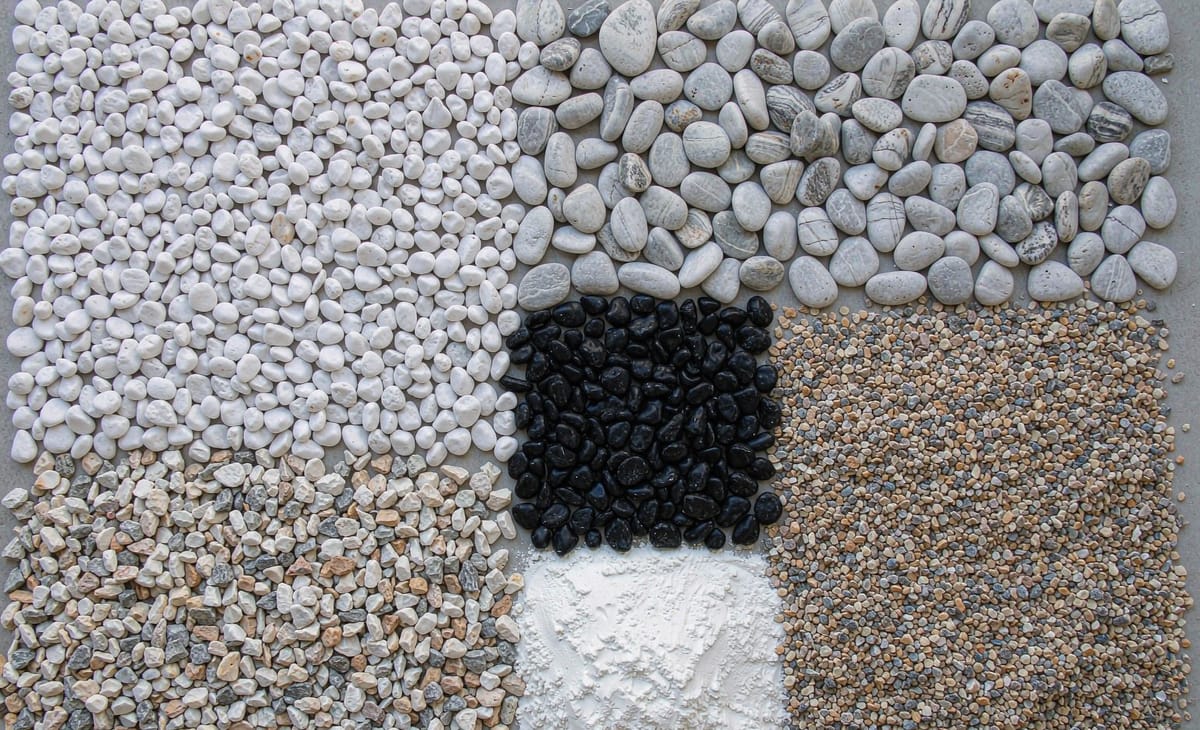
SWME TRADE · Blog
The best garden gravel for commercial landscaping is washed, angular or sub-angular stone screened into a single tight band: 10–20 mm for paths and planted beds, 20–40 mm for driveways and general surfaces, and 40–75 mm for drainage, swales and wide low-maintenance zones. This guide covers how gravel differs from pebbles, which size band suits which job, a specification you can enforce on a purchase order, coverage per square metre, and buying garden gravel in bulk from a supplier.
Published · By Gardenstone Editorial Team · Educational article from the SWME TRADE team
The best garden gravel for commercial landscaping is washed, angular or sub-angular stone screened into one tight size band: 10–20 mm for paths and planted beds, 20–40 mm for driveways and general surfaces, and 40–75 mm for drainage, swales and wide low-maintenance zones. Allow roughly 70–80 kg per square metre at 50 mm depth, and plan on a 20 ft container carrying about 24–27 tonnes.
The reason angular stone wins most commercial specifications is physical rather than aesthetic. Angular gravel interlocks, so it resists displacement under footfall, trolleys and light vehicles, drains freely, and stays where it was spread instead of migrating into gullies and lawn edges. Rounded decorative pebbles are the better material for beds you want to rake and admire, but on a surface that has to carry traffic and survive a wet winter, gravel is the functional choice.
That distinction matters more on a large scheme than on a domestic one, because a commercial site is maintained by a contractor working to a programme. A surface that needs re-levelling every quarter becomes a recurring cost line, and the difference between a bound-looking interlocked gravel surface and a loose migrated one is usually decided by the size band and the sub-base, not by the colour of the stone.
Gravel is crushed or screened stone with sharp or partly rounded faces; pebbles are water-worn or tumbled stone that is smooth and rounded. Both are natural, both are washed and graded, and both are sold by the tonne — but they behave differently once laid. Gravel locks together and carries load; pebbles roll and read as decoration. Mixing the two in one specification is the most common reason a commercial bed looks wrong six months after handover.
Within gravel there are three working families. Crushed angular gravel is quarried rock passed through a crusher, with sharp faces that interlock and compact — the standard material for driveways, sub-bases and drainage. Sub-angular or partly weathered gravel has softer edges and reads more naturally, which suits garden paths and planted beds where a hard engineered look is unwanted. Graded river gravel is screened from a natural deposit, so the particles vary more in shape and diameter; it looks softer but compacts less predictably, so it needs a firmer edge restraint.
The practical test is to pick up a handful and try to compact it in the palm. Angular gravel resists and holds a shape. Rounded gravel slides through the fingers. That single test tells you which surfaces the material is suitable for before you write a single line of the specification.
Size band decides drainage, stability, foot comfort and how much material a square metre consumes. The bands worth quoting for commercial work are 6–10 mm, 10–20 mm, 20–40 mm and 40–75 mm, with 75 mm and above treated as rock rather than gravel.
Match the band to the job. 6–10 mm is a fine finishing grade for resin-bound surfaces, narrow joints and the top of a bound path; it is comfortable underfoot but tracks on shoes and is easily displaced by water flow. 10–20 mm is the commercial workhorse for footpaths, planted beds, tree pits and roof-level or courtyard areas: small enough to walk on, large enough to stay put, and the usual choice when a scheme wants a tidy, even surface. 20–40 mm is the standard driveway and general-surface band, taking light vehicles without rutting when laid over a compacted sub-base, and it is also the safest band for public areas where maintenance crews use blowers and rakes.
Above that, 40–75 mm is a drainage and infrastructure material: French drains, soakaways, swales, permeable borders around buildings and the wide low-maintenance zones on industrial and hotel schemes where nobody walks. Larger stone reads well from a distance and will not wash away in a storm, but it is unpleasant to walk on and awkward to rake, so it should not be specified for a surface anyone crosses.
One clause prevents most disputes: state the size band in millimetres as a sieve band with a within-band percentage, typically 90–95% inside the nominal band and the remainder in one adjacent band. Without that number, a 20–40 mm order can arrive containing enough 60 mm stone to damage a mower and enough fines to turn the surface to paste in the first rain.
Choosing garden gravel is really deciding what the purchase order can measure on a delivered sample. Write the order against numbers rather than adjectives and every later disagreement becomes a measurement instead of an opinion. A workable commercial specification covers six items.
Size band in millimetres with the within-band percentage stated and an explicit cap on oversize particles, which is what actually damages maintenance equipment. Fines and dust content, normally held at or under 1–3% after a standard wash test, because fines are weight you pay freight on and the material that turns a free-draining surface into a crust. Washed condition, stated explicitly, since unwashed gravel arrives with a clay haze that never fully rinses off once it is spread. Angularity, described as angular, sub-angular or rounded, because that single word determines whether the surface interlocks or migrates. Colour held against a sealed wet reference sample signed by both parties, with the off-reference share counted across three random scoops from different pallets rather than from one open bag. And unit mass tolerance of about ±1% on a 20–25 kg bag or ±1–2% on a one-tonne jumbo bag.
Two clauses do the heavy lifting on phased projects. First, approval samples must be drawn from production rather than from the sample room, because a hand-picked sample and the production stream are not the same material. Second, lot retention: keep a labelled reference sack from every production lot so grading or colour drift surfaces in container two rather than on site in container eight, when the first few hundred square metres are already laid and cannot be matched. Judging colour wet is not a nicety — gravel approved from a dry container photograph regularly arrives looking like a different product after the first week of rain.
For a driveway, the best garden gravel is 20–40 mm angular or sub-angular stone laid at a compacted 50–75 mm depth over a compacted permeable sub-base, with the fall running across the drive rather than down it and a bound apron for the first 1–2 m where the drive meets the road so stone does not track onto the highway.
The sub-base is the part that is usually skipped and always regretted. Gravel tipped directly onto soil pumps: the stone is pressed into the ground under load, clay works up through it, ruts form along the wheel lines, and within one season the surface holds water in the tracks. A compacted sub-base with a geotextile membrane between it and the gravel keeps the stone clean and structurally separate from the ground, which is what makes the difference between a drive that survives five years with an annual top-up and one that is re-laid after one winter.
Angular stone is not optional on a driven lane. Rounded gravel rolls out from under a tyre, which is why decorative pebble drives rut so quickly, and why the standard remedy — raking it back — needs repeating indefinitely. Where a client wants the softer look of rounded stone, the workable answer is a bound surface: resin-bound or grid-stabilised 6–10 mm or 10–20 mm gravel over a permeable base, which takes foot and light-vehicle traffic and still reads as gravel. Loose rounded stone then belongs on the verges and margins behind a rigid edge restraint, not on the lane itself.
Edging is the third component. Without a rigid restraint — steel, concrete, stone setts or a heavy timber edge — loose gravel spreads sideways at roughly the rate it is displaced by traffic, so the drive narrows and the adjacent bed thickens. Specify the edging in the same package as the stone, because it is the cheapest item to include at the start and the most disruptive to add later.
Buy by depth and show the arithmetic in the enquiry, so both sides can check it. Gravel runs at roughly 1.4–1.6 tonnes per cubic metre depending on rock type and grading, with dense basalt and granite at the top of that range and lighter limestone below. On that basis a 30 mm bed needs about 45–50 kg per square metre, so one tonne covers roughly 20–22 m². A 50 mm bed needs about 70–80 kg per m², or around 13–14 m² per tonne, and a 75 mm drainage layer needs about 105–120 kg per m², or roughly 8–9 m² per tonne. Add 5–10% for compaction, settlement, edge build-up and later top-ups.
The same arithmetic is the only honest way to compare quotations that arrive in different units. A rate per 20 kg bag and a rate per 25 kg bag are not the same product, and the gap disappears once both are converted to cost per tonne and then to cost per square metre at the specified depth. Where a scheme mixes a fine footpath band with a coarse drainage band, price each area separately rather than averaging, because the coarse band consumes noticeably more tonnage for the same coverage.
Container capacity follows the same logic. A 20 ft container takes about 24–27 tonnes of gravel, or roughly 1,200–1,350 × 20 kg bags when loose-loaded, and about 1,000–1,150 bags if palletised, because pallets consume volume that loose loading gives back to stone. At 50 mm depth one container dresses roughly 320–380 m² of surface, so area-heavy schemes are usually weight-limited rather than volume-limited. Always quote with the destination port in the enquiry, because the freight component changes the delivered figure more than the material does.
Wholesale garden gravel normally starts at one 20 ft container, about 24–27 tonnes, or roughly 1,200–1,350 × 20 kg bags loose-loaded. Ask for the minimum order quantity per size band rather than per product line, because a garden gravel supplier willing to mix two bands and one colour inside a single container is quoting a different minimum from one that will not, and the two quotations are otherwise not comparable. On project supply it is normal to combine gravel with pebbles, sand and larger rock in one shipment, which suits a contractor delivering a drive, a path and a planted bed on the same programme.
Packing should follow where the stone is going. For retail and merchant resale, 20–25 kg PP bags on pallets with a printed grade label hold up and stack better than jumbo bags. For direct project delivery, one-tonne FIBC bags cut the bag count and the handling on site, though they need a forklift or telehandler once they land. For large open areas that can receive a tipping trailer, loose loading in a lined container is the cheapest way to buy tonnage, since every pallet and bag you remove is volume handed back to stone.
On landed cost, treat four factors as the real price drivers instead of the headline rate. Rock type sets density, and therefore how many square metres a tonne actually dresses, so the cheaper material per tonne is not automatically cheaper per square metre. Size band and washing move the price more than colour does for gravel, because a tight single-size washed grade costs more to produce than a broad unwashed one. Washing quality changes both the appearance and how much dust you are paying to ship. And because gravel is heavy and low-value per tonne, ocean freight plus inland haulage is a large share of the delivered figure, so ask for the quotation split into material, packing and freight to your port.
Use washed angular or sub-angular stone screened into one tight band: 10–20 mm for footpaths, planted beds and tree pits, 20–40 mm for driveways and general surfaces, and 40–75 mm for drainage, swales and wide low-maintenance zones. Allow roughly 70–80 kg per square metre at 50 mm depth, and plan on a 20 ft container carrying about 24–27 tonnes.
Use 20–40 mm angular or sub-angular gravel at a compacted 50–75 mm depth over a compacted permeable sub-base with a geotextile membrane, a rigid edge restraint, the fall running across the drive rather than down it, and a bound apron for the first 1–2 m where the drive meets the road. Rounded gravel rolls out from under tyres and should be kept on the verges or used in a resin-bound surface instead.
At roughly 1.4–1.6 tonnes per cubic metre, a 30 mm bed needs about 45–50 kg per square metre, so one tonne covers around 20–22 m². At 50 mm it is about 70–80 kg per m², or roughly 13–14 m² per tonne, and at a 75 mm drainage depth about 105–120 kg per m², or around 8–9 m² per tonne. Add 5–10% for compaction, settlement and spillage.
Gravel is crushed or screened stone with sharp or partly rounded faces that interlock and carry load, so it suits driveways, paths, drainage and sub-bases. Pebbles are water-worn or tumbled stone that is smooth and rounded, reads as decoration and is easy to rake, but rolls under footfall and tyres. Test by compacting a handful in the palm: angular gravel holds a shape, rounded gravel slides through the fingers.
“Trade Map provides comprehensive global trade data for over 230 economies, with monthly, quarterly and yearly updates using official reported data and mirror data techniques.”
ITC Trade Map, trademap.org — official page
Commercial landscaping is the volume end of the stone trade: office parks, public spaces, housing developments…
Pathways combine the functional and decorative sides of landscaping stone: the surface must stay stable underf…
Hotel and resort landscapes are commercial projects with residential finish quality: large areas, premium appe…
Garden landscaping brings together every stone category: ground cover for beds and borders, gravel for paths, …
Everflorae — Artificial Plants & Trees
From the same supplier group, Everflorae supplies UV-stable artificial trees, palms and green walls that pair with stone — one source for hotels, resorts, malls and Japanese gardens.
Send your product, specification and destination — our sales team will prepare a quotation.