 SWME TRADE
Garden Landscaping
Garden landscaping brings together every stone category: ground cover for beds and borders, gravel for paths, …
SWME TRADE · Blog
Mixed color pebbles have no single per-ton price — a mix is a recipe of separately screened colour fractions plus blending labour. See why a mix can cost more than one colour, how the white fraction hides cost cuts, and how to check a mixed quote fairly.
Published · By Gardenstone Editorial Team · Educational article from the SWME TRADE team
There is no single per-ton price for mixed color pebbles, because a mix is a recipe, not a product: you are buying several separately screened colour fractions plus the labour to blend them. The stone itself costs the same as the single-colour equivalent of the same rock and size; each extra colour adds a sorting pass and yield loss, the rarest fraction sets the price floor, and freight still runs 60–80% of the landed cost on a 24–27 tonne container.
So the honest answer is a formula, not a number. A fair mixed-colour quote should decompose into the weighted per-tonne price of each colour fraction, plus a blending and quality-control charge, plus packaging and freight. If a supplier cannot break the mix down that far, you are not looking at a price — you are looking at a guess with a colour photo attached.
Because every fraction is screened out of the same raw feed separately, the yield losses stack. A single-colour order takes one raw tonnage and keeps part of it; a four-colour mix runs that raw material through four sort passes, and every pass discards oversize, undersize and off-tone stone for each fraction in turn. You are paying for the whole raw tonnage while each colour keeps only its own recovery — that is why a 4–5 colour mix routinely prices above the same stone in a single colour, not below it.
The cheap colours do not dilute the expensive one either. Fractions are priced individually and weighted by the recipe, so a low-cost tan fraction sitting next to a scarce green or black fraction does not average the price down — it just adds its own screening and inventory cost on top. Each added colour also means another stockpile to keep apart, another QC check, and another stock line that can drift out of ratio, and the factory prices that handling into the ton.
A commercial mix is specified by ratio, and the ratio drives the work. The usual structure is a main tone at 50–60% of batch weight, one or two secondary tones at 25–35% combined, and accent colours at 5–15% each. Two- and three-colour mixes are the value sweet spot: enough contrast to read as 'mixed' from two metres away, with the fewest sort passes and the least inventory fragmentation.
The accent fractions carry hidden weight in the arithmetic. A 10% accent in a 25-tonne container is 2.5 tonnes — which can fall below that colour's standalone production minimum, forcing a small batch premium onto the whole mix. And every fraction must be held to a tolerance, typically ±5 percentage points per colour, because tonnage that drifts off ratio is real money: the buyer specified a look, and off-ratio stone is not the look that was paid for.
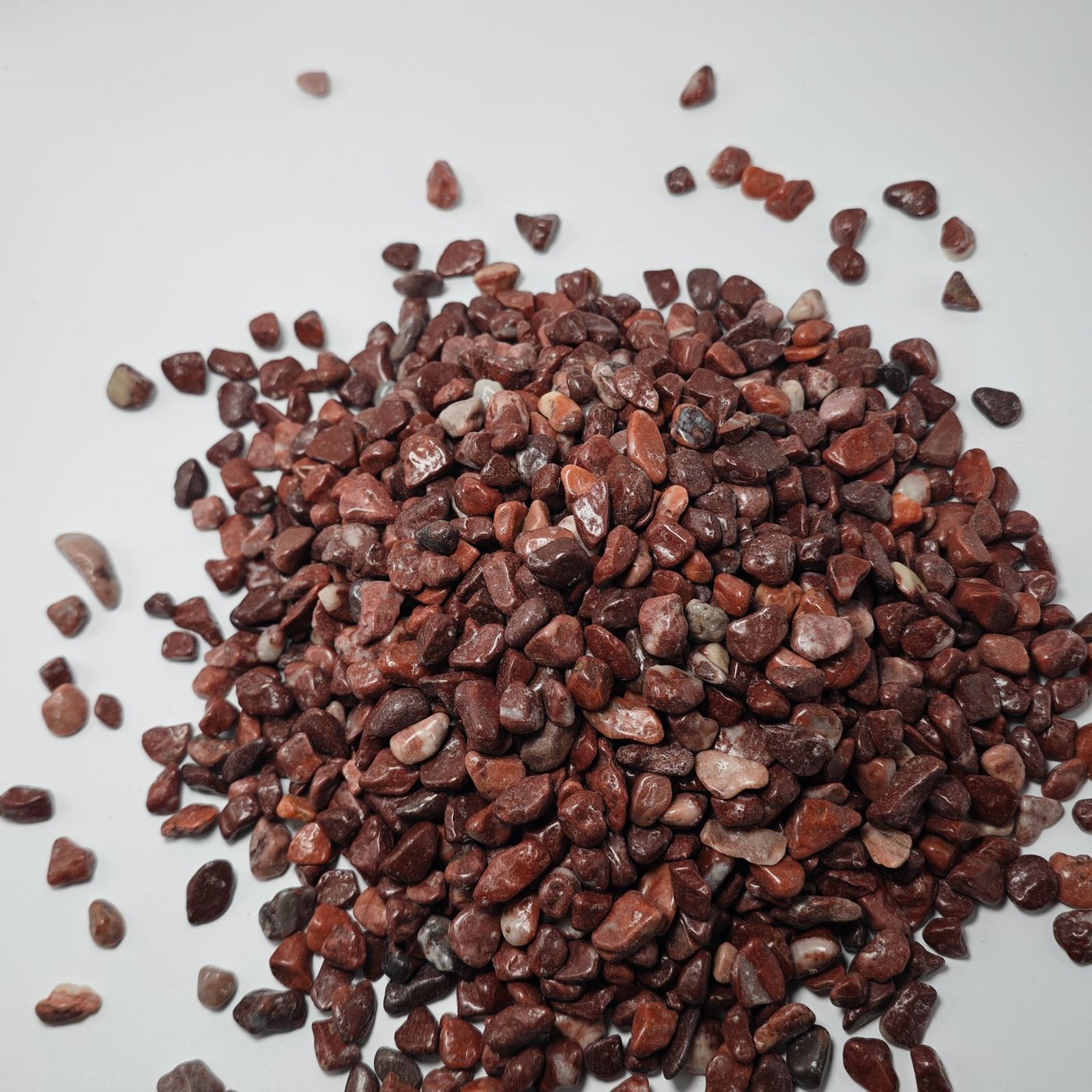
Often, yes. White is the most expensive stable colour to supply, so the cheapest mixed quotes quietly substitute white marble or limestone chips — carbonate rock that costs less per tonne but yellows and greys outdoors, etches under acid cleaners, and raises pH in water features. The mix still looks right in a dry bag photo, which is exactly why the substitution survives until the second season on site.
The defence is a per-fraction rock declaration, not a colour promise. Require each colour fraction to be named by rock type — granite, quartz, river pebble, and no marble in any fraction that touches water or soil where pH matters — and verify on site with the ten-second acid drop test: carbonate foams, inert rock does not. A supplier who will not name the rock in each fraction is telling you where the price was cut.
Ask for the quote as a recipe table: each colour fraction with its weight percentage and its own per-tonne price, the blending charge, the packaging line, and the freight line under a named Incoterm. Sum it yourself and compare the total against any single-colour quote for the same rock and size band — the premium you see is the price of sorting and blending, and it should be visible, not buried. A mix quoted only as one blended number with no breakdown is a quote you cannot audit or defend.
Then pin the sample to the blend, not to the colours. Approve a wet blended-bag sample — colours photographed wet in natural light, mixed in the specified ratio — because dry single-colour samples tell you nothing about how the blend reads together, and mixing is where the value sits. Confirm the ratio tolerance in writing (±5 percentage points per fraction is normal), and remember that coverage does not change with colour: one tonne still covers about 15–17 m² at a 40 mm depth.
No — colour changes the price composition, not the physics. Mixed pebbles run the same bulk density as any decorative pebble, about 1.5–1.7 tonnes per cubic metre, so a tonne covers roughly 15–17 m² at 40 mm, 12–13 m² at 50 mm, and 8–9 m² at 75 mm. A 20 ft container still takes 24–27 tonnes before it is volumetrically full — about 1,200–1,350 bags of 20 kg — and palletised loads give up 10–15% of that payload.
What does change is how the mix is supplied, and it has a cost line. Pre-blended bags arrive ready to open and spread, with the ratio verified bag by bag at the factory; single-colour bags mixed on site cost less to produce and verify per colour, but push the blending labour and the ratio risk onto your crew. For a one-visit landscape install, pre-blended usually wins on total cost; for a reseller stocking shelves, single-colour lines give more SKUs per tonne and less dead stock.
Seven lines carry the risk on a mix. State the recipe: each colour fraction with its weight percentage and a ±5 percentage point tolerance. Declare the rock type per fraction and bar dyes, coatings and wax across the whole blend. Fix the size band with explicit oversize and undersize limits, and the fines limit near 1%. Put moisture on a dried-weight basis, and require a wet blended-bag sample sealed at loading, photographed next to a white tray.
Then close the loop at loading. Require a random three-bag check — weigh each bag and estimate the colour ratio against the recipe — plus the usual reconciliation of total bags times net weight against declared tonnage, a 30–60 day price validity with a freight escalation cap, and retained samples from the production batch. On a mix, the paper trail is the product: the blend is only as good as the last ratio that was actually checked.
There is no single per-ton price, because a mix is priced as a recipe: each colour fraction carries its own screened per-tonne price, weighted by ratio, plus a blending charge, packaging and freight. The stone matches its single-colour equivalent, each extra colour adds a sorting pass, the rarest fraction sets the floor, and freight runs 60–80% of landed cost on a 24–27 tonne container.
Because the yield losses stack. Each colour is screened separately from the same raw feed, so a four-colour mix runs four sort passes and each pass discards oversize, undersize and off-tone stone per fraction. The cheap colours do not dilute the expensive one — fractions are priced individually — and each added colour adds stockpile separation, QC and inventory cost that the factory prices into the ton.
Specify a main tone at 50–60% of batch weight, one or two secondary tones at 25–35% combined, and accent colours at 5–15% each, with a tolerance of ±5 percentage points per fraction. Two- and three-colour mixes are the best value; four or five colours multiply sorting passes, and a small accent fraction can fall below that colour's standalone production minimum and force a batch premium.
No. Colour changes the price composition, not the bulk density. Mixed pebbles run about 1.5–1.7 tonnes per cubic metre, so one tonne covers roughly 15–17 m² at a 40 mm depth, 12–13 m² at 50 mm and 8–9 m² at 75 mm — the same coverage as the same rock in any single colour.
“Trade Map provides comprehensive global trade data for over 230 economies, with monthly, quarterly and yearly updates using official reported data and mirror data techniques.”
ITC Trade Map, trademap.org — official page
Garden landscaping brings together every stone category: ground cover for beds and borders, gravel for paths, …
Commercial landscaping is the volume end of the stone trade: office parks, public spaces, housing developments…
Everflorae — Artificial Plants & Trees
From the same supplier group, Everflorae supplies UV-stable artificial trees, palms and green walls that pair with stone — one source for hotels, resorts, malls and Japanese gardens.
Send your product, specification and destination — our sales team will prepare a quotation.