 SWME TRADE
Commercial Landscaping
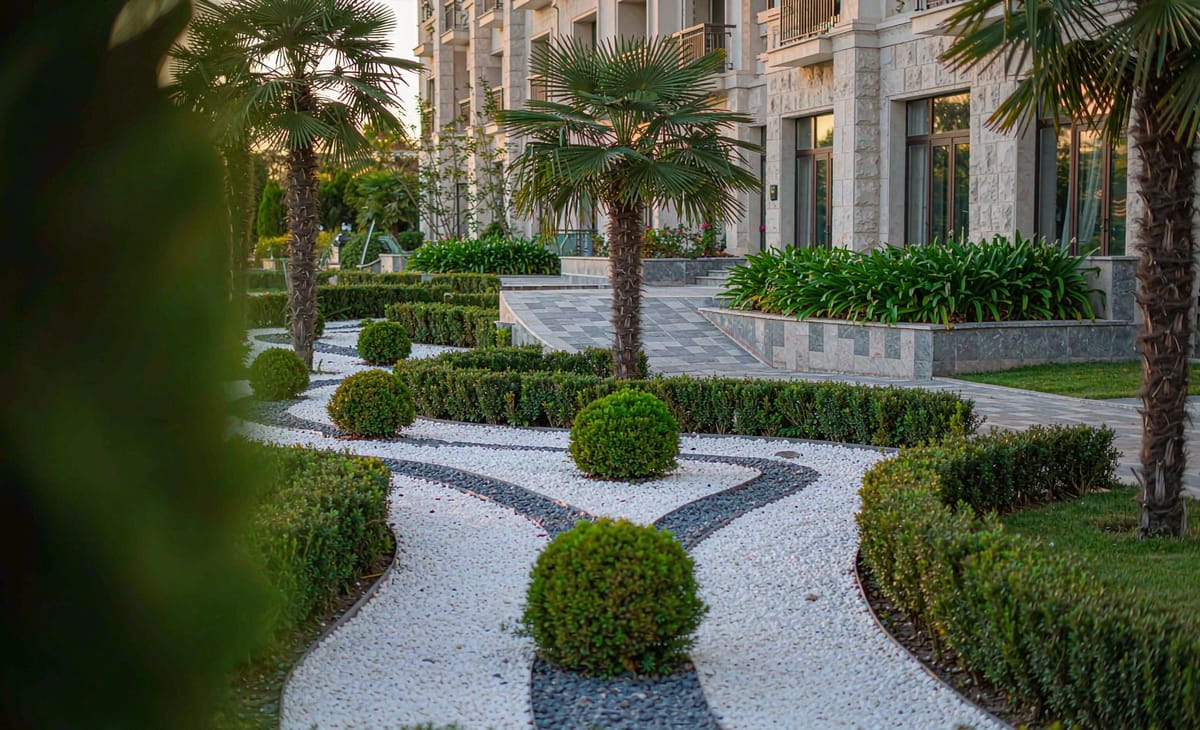
Commercial landscaping is the volume end of the stone trade: office parks, public spaces, housing developments…
SWME TRADE · Blog
Landscape gravel in bulk is bought by function first and by grain band second: decide whether the gravel has to dress a bed, carry a wheel or move water, then fix the band, the fines limit and the packing. Crushed gravel runs at roughly 1.4–1.6 tonnes per cubic metre, a 30 mm dressing needs about 42–48 kg per square metre, and one 20 ft container carries about 24–27 tonnes. This guide covers what makes landscape gravel a separate trade category, the washed versus as-dug decision, size bands by function, coverage and drainage arithmetic per linear metre, how to vet a landscape gravel manufacturer, and what a contractor-grade specification should contain.
Published · By Gardenstone Editorial Team · Educational article from the SWME TRADE team
Landscape gravel in bulk is bought by function first and by grain band second. Decide what the stone has to do on the site — dress a planted bed, carry a wheel, or move water — then fix the band, the fines limit and the packing format in that order. Crushed gravel runs at roughly 1.4–1.6 tonnes per cubic metre, a 30 mm dressing needs about 42–48 kg per square metre, and one 20 ft container carries about 24–27 tonnes.
Landscape gravel is not a rock type; it is a trade category. The stone itself is the same crushed and screened aggregate sold as decorative gravel. What separates the category is the specification discipline around it: the grading has to hold consistent from container one to container eight, the volume has to arrive on the phase dates the contractor planned around, and the paperwork — sieve analyses, lot references — has to be good enough to submit to a landscape architect or a municipal engineer.
That is why the buying questions change. A retail buyer asks which colour looks best in the bag. A bulk buyer of landscape gravel asks three different questions: which of the three jobs the gravel is doing on this project, whether it needs to be washed or can go as-dug, and what the supplier's plant can prove about lot-to-lot consistency. Those three answers determine the specification, and the specification determines everything else.
Decorative gravel is chosen from a colour chart; landscape gravel is chosen from a sieve chart. On a commercial project the gravel is one line item in a contractor's programme, and it has to satisfy the drawing, the budget and the delivery schedule at the same time. The category exists because project-scale work fails differently from a garden bed: a wrong colour is a complaint, but an inconsistent grading across a phased housing development or a hotel ground is a mismatched surface that cannot be corrected after handover.
In practice, buying landscape gravel means buying against a written scope. The contractor needs several related materials on one project — gravel for the structural and drainage work, pebbles for the decorative layers, sand for the joints and bedding — and consolidating them with one supplier simplifies freight, quality control and the documentation trail. The supplier who can hold grading, colour and packing constant across phases is worth more per tonne than the cheapest quotation, because the cost of a drifting lot is measured in re-worked square metres, not in tonnes.
Crushed gravel straight from the screen carries fines — dust and silt that pass through the fine screens along with the sellable band. Whether those fines are acceptable is the single most consequential decision in a bulk landscape gravel order, and it follows the function. In a compacted sub-base under a path or a car park, fines are harmless and even useful, because they help the layer bind and lock. In anything where water is the design intent, fines are the failure mechanism: they clog the geotextile, settle into the pipe bedding, and pump up to the surface as a grey slurry after the first heavy rain.
So specify fines as a number, not as the word clean. A drainage-grade order should state the percentage passing the 63 micron sieve or an equivalent dust and silt limit, and the delivery should be washed material. The field check is simple enough to run during a pre-shipment visit: rub a damp handful between your palms — washed gravel leaves them mostly clean, dusty gravel coats them in a visible film that will end up in the drain. Washing adds cost in water, handling and drying time, but on drainage and permeable work it is not negotiable, and the washed premium is a fraction of the cost of digging out a clogged French drain two years later.
Three working bands cover nearly all landscape gravel scopes, and the choice follows the function. The 4–10 mm fine band is the decorative topping grade: raked beds, joints between paving, contrast bands next to darker surfacing — areas that are viewed closely and never trafficked. The 10–20 mm band, ordered single-size and washed, is the drainage grade: French drains, soakaways, the stone envelope around a perforated pipe, backfill behind retaining walls and the drainage layer under green roofs. The 20–40 mm band is the structural grade for driveways, car park edges and permeable bases, where the angular pieces interlock into a load-spreading crust.
The drainage band deserves one extra sentence in the specification: single-size, not graded. A single-size stone leaves connected voids for water to travel through; a continuously graded stone packs tighter, which is exactly what you want on a wearing course and exactly what you do not want around a pipe. This is also why bulk landscape gravel orders are usually mixed orders — one band for the drainage, one for the surface — and why the supplier's willingness to combine two or three bands inside one container, with each band kept separate in labelled packing, changes what the project can actually order.
Coverage is depth arithmetic, and it should be shown in the enquiry so both sides can check it. At a bulk density of roughly 1.4–1.6 tonnes per cubic metre, a 30 mm dressing needs about 42–48 kg per square metre, a 50 mm layer about 70–80 kg, and a 75 mm working surface about 105–120 kg. Add 5–10% for settlement, edge build-up and top-ups, and increase the depth by about 25% on any surface that carries vehicles, because gravel compacts and migrates under load.
Drainage work is measured per linear metre instead. A French drain trench 300 mm wide and 400 mm deep holds about 0.12 cubic metres of stone per metre of run; with a 100 mm perforated pipe bedded in the base, figure on roughly 160–170 kg of 10–20 mm washed gravel per linear metre once the pipe volume is subtracted. A soakaway or a stone envelope behind a retaining wall is quoted the same way — volume of the void, minus the structure, times the bulk density — so the enquiry should state the trench section, not just the area.
Container capacity closes the calculation. A 20 ft container carries about 24–27 tonnes, and crushed gravel is a dense, weight-limited cargo: the weight ceiling arrives before the volume does. That makes the loading plan part of the order on any mixed shipment — a container of drainage stone plus topping gravel plus pebbles can hit 27 tonnes while the doors still close, and a shipment planned on volume alone gets rejected at the port weighbridge.
Judge the processing plant, not the sample room. Four questions separate a producer from a trader with a stocklist: which quarry or deposit the material is crushed from; what crushing and screening plant is installed; whether the plant runs its own washing line — which decides whether it can supply drainage-grade washed material at all; and what bagging and bulk-loading capacity sits behind the quarry gate. A landscape gravel manufacturer who answers all four directly is selling its own production; one who goes quiet is adding a margin layer and a quality risk between you and the stone.
Project-scale work adds a fifth test that retail supply never needs: documentation. Ask whether the manufacturer issues a sieve analysis per production lot, retains a labelled sample from each lot, and can hold the grading and colour within a stated tolerance across a phased order. On a three-phase development, container one is a reference and container eight is the surface the client walks; a plant with lot records can prove consistency, and one without can only promise it. Finally, ask for the minimum order quantity per band rather than per product line, and confirm in writing that bands may be mixed in one container — that single clause often decides who the project's landscape gravel supplier is.
Write the order against numbers. A workable contractor-grade specification for bulk landscape gravel covers seven items: the grain band in millimetres with a sieve analysis; the washing status declared as washed or as-dug, with a fines limit for drainage grades; the base rock type, so hardness and weathering behaviour are fixed in writing; colour held as a sealed reference sample; a cap on the oversize fraction; a unit mass tolerance per bag or jumbo bag; and the packing format — 20–25 kg bags, one-tonne jumbo bags or loose loading — stated per line.
Price follows the same items. Washing, grading tightness, base rock and packing format move a quotation more than the headline rate, and because gravel is heavy, low-value freight, ocean and inland haulage are a large share of the delivered cost — which is why the honest comparison is cost per square metre at the specified depth, not per tonne. Before shipment, keep the inspection short and repeatable: draw scoops from different pallets, compare them wet and dry against the sealed reference, run a sieve check on a retained sample, and photograph washed and unwashed material side by side. Two clauses protect the rest: lot retention, so a drift surfaces in container two rather than on site, and packing integrity, because a split bag of dusty gravel is a claim, not a discount.
Decide the function first — decorative dressing, structural surface or drainage — then fix the grain band, the washing status and the packing format in that order. Crushed gravel runs at roughly 1.4–1.6 tonnes per cubic metre, a 30 mm dressing needs about 42–48 kg per square metre, and a 20 ft container carries about 24–27 tonnes. Write the sieve analysis, the fines limit and the base rock into the specification.
A 10–20 mm single-size washed gravel is the standard drainage grade for French drains, soakaways and the envelope around a perforated pipe. Single-size stone leaves connected voids for water to pass through, while a continuously graded stone packs tight and restricts flow. The material must be washed, because fines clog the geotextile and the pipe bedding.
At a bulk density of roughly 1.4–1.6 tonnes per cubic metre, a 30 mm dressing needs about 42–48 kg per square metre, a 50 mm layer about 70–80 kg, and a 75 mm working surface about 105–120 kg. Add 5–10% for settlement and top-ups, and increase the depth by about 25% on driveways and other trafficked surfaces.
Judge the plant, not the sample room: ask which quarry the stone comes from, what crushing and screening equipment is installed, whether the plant runs its own washing line, and what bagging capacity sits behind it. For project work, add the documentation test — sieve analyses per production lot, retained lot samples and a stated grading tolerance across phased deliveries — and confirm the MOQ per band and whether bands can be mixed in one container.
“Trade Map provides comprehensive global trade data for over 230 economies, with monthly, quarterly and yearly updates using official reported data and mirror data techniques.”
ITC Trade Map, trademap.org — official page
Commercial landscaping is the volume end of the stone trade: office parks, public spaces, housing developments…
Hotel and resort landscapes are commercial projects with residential finish quality: large areas, premium appe…
Garden landscaping brings together every stone category: ground cover for beds and borders, gravel for paths, …
Pathways combine the functional and decorative sides of landscaping stone: the surface must stay stable underf…
Everflorae — Artificial Plants & Trees
From the same supplier group, Everflorae supplies UV-stable artificial trees, palms and green walls that pair with stone — one source for hotels, resorts, malls and Japanese gardens.
Send your product, specification and destination — our sales team will prepare a quotation.