 SWME TRADE
Commercial Landscaping
Commercial landscaping is the volume end of the stone trade: office parks, public spaces, housing developments…
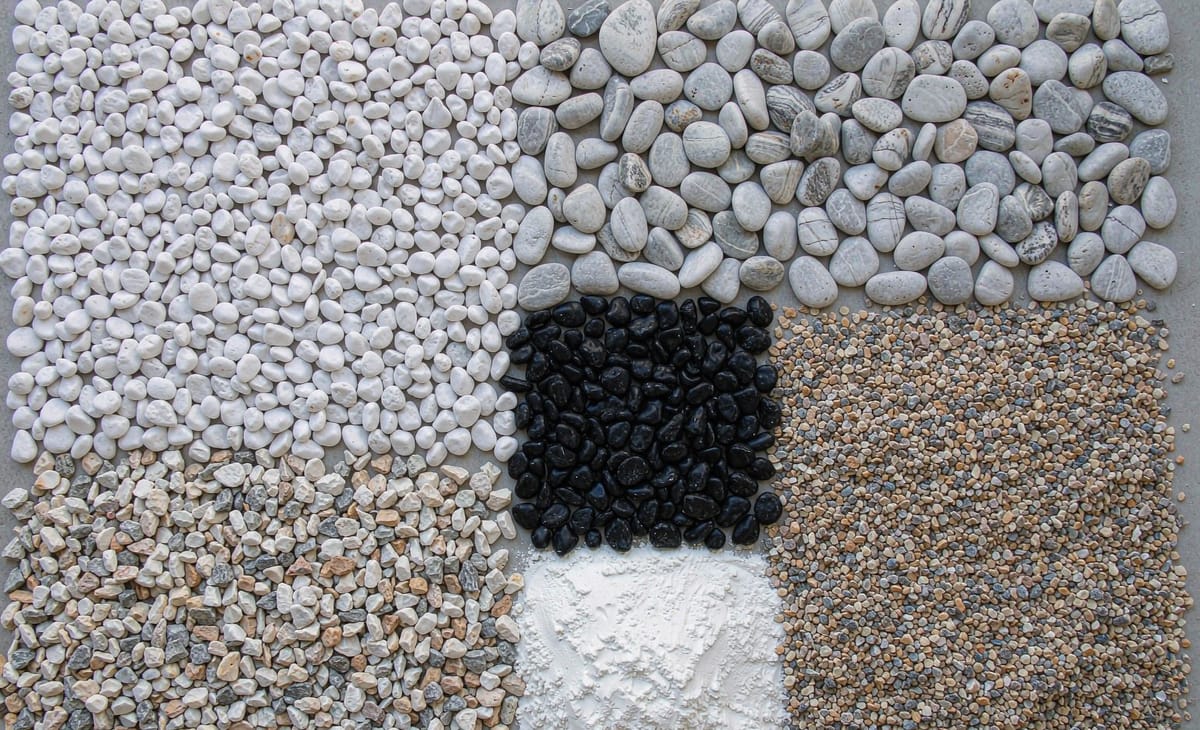
SWME TRADE · Blog
A reliable decorative pebbles manufacturer washes, grades and colour-matches stone in its own plant rather than reselling mixed stock: expect a minimum order of about one 20 ft container (roughly 24–27 tonnes), a production lead time of 15–30 days, and a retained wet reference sample per lot for consistent reorders.
Published · By Gardenstone Editorial Team · Educational article from the SWME TRADE team
The most reliable decorative pebbles manufacturer is one that washes, grades and colour-matches stone in its own plant rather than reselling mixed stock from several quarries. Expect a minimum order of about one 20 ft container — roughly 24–27 tonnes — a production lead time of 15–30 days, and a retained wet reference sample per lot so the colour you approve stays consistent across reorders and top-ups.
Everything else in this guide is about separating a real manufacturer from a trader, and about the production checks that protect your colour and grade. We cover why a factory matters for decorative pebbles, which production capabilities to verify, the typical minimum order quantity, how to lock colour and quality on paper, and the lead time and packing questions to settle before you commit.
Decorative pebbles live and die on consistency: tone, washing quality and grade spread are what the buyer actually pays for. A manufacturer that runs its own washing and grading line controls all three and can seal a wet reference sample from the exact production lot. A trader buying from whichever quarry is cheapest this week cannot promise that the second container will match the first — and for decorative work, a colour drift between deliveries is the single most expensive surprise.
You can usually tell them apart quickly. Ask for production-floor photos, a processing licence or factory audit, and a certificate of analysis tied to a specific lot. A real manufacturer answers these without hesitation and will name the rock type and the production date; a trader deflects or only ever shows the same stock catalogue photos. The margin a trader adds is small compared with the cost of a mismatched top-up order on a finished landscape.
Four capabilities define a serious decorative pebbles manufacturer. A washing line removes fines so the stone arrives clean instead of greying out after the first rain. A multi-deck sieve grades stone into tight millimetre bands — typically 6–10, 10–20, 20–40 and 40–75 mm — rather than a loose 'mixed' grade. A colour-sorting step (manual or optical) holds tone within a batch. And a finishing line supports the surface you specified, whether tumbled, polished or colour-washed.
Capacity is the practical second question. Ask the monthly throughput and whether the plant can mix several size bands or finishes inside one container, because most importers do not want 24 tonnes of a single grade they have never laid. A plant that processes around 2,000 tonnes a month with flexible lotting is large enough to hold your spec yet small enough to care about a single export order.
The typical decorative pebbles MOQ is one 20 ft container, about 24–27 tonnes loose, because stone reaches the weight limit before it fills the cube. The real constraint is rarely the total tonnage — it is the sub-minimum per size band or finish: a polished or colour-washed grade usually carries a tighter minimum than a plain tumbled band, and a custom mix may need a few tonnes of each component to be worth setting up.
Most manufacturers will split that container across two or three grades so a first order can carry, say, the 10–20 mm working band and the 20–40 mm edging band without committing to 24 tonnes of one size. Trial or sample orders of 3–5 tonnes are sometimes possible by sharing container space, and a half-container of 10–12 tonnes is a common middle step. Always lock the MOQ together with a price validity of 30–60 days, because freight and exchange rates move faster than production.
Lock quality on paper before production, not after. Your specification sheet should state the rock type, the millimetre band, the finish, and an inert (non-fizzing) requirement for any application near planting or water — a drop of dilute acid on a sample settles it: granite, quartz and basalt stay silent, limestone and marble fizz. Require a sieve analysis and a wet reference sample retained by both sides so every later top-up still matches the lot you approved.
Close with a pre-shipment inspection: a third-party or your own agent checks grade spread, washing cleanliness and colour against the sealed sample before the container is booked. For decorative work this step is cheap insurance — a container of the wrong tone is a container you cannot lay, and reselling mismatched decorative stone is far harder than reselling a commodity grade.
Production lead time from a decorative pebbles manufacturer is typically 15–30 days after sample approval and deposit, longer if a custom finish or large mixed order is involved. Packing is your choice and affects unit mass tolerance: 25 kg bags suit retail resale, FIBC jumbo bags suit project sites, and loose loading suits direct spreading at the lowest cost per tonne.
Ask for the destination-port landed cost, not just the ex-works price, because freight dominates the final number for heavy bulk stone. Confirm container loading patterns and gross weight, and request loading photos so you can verify grade and packing before the shipment sails. A manufacturer that handles export documentation and books the container with care saves more than the few dollars a trader might shave off the stone price.
Before you place the order, ask five things: can you show the production line and a lot-specific certificate of analysis; what are the exact millimetre bands and finish options; what is the MOQ per grade and can the container be mixed; what is the lead time and price validity; and will you retain a wet reference sample and accept a pre-shipment inspection. A reliable decorative pebbles manufacturer answers all five clearly and in writing.
If the answers are vague, the photos are generic, or the sample cannot be tied to a production lot, treat it as a trader and price the colour-risk accordingly. For volume sourcing, start from the wholesale buying guide and request a quote with your destination port so the landed cost is realistic from the first conversation.
Ask for production-floor photos, a processing licence or factory audit, and a certificate of analysis tied to a specific lot and production date. A real manufacturer names the rock type and lot without hesitation; a trader shows generic catalogue photos and deflects. The ability to seal a wet reference sample from the actual production lot is the clearest proof of a factory.
The typical MOQ is one 20 ft container of about 24–27 tonnes loose, because stone hits the weight limit before the cube is full. The practical constraint is the sub-minimum per size band or finish — a polished or colour-washed grade carries a tighter minimum — and most manufacturers will split the container across two or three grades. Trial orders of 3–5 tonnes or a 10–12 tonne half-container are sometimes possible.
Require a specification sheet stating rock type, millimetre band and finish, plus a wet reference sample retained by both sides from the approved lot. Use a third-party or your own pre-shipment inspection against that sealed sample, and buy the full project quantity from one production lot so colour cannot drift between deliveries. A drop of dilute acid confirms an inert, non-discolouring rock.
Production lead time is typically 15–30 days after sample approval and deposit, longer for a custom finish or a large mixed order. Lock the price validity at 30–60 days alongside the MOQ, because freight and exchange rates move faster than the production schedule, and always confirm packing, gross weight and loading photos before the container sails.
“ISO 9001 is a globally recognized standard for quality management. It helps organizations of all sizes and sectors to improve their performance, meet customer expectations and demonstrate their commitment to quality.”
ISO, ISO 9001:2026 “Quality management systems — Requirements” — official page
Commercial landscaping is the volume end of the stone trade: office parks, public spaces, housing developments…
Hotel and resort landscapes are commercial projects with residential finish quality: large areas, premium appe…
Garden landscaping brings together every stone category: ground cover for beds and borders, gravel for paths, …
Everflorae — Artificial Plants & Trees
From the same supplier group, Everflorae supplies UV-stable artificial trees, palms and green walls that pair with stone — one source for hotels, resorts, malls and Japanese gardens.
Send your product, specification and destination — our sales team will prepare a quotation.