 SWME TRADE
Zen Garden
Zen gardens reduce the landscape to three materials: raked sand or fine gravel for water and openness, selecte…
SWME TRADE · Blog
The typical MOQ for decorative sand is one 20 ft container, about 24–27 tonnes when loose-loaded, but the minimum that actually affects a buyer is the per-grain-band and per-colour sub-minimum, which is usually far lower. Most suppliers also accept a 3–5 tonne trial or a 10–12 tonne partial at a small premium, and will mix two or three bands and colours inside a single container rather than insisting on a full band per load.
Published · By Gardenstone Editorial Team · Educational article from the SWME TRADE team
The typical MOQ for decorative sand is one 20 ft container, about 24–27 tonnes when loose-loaded, but the minimum that actually affects a buyer is the per-grain-band and per-colour sub-minimum, which is usually far lower. Most suppliers also accept a 3–5 tonne trial or a 10–12 tonne partial at a small premium, and will mix two or three bands and colours inside a single container rather than insisting on a full band per load.
A 20 ft container of loose decorative sand holds about 24–27 tonnes because sand is dense and weight-limited rather than volume-limited. Wholesale suppliers price, schedule and pack around that unit, so the per-tonne rate buyers compare is almost always the one-container rate — the figure the market actually trades on.
A container, not a few pallets, is the natural order quantum because sand is cheap per tonne and heavy, so freight and handling dominate the landed cost. Below a full container the per-tonne rate rises sharply: you pay for under-used space and extra handling. Most mills and exporters will not open a production and packing line for a handful of bags, which is exactly why the realistic minimum starts at one container and steps down only on the band and colour inside it.
The minimum that matters to a buyer is usually the minimum per grain band and per colour, not the minimum per product line. A supplier may quote a full-container minimum for the whole order while still accepting, say, 3–5 tonnes of a single band or colour inside it. Always ask the per-band and per-colour minimum separately, because those are the numbers that decide whether a small or mixed order is even possible.
Colour is the bigger constraint than band in practice. A naturally coloured deposit is a different product from a colour-sorted or dyed grade, and dyed grades carry a colourfastness ceiling and a smaller, slower production run. If your scheme needs two or three colours, expect each colour to carry its own sub-minimum rather than sharing one, and budget the order around the tightest of those.
Band width matters too. A tight 0.3–1 mm raked-zen grade needs more screening and rejects more material than a wide natural run, so its per-band minimum is often higher. Pin the exact band in your enquiry so the minimum you are quoted is for the product you actually want, not a looser grade the mill would rather sell you at a lower commitment.
Decorative sand is sold loose, in 20 kg and 25 kg retail bags on shrink-wrapped pallets, or in one-tonne FIBC jumbo bags. The per-bag price is the per-tonne material rate plus packing plus the freight allocated to that packing format, so a 25 kg bag costs noticeably more per tonne than a jumbo bag, which in turn costs more than loose loading. The bag price only becomes comparable once it is converted to the same unit as everything else.
Convert the bag price to cost per square metre at your specified depth before comparing. At roughly 1.5–1.7 tonnes per cubic metre loose and dry, a 20 mm dressing needs about 30–34 kg per square metre, so one 25 kg bag covers roughly 0.7–0.8 m² at that depth. A quotation given only in bags is easy to judge once every format is converted to the same per-m² figure, whatever the supplier's native unit.
For retail resale, bagged and palletised is the right format even though it costs more per tonne, because shelf-fit and handling outweigh the material saving. For a contractor site, jumbo bags or loose loading land cheaper but need equipment to move. State the format in the enquiry so the MOQ and price you receive are for the packing you can actually handle on site.
Yes, and mixing is the normal way to keep a decorative-sand order affordable. A supplier who will combine two or three bands and colours inside a single 24–27 tonne container is quoting a very different minimum from one that insists on a full band or colour per container, so ask explicitly whether mixed loading is allowed and whether there is a per-band sub-minimum before you commit.
Mixing is also how most landscape contractors and hotel-resort schemes buy, because a raked zen area, a jointing sand and a coarse topping are three different products that together fill one container neatly. Bag or palletise each grade separately and label it clearly so the wrong material is never laid in the wrong zone during unloading.
The trade-off is inspection complexity: each band and colour in the mix needs its own wet reference and sieve check. That is manageable if the specification is written band-by-band from the start, and it is far cheaper than ordering three separate containers to hit three separate full-band minimums.
A 3–5 tonne trial of a single band and colour is a realistic opening ask, usually at a small premium to the one-container rate. It is enough to lay a representative sample area, check colour and grain against a sealed wet reference, and confirm the material behaves on site before committing to 24–27 tonnes.
Some suppliers offer a 10–12 tonne partial container, which keeps the per-tonne rate closer to the full-container baseline while still below a full load. Either route lets a buyer validate consistency across lots — the single biggest risk on a bulk sand order — without tying up capital in a full container on a first deal.
Treat the trial as the first half of the qualification process, not a one-off. Use it to agree the sealed wet reference, the sieve analysis and the inspection sheet that the later full container will be measured against, so the volume order is uneventful rather than a fresh negotiation every time.
Write the order against numbers, not adjectives. A workable decorative-sand buying specification covers grain band in millimetres or mesh with a sieve analysis, colour held as a sealed wet 1 kg reference signed by both parties, a moisture maximum on an oven-dry basis, fines and dust content, and unit-mass tolerance per bag or jumbo bag. That is the yardstick the MOQ is measured against, and it is what protects the buyer when a later lot drifts.
Ask for price validity of 30–60 days and, where freight swings, an agreed freight index ceiling, because the delivered figure moves with ocean rates more than with the sand itself. Pre-shipment inspection should draw three random scoops from different pallets, check them wet against the sealed reference, confirm the sieve analysis, and record loading photographs.
Finally, confirm the production lead time against the MOQ. A smaller minimum is worth little if it still ties up a production slot for weeks; the realistic commercial question is not just how little you can order, but how quickly and consistently the supplier can deliver it band-after-band and colour-after-colour.
Yes, across all three, provided the grain band matches the job. Fine 0.1–0.8 mm sand is the craft, terrarium and display grade, while 0.3–1 mm is the raked zen and Japanese dry-garden grade because it holds a rake line instead of slumping. For retail, control packing moisture so the sand does not cake, and test any dyed grade for bleed resistance before a volume order.
On landscape work, decorative sand works best as a topping, raked plane or jointing material over a stable base rather than as a load-bearing path surface, because a loose sand plane migrates under traffic. Pair it with edging and keep it separated from any pebble or gravel in the same container so products are never cross-laid.
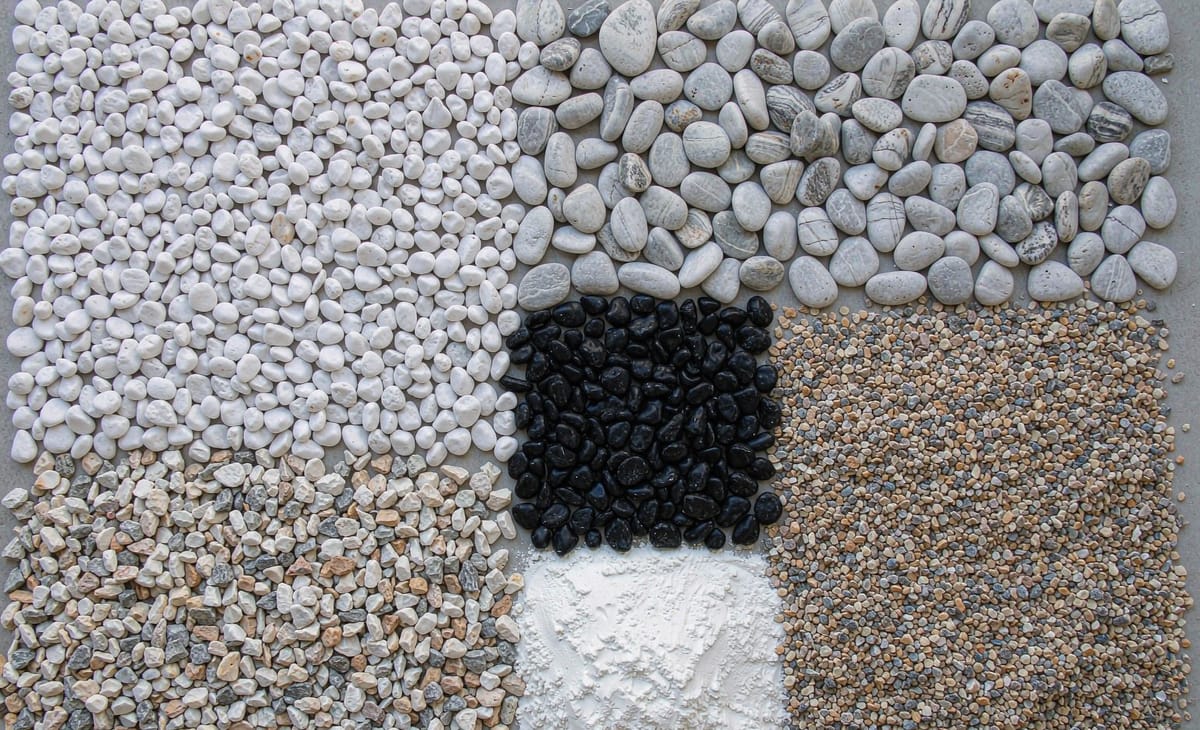
For buyers sourcing the full look, decorative sand is most often ordered alongside white sand, decorative gravel and white pebbles in a single mixed shipment, with each grade bagged or palletised separately. A supplier who can hold colour and grain across all of them inside one container is supplying a coordinated decorative palette — and that is where a sensible MOQ becomes a supply advantage rather than a hurdle.
The typical MOQ for decorative sand is one 20 ft container, about 24–27 tonnes when loose-loaded. The minimum that actually affects a buyer is usually the per-grain-band and per-colour sub-minimum, which is far lower. Most suppliers also accept a 3–5 tonne trial or a 10–12 tonne partial at a small premium, and will mix bands and colours inside a single container.
Decorative sand is sold loose, in 20 kg and 25 kg retail bags on pallets, or in one-tonne FIBC jumbo bags. The per-bag price is the per-tonne material rate plus packing and freight for that format, so a 25 kg bag costs more per tonne than a jumbo bag, which costs more than loose loading. At 1.5–1.7 tonnes per cubic metre, a 25 kg bag covers about 0.7–0.8 m² at a 20 mm depth.
Yes. Most suppliers will combine two or three bands and colours inside a single 24–27 tonne container rather than insisting on a full band per load, and each band or colour usually carries its own sub-minimum. Bag or palletise each grade separately and label it clearly, and write the specification band-by-band so inspection stays simple.
Yes, with the right grain band. Fine 0.1–0.8 mm sand is the craft and display grade, while 0.3–1 mm is the raked zen and Japanese dry-garden grade because it holds a rake line. For retail, control packing moisture so the sand does not cake, and test any dyed grade for bleed resistance before a volume order.
“Trade Map provides comprehensive global trade data for over 230 economies, with monthly, quarterly and yearly updates using official reported data and mirror data techniques.”
ITC Trade Map, trademap.org — official page
Zen gardens reduce the landscape to three materials: raked sand or fine gravel for water and openness, selecte…
Garden landscaping brings together every stone category: ground cover for beds and borders, gravel for paths, …
Hotel and resort landscapes are commercial projects with residential finish quality: large areas, premium appe…
Stone-topped flower beds replace mulch with a permanent surface: stones suppress weeds when laid over membrane…
Everflorae — Artificial Plants & Trees
From the same supplier group, Everflorae supplies UV-stable artificial trees, palms and green walls that pair with stone — one source for hotels, resorts, malls and Japanese gardens.
Send your product, specification and destination — our sales team will prepare a quotation.