 SWME TRADE
Garden Landscaping
Garden landscaping brings together every stone category: ground cover for beds and borders, gravel for paths, …
SWME TRADE · Blog
The price of decorative sand is quoted on a delivered basis rather than one flat ex-works rate: a 20 ft container of washed, graded decorative sand holds about 24–27 tonnes, and the material cost moves with grain band, colour, washing quality and freight. Most buyers should budget in cost per square metre at the specified depth instead of chasing a single per-tonne number, because sand is heavy, low-value per tonne and freight-driven.
Published · By Gardenstone Editorial Team · Educational article from the SWME TRADE team
The price of decorative sand is quoted on a delivered basis rather than one flat ex-works rate: a 20 ft container of washed, graded decorative sand holds about 24–27 tonnes, and the material cost moves with grain band, colour, washing quality and freight. Most buyers should budget in cost per square metre at the specified depth instead of chasing a single per-tonne number, because sand is heavy, low-value per tonne and freight-driven.
Stating a single price per ton for decorative sand is misleading for two reasons. First, the product is defined by grain size and colour, not by the word sand alone, so a fine 0.3–1 mm raked-zen grade and a coarse 2–4 mm exposed-aggregate grade are different products with different screening and reject costs. Second, because sand is dense and cheap per tonne, ocean freight and inland haulage are a large share of the delivered figure, often a bigger swing than the material itself. A quotation that hides freight inside a per-tonne number hides the part that actually varies.
So the honest way to talk about decorative sand price per ton is to ask for three separate lines — material, packing and freight to your named port — and then convert the whole scheme into cost per square metre at the depth you are actually specifying. That single conversion makes every supplier comparable, whatever units their quotation uses.
Four factors move the per-tonne material cost more than the headline rate, and none of them is visible on a single line. Grain band is the first: a tight, narrow band costs more to produce than a wide natural run, because it means more screening and more reject material that has to be sold or discarded. Washing quality is the second, and it changes both appearance and how much dust you are paying to ship.
Colour is the third. A naturally white or cream deposit is a different product from a colour-sorted or dyed grade, and dyed material carries both the pigment cost and a colourfastness ceiling that natural sand does not. Moisture is the fourth, because water is freight weight that buys the buyer nothing — damp sand is weight you pay ocean freight on and, in retail packing, a product that cakes on the shelf and looks tired on arrival.
On a like-for-like grade, the practical move is to fix the grain band and colour first, then ask each supplier for the per-tonne figure at that exact specification. Comparing a dyed fine sand against a natural coarse sand on price alone tells you nothing useful; comparing the same band and the same colour across two suppliers is the only comparison that means anything.
Buy by depth and do the arithmetic in the enquiry so both sides can check it. Washed decorative sand runs at roughly 1.5–1.7 tonnes per cubic metre when loose and dry, so a 10 mm dressing needs about 15–17 kg per square metre, a 20 mm dressing about 30–34 kg per square metre, and a 40 mm deep decorative plane about 60–68 kg per square metre. Add 5–10% for settlement, edge build-up, spillage and later top-ups.
Container capacity follows the same logic but with one important difference: sand is weight-limited long before it is volume-limited. A 20 ft container takes about 24–27 tonnes of sand. Loose-loaded that is roughly 1,200–1,350 x 20 kg bags, or about 960–1,080 x 25 kg bags, or 24–27 one-tonne jumbo bags. Because sand packs tight, there is much less volume to be gained back by switching to loose loading than there is with pebble, so the packing decision is driven by handling and retail shelf-fit rather than by freight volume.
The coverage arithmetic is the only honest way to compare quotations that arrive in different units. A price per 20 kg bag, a price per 25 kg bag and a price per tonne only mean something once all three are converted to cost per square metre at the depth you are actually specifying. On a mixed scheme, price the fine raked areas and the coarse topping areas separately, because the coarse band consumes noticeably more tonnage for the same depth of cover.
Because sand is heavy and low in value per tonne, ocean freight and inland haulage dominate the delivered figure. That is why a quotation should be split into material, packing and freight to your named port, so the buyer can see which part is negotiable and which part is simply geography. Ask for packing density and container-loading figures for the exact grain band and packing format you intend to order.
Order size and mixing are the next lever. Wholesale decorative sand normally starts at one 20 ft container, about 24–27 tonnes. Ask for the minimum order quantity per grain band and per colour rather than per product line, because a supplier willing to mix two bands and two colours inside a single container is quoting a different minimum from one that will not. A smaller trial order is usually possible at a premium, but the per-tonne rate at one container is the realistic wholesale baseline.
Packing format also shifts the landed cost. Twenty-five kg retail bags on shrink-wrapped pallets cost more per tonne than one-tonne FIBC jumbo bags, which in turn cost more than loose-lined container loading. The right format depends on where the sand lands: retail resale wants bagged and palletised, a contractor site wants jumbo bags or loose, and the difference is real money across 24–27 tonnes.
The trap with decorative sand price per tonne is that two numbers that look identical are rarely the same product. Before comparing, pin down four things on both quotations: the grain band in millimetres or mesh with a sieve analysis, the colour method (natural deposit, optical sorting or dyeing), the moisture maximum on an oven-dry basis, and the packing format with unit-mass tolerance.
Then convert everything to cost per square metre at your specified depth. A supplier quoting a low per-tonne rate on a wide, dusty, damp grade may cost more laid down than a supplier quoting a higher per-tonne rate on a clean, dry, narrow grade, once freight, dust hazing and top-up are counted. The conversion removes the illusion.
Finally, ask both suppliers for loading photos, a retained sealed wet reference, and a signed inspection sheet. The cheapest quotation that cannot show consistency across lots is not cheaper — it is simply unproven, and the cost of a rejected second container is far larger than the saving on the first.
Write the order against numbers rather than adjectives, and every later disagreement becomes a measurement instead of an opinion. A workable commercial specification for bulk decorative sand covers six items: grain band in millimetres or mesh with a stated sieve analysis; colour held as a sealed wet 1 kg reference signed by both parties; moisture content with a maximum on an oven-dry basis; fines and dust content, because dust is weight you pay freight on and haze you pay a contractor to hose off; the share of oversize or coarse particles, which is what damages a rake and a mower edge; and unit-mass tolerance per bag or per jumbo bag.
For dyed or coloured grades the specification needs two more lines. State the bleed resistance the product must pass, tested by soaking a sample in clean water and checking whether the water takes colour, and state the lightfastness expectation for exterior use. On a shelf product both can be nominal; on any exterior decorative scheme they need a value and a test, because a colour that runs in the first wet season is a complaint the buyer owns, not the factory.
Pre-shipment inspection should be simple and repeatable: draw three random 1 kg scoops from different pallets rather than one open bag, check them wet against the sealed reference, confirm the sieve analysis on a retained sample, and take a moisture reading. Everything that follows — container-loading photographs, sealed reference sacks, a signed inspection sheet — exists to make the next order uneventful rather than to win an argument after the fact.
Yes, with the right grain band. Fine 0.1–0.8 mm sand is the standard craft, terrarium and display grade because it flows and layers cleanly, while 0.3–1 mm sand is the raked zen and Japanese dry-garden grade because it holds a rake line instead of slumping. For craft and retail products, control moisture during packing so the sand does not cake in the bag, and test any dyed grade for bleed resistance before committing to a volume order.
On landscape work, decorative sand is best used as a topping, raked plane or jointing material rather than as a load-bearing path surface, because a loose sand plane migrates and compacts under traffic. Pair it with edging and a stable base, and treat it as a finishing layer over a proper substrate. Where a scheme also uses pebble or gravel, keep the products physically separated and clearly labelled in the container so the wrong material is never laid in the wrong zone.
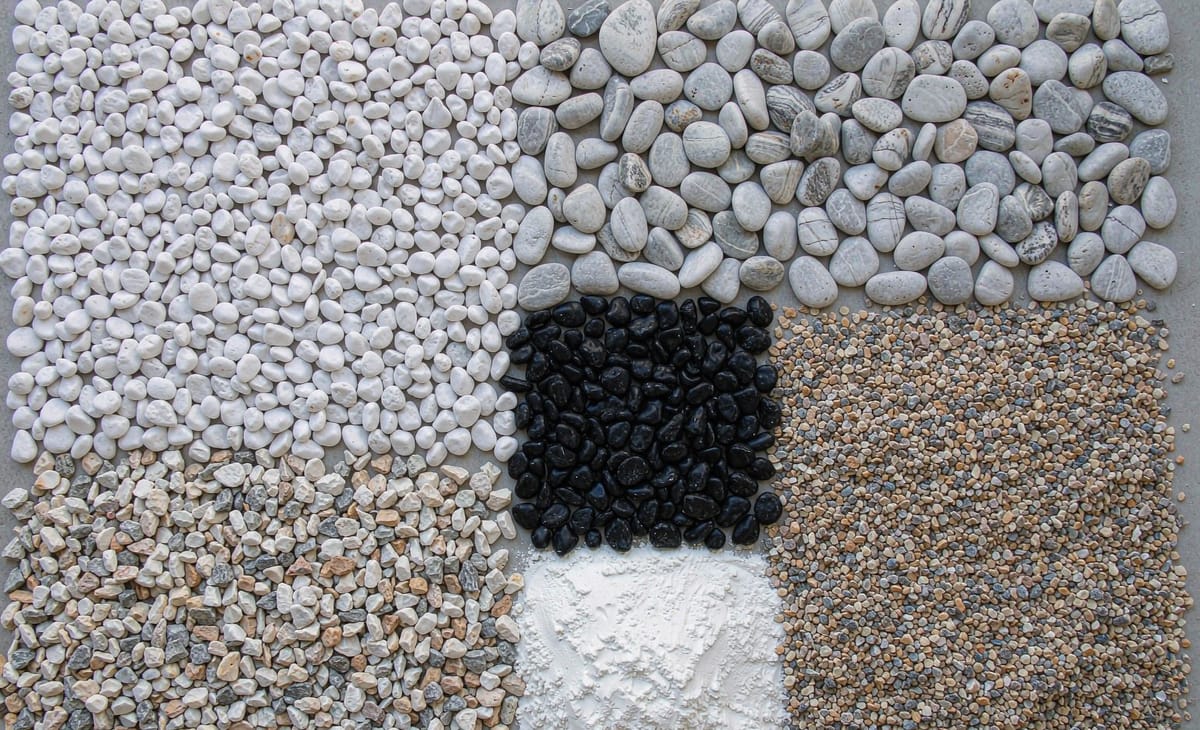
For buyers sourcing the full look, decorative sand is most often ordered alongside white sand, decorative gravel and white pebbles in a single mixed shipment, with each grade bagged or palletised separately. A supplier who can hold colour and grain across all four inside one container is doing more than selling sand — they are supplying a coordinated decorative palette, which is what most landscape contractors and hotel-resort schemes actually need.
Decorative sand is quoted on a delivered basis, not one flat ex-works rate. A 20 ft container of washed, graded decorative sand holds about 24–27 tonnes, and the material cost moves with grain band, colour, washing quality and freight. Budget in cost per square metre at the specified depth rather than a single per-tonne number, because sand is heavy, low-value per tonne and freight-driven.
The per-tonne material cost is set mainly by four factors: grain band (a tight narrow band costs more to screen), washing quality (clean washed sand carries less dust freight), colour (natural deposits differ from colour-sorted or dyed grades), and moisture (water is freight weight that buys nothing). Compare the same band and colour across suppliers rather than comparing different products on price alone.
A 20 ft container takes about 24–27 tonnes of sand, because sand is dense and weight-limited rather than volume-limited. That is roughly 1,200–1,350 x 20 kg bags, about 960–1,080 x 25 kg bags, or 24–27 one-tonne jumbo bags. Wholesale normally starts at one container, with smaller trial orders possible at a premium.
Yes, with the right grain band. Fine 0.1–0.8 mm sand is the craft, terrarium and display grade because it flows and layers cleanly, while 0.3–1 mm sand is the raked zen and Japanese dry-garden grade because it holds a rake line. For retail products, control packing moisture so the sand does not cake, and test any dyed grade for bleed resistance before a volume order.
“Trade Map provides comprehensive global trade data for over 230 economies, with monthly, quarterly and yearly updates using official reported data and mirror data techniques.”
ITC Trade Map, trademap.org — official page
Garden landscaping brings together every stone category: ground cover for beds and borders, gravel for paths, …
Zen gardens reduce the landscape to three materials: raked sand or fine gravel for water and openness, selecte…
Hotel and resort landscapes are commercial projects with residential finish quality: large areas, premium appe…
Stone-topped flower beds replace mulch with a permanent surface: stones suppress weeds when laid over membrane…
Everflorae — Artificial Plants & Trees
From the same supplier group, Everflorae supplies UV-stable artificial trees, palms and green walls that pair with stone — one source for hotels, resorts, malls and Japanese gardens.
Send your product, specification and destination — our sales team will prepare a quotation.