 SWME TRADE
Water Features
Water features are the most natural fit for river materials: water-worn pebbles and rocks around ponds, stream…
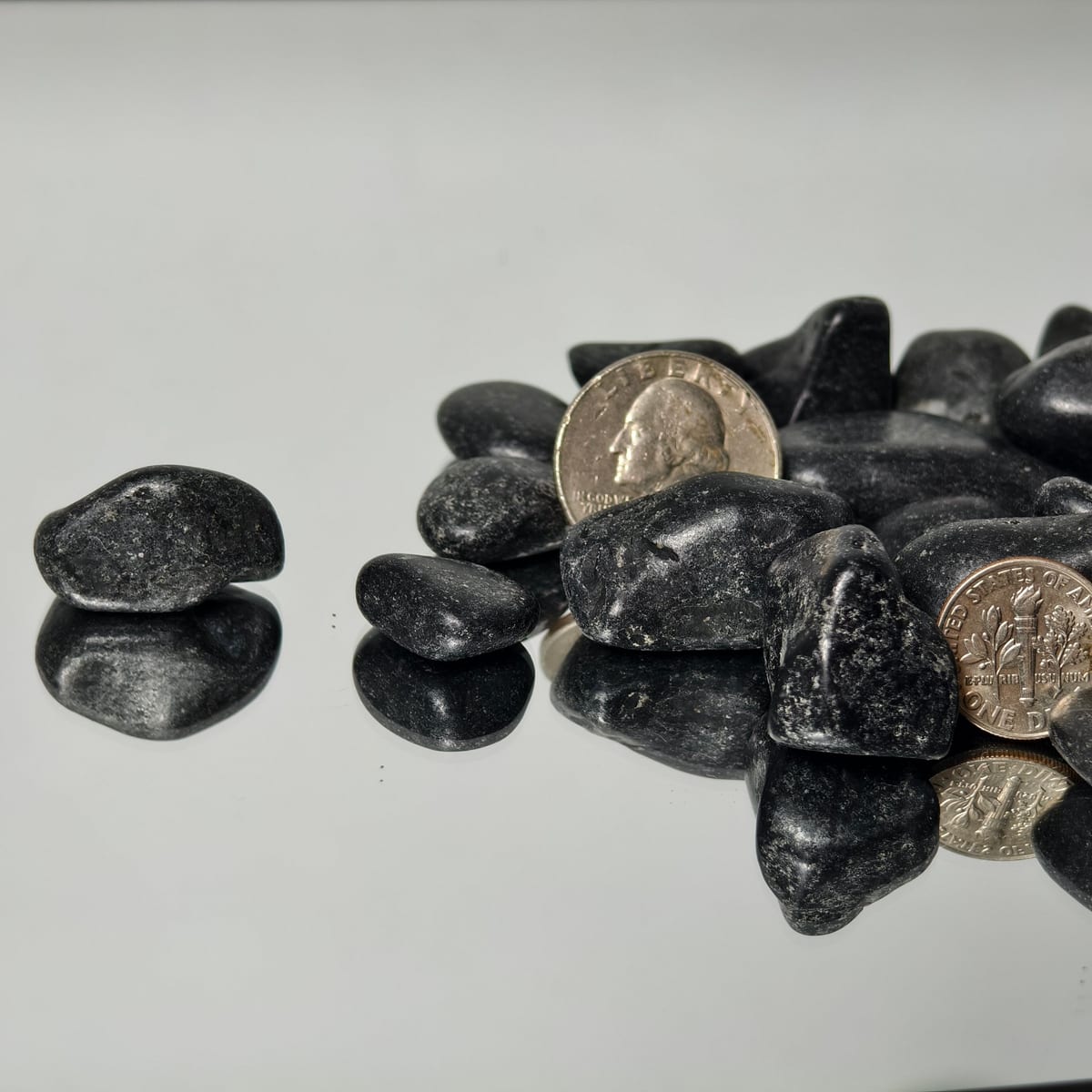
SWME TRADE · Blog
The best polished pebbles for a water feature are through-polished — never waxed or resin-coated — 20–40 mm inert stone such as black basalt or grey granite, laid as a waterline band and spillway accent rather than across the whole submerged bed. One tonne covers about 12–14 m² at 50 mm, and a 20 ft container holds 24–27 tonnes.
Published · By Gardenstone Editorial Team · Educational article from the SWME TRADE team
The best polished pebbles for a water feature are through-polished — never waxed or resin-coated — 20–40 mm inert stone such as black basalt or grey granite, laid as a waterline band and around spillways rather than across the whole submerged bed. One tonne covers about 12–14 m² at a 50 mm depth, and a 20 ft container holds 24–27 tonnes, so most projects need only a fraction of a container.
The distinction that matters is not colour or size but how the gloss was made. A through-polished pebble is ground and buffed until the stone itself reflects light, so the shine cannot peel, fade or wash off. A coated pebble is a natural stone wearing a plastic or wax film, and water features are the fastest place outdoors to destroy that film: constant wetting, sunlight and frost lift it within a season or two, leaving a patched, milky surface that reads as a defect from across the garden.
This guide is written for wholesalers, landscape contractors and importers. It covers the three ways a pebble gets glossy and how to tell them apart in ten seconds, where polished stone earns its place at a water feature and where it causes problems, how it behaves under hard water and sunlight, how it works in a zen garden, and the purchase-order wording that stops coated stone arriving in a container marked polished.
There are three ways to make a pebble glossy. Through-polishing is mechanical: the stone is tumbled with progressively finer grit and finally buffed, so the gloss is a property of the rock itself. Waxing dips the stone in molten paraffin. Resin coating sprays or dips it in a clear film. Wax and resin are cheaper per tonne because they skip hours of grinding, which is exactly why they are quietly substituted for polished stone in bulk orders.
Outdoors next to water, the three behave nothing alike. A film coating sits above the stone and takes the weather first: ultraviolet chalking, water getting under the film at chips and drill marks, freeze–thaw lifting it in flakes. Coated pebbles around a pond commonly go cloudy, blotchy or start shedding film within 6–18 months, and once a film fails there is no repair short of stripping every stone. A through-polished surface has no film to fail — the gloss is the stone, all the way through a scratch, a chip or ten years of splashing.
Two ten-second tests separate them on delivery, and both belong in your inspection routine. Drag a steel nail across the face of a stone: on a through-polished pebble you leave a bright metal smear that wipes off and the stone is unchanged; on a coated pebble the nail cuts through to matte stone underneath, leaving a pale scratch line. Then wipe a hidden face with a cloth dampened in white spirit or acetone: wax and resin lift onto the cloth and leave a dull patch; a true polish is unmoved. Reject any lot that fails either test, because the failure will not show until the film starts coming off in your customer's pond.
Polished pebbles are a highlight material, and they pay for their processing premium where water is moving or where the waterline meets the eye. Three placements work every time: a single-course waterline band of 60–90 mm polished stone along the edge where the water surface meets the bank; spillway cheeks and waterfall lips, where running water keeps the stones permanently wet and the polished surface doubles the sheen; and the interior of fountain bowls and urns, where the stones sit close to the viewer and the gloss does the visual work at arm's length.
Two placements cause complaints. The first is broad submerged beds: a polished black bed reads spectacular on day one, but it also displays every leaf, every dust film and every speck of silt the water delivers, and what was a feature becomes a maintenance accusation. Tumbled matte stone hides all of that, which is why professional installs put tumbled stone on the bed and polished stone on the band. The second is anywhere people walk. Are polished pebbles slippery when wet? Yes — a polished surface plus a water film behaves like glass, and a wet polished pathway is a genuine slip liability around a pool or pond. Keep foot-traffic lines on tumbled stone, resin-bound surfacing or paving, and let polished stone hold the edges where eyes go and feet do not.
A practical split for a typical feature: roughly 80–90% of the stone in tumbled grades for beds and margins, and 10–20% in polished grades for the waterline band, spillway cheeks and accent clusters. That ratio also spreads across a container neatly, because polished and tumbled of the same rock and size band can travel in the same shipment as separate line items.
A through-polished stone does not lose gloss under water or sunlight, because there is nothing on the surface to degrade — the reflectivity is in the rock. Water actually flatters polished stone: submerged, the refractive index gap between stone and water sharpens contrast and deepens colour, which is why polished black basalt under clear water looks like poured obsidian. The wet look a buyer tries to preserve in photos is permanent with a true polish; the stones look wet even bone-dry on a July afternoon.
What does dull a polished surface is what sits on it. Hard water leaves limescale at the fluctuation line — a chalky white mineral ring that is most visible on polished black, precisely because the surface is smooth enough to show it. It is maintenance, not damage: a dilute white-vinegar wash or a mild acidic stone cleaner dissolves the scale in minutes, followed by a rinse. Biofilm and algae also colonise polished stone, but wipe off a smooth surface far more easily than a porous matte one.
Specify two things to keep the look predictable. First, a spare allowance of 5–10% over the laid quantity, so stones that end up under the worst scale exposure can be swapped rather than cleaned in place. Second, a wet reference sample: seal a 1 kg lot, submerge it in 100 mm of water in a white tray, and photograph it in daylight as the standard both sides sign. With through-polished stone the wet and dry appearances are nearly identical — which is itself a useful acceptance check, because a lot whose dry state looks dead next to the reference is telling you it was coated.
Size follows placement. Use 20–30 mm polished pebbles for inlay work between sawn slabs and tight joints, 30–50 mm for general waterline banding at 40–60 mm depth, and 60–90 mm as a single-course statement band where each stone is placed by hand — a 100 mm wide band of 60–90 mm stone runs about 10–14 pieces per linear metre. Broad coverage is not a polished job; the accents carry the effect.
Coverage arithmetic is the same as any pebble grade: loose bulk density runs about 1.5–1.7 tonnes per cubic metre, so one tonne covers roughly 12–14 m² at 50 mm depth or 20–23 m² at 30 mm. Add 5–10% for placement losses on a single-course band, because hand-placed large stones generate more offcuts of time than of stone. A typical 12 m waterline band, 0.4 m wide at 50 mm, is about 0.24 m³ — roughly 0.4 tonnes of polished stone.
Colour is where polished basalt dominates the export trade. Polished black pebbles for pond work are the reference grade: the deepest contrast against water, the strongest wet-look, and the most consistent supply in through-polished quality. Polished grey granite is the durable neutral. Polished whites and creams are usually marble or quartzite — beautiful, but check the rock with a drop of dilute acid before it goes near a fish pond, because calcareous stone slowly raises pH and hardness. Whatever the colour, the order should state the finish and the rock, not just the name: 'polished' without 'through-polished, no coating' is where substitution walks in.
In a zen garden, polished pebbles do something no matte stone can: they read as water while staying perfectly dry. A dry stream bed of through-polished black or grey pebbles carries the permanent suggestion of a stream that has just passed — the gloss does the work that water would do, which is the entire visual trick of karesansui. Used this way, polished pebbles are the wet note in a composition built from matte materials.
The discipline is restraint. The raked field must stay matte — 2–6 mm angular granite or quartz sand — because a polished grain reflects raking light and flattens the shadow lines the rake exists to make. Polished pebbles belong to the accents: a dry waterfall head, the 'pool' at the end of a dry stream, the waterline of a stone basin, and the touch points where the composition implies water. Keep one rock family and two tones, and hold the polished stones to roughly a tenth of the stone in the composition so the gloss stays an event rather than a surface.
Quantities are small, which makes zen work an easy add-on line to a container order. A 6 m dry stream, 0.3 m wide, laid as a single course of 60–90 mm polished pebbles, takes about 0.2 m³ — roughly 0.3–0.35 tonnes, or 10–14 hand-placed stones per metre of stream. That is kilos, not tonnes, so the efficient purchase is to combine the polished accent grade with the sand and the framing stone in one mixed container rather than sourcing it separately.
Order by finish and rock, not by name. The purchase order should read: 'pebbles, through-polished (machine ground and buffed, no wax, no resin, no dye, no colour coating), washed, [rock type, e.g. basalt], size band X–Y mm, fines ≤1%'. Adding 'substitution of coated material not accepted' closes the loophole that lets a supplier ship waxed stone at a polished price when grinding capacity is tight. State the same finish rule on every line item of a mixed container, because coated stone smuggled into one band contaminates the whole shipment's claim.
Price moves with the finish for a reason. Through-polishing adds real processing passes per tonne, so a true polish carries a premium over tumbled of the same rock and grade — and a quote at or below tumbled pricing for 'polished' stone is itself a warning sign that the finish is a film. Compare suppliers on the same three pinned variables — identical size band, identical rock, identical finish definition — and convert to a per-square-metre laid cost before judging; a cheaper coated lot that fails in two seasons is the most expensive stone on the invoice.
Inspect before the container closes: the nail test and solvent wipe on five stones per lot from different bags, a jar rinse to confirm washing, a sieve check on each size band, and a sealed 1 kg wet reference per lot for future reorders. Stock polished grades normally ship in one to two weeks; a specific polished band produced to order takes three to five. Those checks cost an hour, and they are the difference between a waterline that still gleams in year five and a callback to re-dress a pond in peeling film.
The best polished pebbles for a water feature are through-polished — not waxed or resin-coated — 20–40 mm inert stone such as black basalt or grey granite, used as a waterline band and spillway accent rather than across the whole submerged bed. One tonne covers about 12–14 m² at a 50 mm depth, and a 20 ft container holds 24–27 tonnes.
Yes. A polished surface plus a film of water behaves like glass, so polished pebbles should not carry foot traffic around a pool or pond. Keep walking lines on tumbled stone, resin-bound surfacing or paving, and use polished pebbles in the waterline band, spillway cheeks and accent clusters where eyes go and feet do not.
Through-polished pebbles do not — the gloss is the stone itself, so it cannot peel, chalk or wash off, and the stones look wet even when dry. Waxed or resin-coated pebbles usually fail outdoors within 6–18 months as the film lifts under sunlight, water and frost. A steel nail scratch and a solvent wipe on delivery separate the two finishes in seconds.
Through-polished black basalt, 30–60 mm, works best: a dry stream of polished pebbles reads as water while staying dry, which is the visual heart of a zen composition. Keep the raked field as matte 2–6 mm angular sand, hold polished stone to about a tenth of the composition, and keep to one rock family and two tones.
“ISO 9001 is a globally recognized standard for quality management. It helps organizations of all sizes and sectors to improve their performance, meet customer expectations and demonstrate their commitment to quality.”
ISO, ISO 9001:2026 “Quality management systems — Requirements” — official page
Water features are the most natural fit for river materials: water-worn pebbles and rocks around ponds, stream…
Zen gardens reduce the landscape to three materials: raked sand or fine gravel for water and openness, selecte…
Japanese garden design uses stone as its structural vocabulary: larger stones placed as islands and mountains,…
Pool surroundings combine hard performance requirements with a resort aesthetic: stone around pools must toler…
Everflorae — Artificial Plants & Trees
From the same supplier group, Everflorae supplies UV-stable artificial trees, palms and green walls that pair with stone — one source for hotels, resorts, malls and Japanese gardens.
Send your product, specification and destination — our sales team will prepare a quotation.