 SWME TRADE
Garden Pathways
Pathways combine the functional and decorative sides of landscaping stone: the surface must stay stable underf…
SWME TRADE · Blog
The best polished pebbles for a garden pathway are through-polished 10–20 mm stone used as inlay bands, edging and resin-bound accents — not as a loose wearing surface. This guide covers where polished pebbles work on a path, hotel landscaping zones, coverage per square metre and bulk order checks.
Published · By Gardenstone Editorial Team · Educational article from the SWME TRADE team
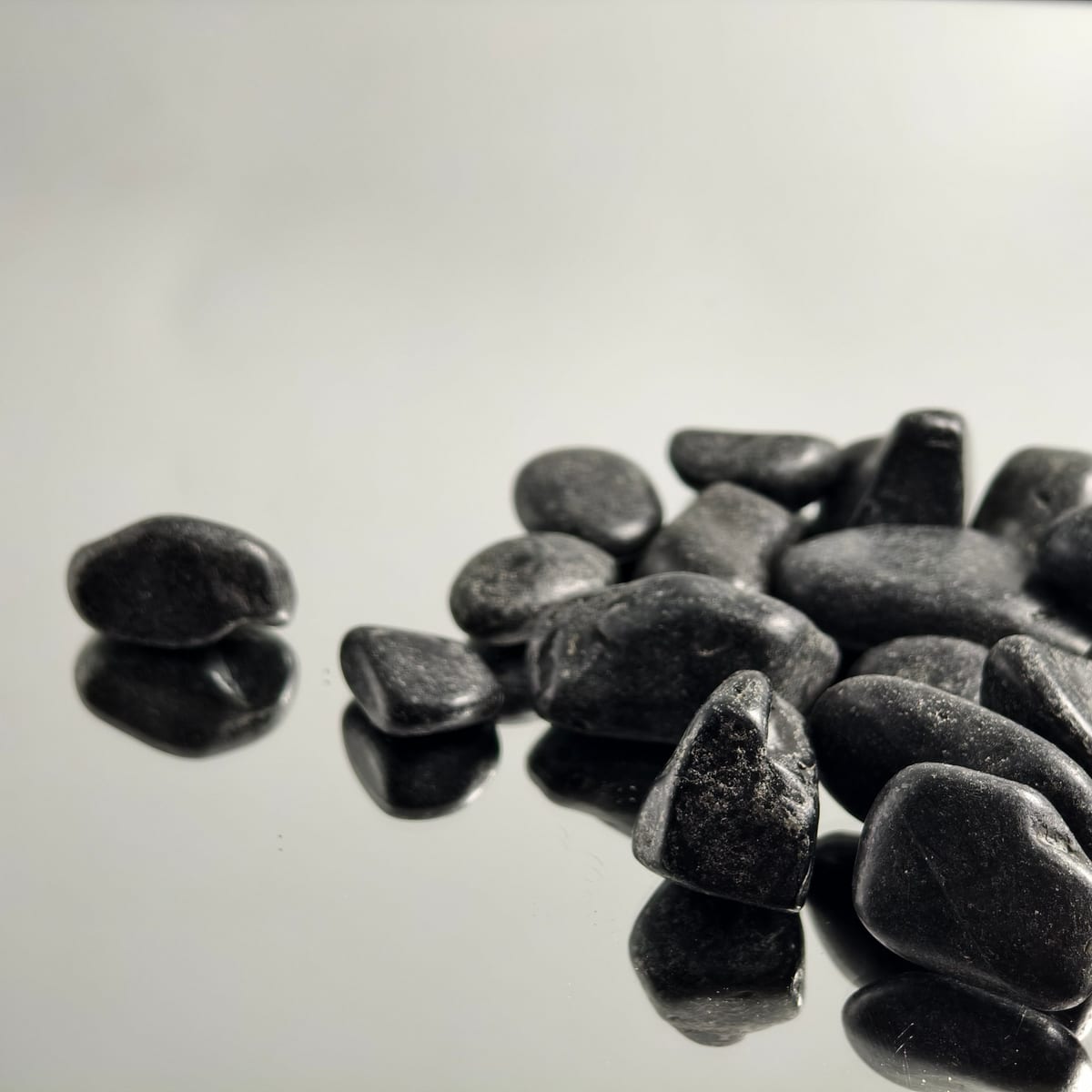
The best polished pebbles for a garden pathway are through-polished, washed 10–20 mm stones used as an accent rather than a wearing surface — set as inlay bands between sawn slabs, rigid edging lines, stepping-stone features or resin-bound sections, at roughly 60–68 kg per square metre for a 40 mm bed. A loose polished run under daily footfall scuffs, rolls and turns slippery when wet, so the winning layouts put polished stone where the eye travels and tumbled or matte stone where the feet do.
That placement rule comes from what 'polished' actually is. A polished pebble is ordinary tumbled stone that has been machine-ground to a gloss — the gloss sits in the surface, and it behaves like any polished surface: it shows every scuff mark, it darkens and gleams when wet, and it loses grip exactly when rain arrives. None of that is a defect. It simply means a pathway is two materials in one: a walking surface that must stay stable and forgiving, and a decorative line that must stay bright. Polished pebbles belong in the second role, and the specification should say so in the purchase order rather than leaving the installer to discover it on site.
For a buyer, the practical consequences are narrow and testable. Order polished stone by named size band and named tone, confirm the polish is through the stone rather than a wax or resin coating, and plan the layout so polished bands are edged or bound — because a gloss line that stays crisp for years is precisely the look imported polished pebble is bought to deliver.
Polished and tumbled pebbles start as the same stone; the finish is what separates them. Tumbled pebbles come out of the drum with a soft matte skin that hides dust, scratches and footfall — which is why every previous pathway guide on this site defaults to tumbled for the running surface. Polished pebbles trade that forgiveness for depth of colour and reflectivity: a black polished pebble reads near-mirror when wet, and a white or red polished pebble holds a saturated, ceramic-like sheen that matte stone never reaches.
The trade-offs are physical, not aesthetic. A polished surface wears to matte along any line feet take daily — a loose polished path develops a dull track down its centre within one or two seasons of public use. Round, slick stones roll underfoot more than tumbled ones, and rain turns a loose polished bed into the slipperiest surface in the garden. Finally, gloss is honest about maintenance: fingerprints of soil, leaf tannin and algae film all show on a shine that a matte skin would hide.
There is one trap worth a paragraph, because it is the single most common dispute in this category: waxed or resin-coated 'polish'. Some cheap supply is tumbled stone dipped in wax or lacquer to fake a wet-look gloss. Outdoors, UV and abrasion strip that coating in months, and the stone arrives back at matte while your customer photographs the difference. True through-polished stone — ground and buffed to a gloss in the stone itself — keeps its look. The verification is simple and belongs in your receiving check: scratch a hidden spot on a sample stone with a steel nail (a coated stone shows a scar with clear film lifting at the edge), and wipe one stone with a little white spirit — wax comes off on the cloth, through-polish does not.
Four placements deliver the polished look without the failure modes. First, inlay bands between sawn paving slabs: the slabs carry the traffic, the 50–100 mm wide polished strip carries the eye, and the rigid edges stop the stones migrating. This is the classic high-end detail and the single best use of 10–20 mm polished pebbles. Second, edging and transition lines — a single-course polished line along a path margin or between lawn and gravel reads as a deliberate stitch and takes almost no wear.
Third, stepping-stone and mosaic features: polished pebbles bedded into a concrete or resin matrix as inset circles, borders or full decorative pads put the gloss exactly where it photographs, with no loose stones underfoot at all. Fourth, resin-bound sections: 6–10 mm polished pebbles bound in clear resin make a fully walkable, slip-managed gloss surface for short feature runs — the only context where small polished stone should take regular footfall, because the resin locks the stones and presents a textured, not polished, surface to the shoe.
What to avoid is equally specific: no loose polished beds across the main walking line, no loose 6–10 mm polished stone anywhere (it sticks to soles and scatters), and no unedged polished bands adjacent to lawns or soil — a gloss line is only crisp while its edge is, and a geotextile membrane plus rigid edging beneath the band is what keeps it that way. Budget a bed depth of 30–40 mm for inlay and edging work rather than the 40–50 mm a loose pathway needs; the stones are being set, not walked on.
Hotel and resort projects are where polished pebbles earn their premium, because the gloss reads as finish at exactly the moments guests form impressions: the arrival court, the lobby approach, the spa and pool surrounds, the courtyard photographed at dusk. Used as inlay between large-format sawn pavers, or as broad decorative bands in zones cordoned off from luggage wheels and heels, polished pebbles deliver a wet-look depth of colour that tumbled stone cannot — and at night, uplighting raking across a polished band doubles the effect for free.
Specify by zone the same way as any hotel stone order. Resin-bound polished 6–10 mm or slab-inlay bands for anywhere guests actually walk; loose polished pebbles reserved for planted margins, water-line accents and dry stream features where the paving carries the traffic. Around pools, polished stone is genuinely at home — the wet-look gloss matches the water — but keep it out of barefoot walking lanes, because wet polished stone under wet feet is the one combination no resort should lay loose.
Two procurement clauses matter more here than in private work. First, a coating-disclosure line: 'polish to be through the stone, no wax, lacquer or resin coating' — a resort cannot repaint its arrival court every season, and coated stone will fail visibly within the first year of sun. Second, phase continuity: resorts refurbish in wings, so fix the tone with a signed wet 1 kg reference held by both sides and keep per-lot retention sacks, so the wing re-paved in year three matches the arrival court guests remember from year one.
Size bands do the same job as on any pebble path, with polished-specific notes. A 10–20 mm polished pebble is the workhorse: large enough for inlay bands and edging courses, small enough to bed densely, and the band most stockists hold in depth. A 20–30 mm polished stone makes a bolder feature band or stepping-stone inlay where the detail is seen from a distance. A 6–10 mm polished grade is a resin-bound aggregate first and foremost — too small to stay put loose, ideal once bound. Whatever band you choose, buy it as one nominal size with the tolerance written down: 90–95% of stones within the agreed band, checked across three random 1 kg scoops from different pallets.
Grade adds three lines a tumbled order does not need. State the polish method as through-polished, coating-free. State the tone with a wet reference: polished stone is chosen for its wet look, but it is shipped dry, so approve colour on a 1 kg wet sample board and keep it as the sealed standard. And state finish consistency — a mixed lot where half the stones are semi-polished reads as a defect at inlay scale, so the order should say 'polish uniform across the lot', verified by laying the three scoop samples side by side under water.
Wash quality closes the specification. Polished surfaces show dust and drying marks more loudly than matte stone, so the low-fines and washed clauses that matter on white pathways matter doubly here: a polished inlay laid with dusty stone films over grey within the first rain, and the gloss that sold the order disappears under the dust that came with it.
Quantities follow the same density arithmetic as every pebble order — polished stone runs at roughly 1.5–1.7 tonnes per cubic metre loose, depending on the rock family — but accent placement usually needs less material than a full pathway. A 40 mm inlay or feature band needs about 60–68 kg per square metre, a 30 mm band about 45–50 kg, and a 50 mm edging course about 75–85 kg. For a 100 mm wide, 40 mm deep inlay strip, that is roughly 6–7 kg per linear metre — a figure worth keeping at hand, because inlay quantities are ordered by the metre and mis-scaled orders are common on first tenders.
Convert to containers the same way as bulk runs: one 20 ft container holds about 24–27 tonnes, which at 40 mm depth covers roughly 350–400 square metres of band — far more linear metres than any single project usually needs, which is why polished pebble orders are often mixed containers: polished 10–20 mm for the details, tumbled stone of the same tone for the surfaces, sharing one shipment and one sealed colour reference. Add 5–10% for settlement and later top-ups, and order the full project quantity from one production lot so the gloss depth and tone do not shift between phases.
One subtlety: polished stone in small packs (20–25 kg bags) costs visibly more per tonne than one-tonne FIBC bags, and on accent quantities the difference can be material. Decide the pack split before quoting the job, because a 300-metre inlay programme bought in retail bags can carry a double-digit percentage cost penalty over the same stone in bulk bags decanted on site.
Wholesale polished pebbles start at one 20 ft container, about 24–27 tonnes, and most producers will split a container across two or three size bands of the same stone family. Ask for the MOQ per size band, confirm the producer polishes in-house rather than buying in coated stone, and put the two decisive lines in writing: polish through the stone with no wax, lacquer or resin coating, and tone fixed by a signed wet 1 kg reference held by both parties.
The specification, as lines rather than adjectives: through-polished, coating-free; single named tone with wet sealed sample; nominal size band with 90–95% within-band tolerance; washed with a stated fines limit; packing as 20–25 kg bags on pallets, one-tonne FIBC bags, or loose in a lined container, confirmed before quoting. Then verify before the container ships. Lay the wet reference board and sign it; draw three random 1 kg scoops from different pallets and compare wet, in daylight; nail-scratch one stone per pallet line and wipe one with white spirit to confirm no coating; sieve-check the size band; spot-check bag mass on five bags per lot; photograph the loaded container with date and lot reference.
Run the same three tests again at receiving — scratch, solvent wipe, wet side-by-side — because coating disputes only surface months later, after the sun has stripped the wax, and by then the claim has to travel back through an entire season of installed work. A supplier who welcomes the tests is quoting genuine through-polished stone; one who resists them has told you what the shipment is before it sails.
Use through-polished, washed 10–20 mm pebbles as an accent material — inlay bands between sawn slabs, rigid edging lines, stepping-stone features or resin-bound 6–10 mm sections — not as a loose wearing surface, which scuffs, rolls and turns slippery when wet. Approve the tone on a signed wet 1 kg sample, specify the polish as coating-free, and bed the bands at 30–40 mm over a geotextile membrane with rigid edging.
Yes — a polished surface loses grip in rain, and loose polished stones also roll underfoot, so they are the wrong choice for a primary walking route. Keep loose polished pebbles to low-traffic accent bands and margins, and use tumbled or matte stone for the running surface. Resin-bound polished 6–10 mm stone is the exception: the resin locks the stones and gives the shoe a textured rather than a polished surface, so short feature runs stay walkable.
Polished pebbles run at roughly 1.5–1.7 tonnes per cubic metre loose, so a 30 mm band needs about 45–50 kg per square metre, 40 mm about 60–68 kg and 50 mm about 75–85 kg. A 100 mm wide, 40 mm deep inlay strip uses roughly 6–7 kg per linear metre, and one 20 ft container of 24–27 tonnes covers about 350–400 square metres of 40 mm band. Add 5–10% for settlement and top-ups.
Choose a single named tone matched to the property's paving, specify it as through-polished with no wax or resin coating, and zone it: resin-bound or slab-inlay polished bands for arrival courts, lobbies and pool surrounds, loose polished pebbles only in planted margins, water-line accents and dry stream features. Fix the tone with a signed wet reference and keep per-lot retention sacks so phased refurbishments match the original stone years later.
“ISO 9001 is a globally recognized standard for quality management. It helps organizations of all sizes and sectors to improve their performance, meet customer expectations and demonstrate their commitment to quality.”
ISO, ISO 9001:2026 “Quality management systems — Requirements” — official page
Pathways combine the functional and decorative sides of landscaping stone: the surface must stay stable underf…
Hotel and resort landscapes are commercial projects with residential finish quality: large areas, premium appe…
Zen gardens reduce the landscape to three materials: raked sand or fine gravel for water and openness, selecte…
Everflorae — Artificial Plants & Trees
From the same supplier group, Everflorae supplies UV-stable artificial trees, palms and green walls that pair with stone — one source for hotels, resorts, malls and Japanese gardens.
Send your product, specification and destination — our sales team will prepare a quotation.