 SWME TRADE
Dry River Bed
A dry river bed (dry creek bed) is a landscape feature that mimics a natural stream channel — both as a design…
SWME TRADE · Blog
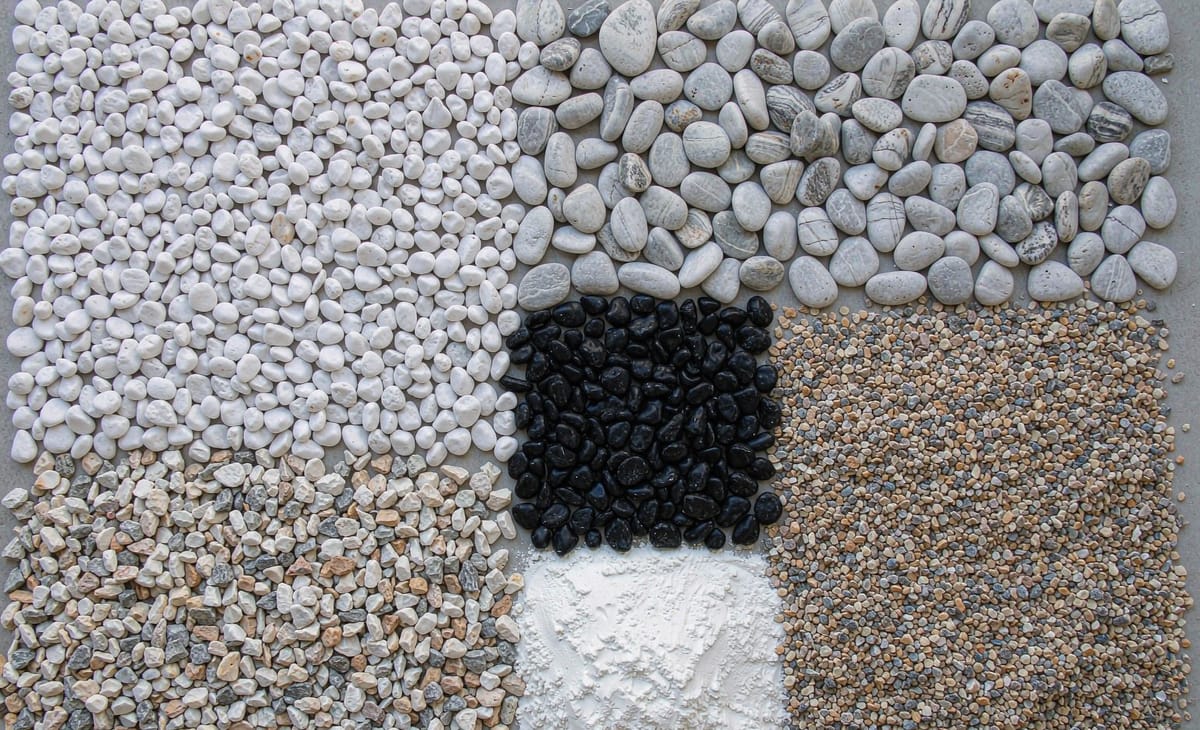
The best garden gravel for a dry river bed is rounded, washed, inert stone — granite, quartz or basalt — graded in three bands (10–20 / 20–40 / 40–75 mm). One tonne covers about 12–15 m² at a 50 mm depth and a 20 ft container holds 24–27 tonnes, enough for roughly 130–140 running metres.
Published · By Gardenstone Editorial Team · Educational article from the SWME TRADE team
The best garden gravel for a dry river bed is rounded, washed, inert stone — granite, quartz or basalt — graded in three bands: 10–20 mm for the channel, 20–40 mm for the banks and 40–75 mm for anchor rocks. One tonne covers about 12–15 m² at a 50 mm depth, and a 20 ft container holds 24–27 tonnes, enough for roughly 130–140 running metres of a 1.2 m wide bed.
Read the phrase 'best garden gravel for dry river bed' as a specification, not a single product: the job needs shape (rounded), cleanliness (washed) and rock chemistry (inert) before colour or price. Get those three right and a 20 ft container of mixed bands will lay a long, believable channel; get them wrong and the bed crusts with fines, leaches lime or reads as a pile of crusher run rather than a stream.
A dry river bed is an illusion of water, and rounded, tumbled stone is what makes the eye accept it. Angular crusher run has sharp points that puncture the weed membrane, trap silt in every facet and cast hard shadows that read as rubble, not flow. Washed rounded gravel lies flat, lets rain sheet across it, and photographs as a dry channel even on a cloudless day.
Washing matters as much as shape. Unwashed pit run carries a fines fraction that, once it rains, turns into a grey crust on the surface and a slurry in the dips — the single most common reason a new dry river bed looks tired within a season. Specify 'washed, fines near 1%' and you remove that failure mode at the source.
Chemistry is the quiet one. Inert granite, quartz and basalt are safe anywhere, including where the bed meets real water. Carbonate stone — limestone or marble — slowly leaches calcium and raises pH, etching nearby stone and stressing acid-loving plantings; a single vinegar drop that fizzes tells you which camp a sample is in. For a feature that may carry overflow, inert is the only safe default.
Use three coordinated bands on one purchase order rather than one 'river gravel' size. Lay 10–20 mm through the thalweg (the deepest channel line) where flow reads fastest, 20–40 mm on the banks and transition edges where the stream meets the lawn, and 40–75 mm — or individual 75–150 mm rocks — as the boulders the water appears to have rolled around. Keeping all bands in the same rock family is what makes the bed age as one feature instead of three unrelated piles.
Depth sets the look and the tonnage together. A believable bed is mounded, not flat: 60–100 mm in the channel rising to a thin scatter at the edges. At a nominal 50 mm average over a 1.2 m width, the bed consumes about 190–200 kg per running metre at 1.6 t/m³ — a number worth committing to memory before you price the project.
Coverage follows bulk density and depth: garden gravel runs about 1.5–1.7 tonnes per cubic metre, so one tonne covers roughly 12–15 m² at a 50 mm depth, 15–20 m² at a 30 mm depth, and 7–9 m² at a 75 mm depth. In reverse, budget about 65–80 kg per square metre at a 50 mm depth and add 5–10% for curves, edges and first-season settlement before converting area into tonnes.
Container maths then closes the order. A 20 ft container carries 24–27 tonnes of this dense stone and is weight-limited rather than volume-limited, so it fills long before it is full. At ~190–200 kg per running metre, a full container lays roughly 130–140 running metres of a 1.2 m bed — and because it is weight-limited, mixing in the three size bands costs no extra freight and is the normal way to fill the last tonnes of the order.
Yes — the same inert, washed gravel that builds the river bed is an excellent flower-bed mulch, which is why 'best garden gravel for flower bed' is the natural companion question. A 6–10 mm or 10–20 mm band laid 25–40 mm deep suppresses weeds, sheds splash-back onto foliage, and drains better than bark or shredded mulch, while staying cool under summer sun. The bed and the stream then share one approved sample and one delivery.
Two cautions keep it safe. Stay inert — the same vinegar test applies — because carbonate fines around acid-loving plantings (azalea, camellia, heather) will nudge the root zone alkaline over a season. And keep the bed band finer than the stream band so the two reads stay distinct: a 6–10 mm around the plants, the 10–20 mm and up in the channel, all from the same rock family and the same wet sealed sample.
Three details decide whether the bed still reads as water in year three. Lay a permeable weed membrane under the stone and hold both edges with a rigid restraint (steel, timber or set stone) so the gravel cannot creep into the lawn or the beds. Do not resin-bound the raked surface — a dry river bed is meant to be re-raked and replenished, not frozen in place.
Maintenance is light but annual. Rinse silt after heavy rain, re-level any dips, and plan a 5–10% top-up as stone migrates under hoses, feet and blowers. The top-up only matches the original if you kept a wet sealed sample at loading: order every replenishment batch against that sample within an agreed colour and size tolerance, or each year's gravel will read as a slightly different stream.
Price the bed per square metre installed, not per tonne, then pin the variables that make two quotes comparable: the rock type, the grain-size bands with explicit oversize and undersize tolerances, a fines limit for washed product, moisture on a dried-weight basis, bag or jumbo weight, the Incoterm and named port, and a validity window of 30–60 days. On dense stone, ocean freight and local haulage usually take 60–80% of the landed cost, so the Incoterm moves the number more than a small grade difference.
Buy on the container, not the bag, for a job this size: MOQ is normally one 20 ft container (24–27 tonnes) and mixing up to three size bands in that container costs no extra freight. Require a wet sealed sample taken at loading and photographed next to a scale reference, plus loading photos, because gravel is judged wet in daylight and never from a dry photo. Our garden gravel range lists the current grades and band options so you can spec the three bands on a single order.
Use three coordinated bands on one order: 10–20 mm for the channel, 20–40 mm for the banks and 40–75 mm for anchor rocks. One tonne covers about 12–15 m² at a 50 mm depth and a 20 ft container holds 24–27 tonnes, so coverage and freight are fixed arithmetic once the bands are set.
A 1.2 m wide bed averaging 50 mm deep consumes about 190–200 kg per running metre at 1.6 t/m³. A full 20 ft container of 24–27 tonnes therefore lays roughly 130–140 running metres — and because the stone is weight-limited, mixing the three size bands costs no extra freight.
Yes: inert, washed granite or quartz at 6–10 mm or 10–20 mm makes a clean, cool, well-draining mulch that suppresses weeds and reduces splash-back. Keep it inert (vinegar-drop test) near acid-loving plants, lay it 25–40 mm deep, and plan a 5–10% annual top-up.
About 24–27 tonnes. Dense gravel is weight-limited rather than volume-limited, so the container fills on weight long before it is full; that is also why mixing two or three adjacent size bands in one order costs no extra ocean freight.
“Over 13,000 ASTM standards operate globally. Defined and set by us, they improve the lives of millions every day. Combined with our innovative business services, they enhance performance and help everyone have confidence in the things they buy and use.”
ASTM International, “About ASTM Overview” — official page
A dry river bed (dry creek bed) is a landscape feature that mimics a natural stream channel — both as a design…
Stone-topped flower beds replace mulch with a permanent surface: stones suppress weeds when laid over membrane…
Garden landscaping brings together every stone category: ground cover for beds and borders, gravel for paths, …
Everflorae — Artificial Plants & Trees
From the same supplier group, Everflorae supplies UV-stable artificial trees, palms and green walls that pair with stone — one source for hotels, resorts, malls and Japanese gardens.
Send your product, specification and destination — our sales team will prepare a quotation.