 SWME TRADE
Water Features
Water features are the most natural fit for river materials: water-worn pebbles and rocks around ponds, stream…
SWME TRADE · Blog
The best garden gravel for a water feature depends on the layer: 20–40 mm washed rounded stone as ballast at 50–75 mm depth (75–120 kg/m²), 8–16 mm washed inert gravel as bog-filter media at 300 mm depth (450–480 kg/m²), and 10–20 mm for the visible edge band. Gravel is not a liner bedding material — this guide explains the three grades, the quantities, zen-garden framing and the purchase order wording that keeps them apart.
Published · By Gardenstone Editorial Team · Educational article from the SWME TRADE team
The best garden gravel for a water feature depends on which of three layers you are buying: 20–40 mm washed rounded stone as ballast and edge dressing at 50–75 mm depth, about 75–120 kg per square metre; 8–16 mm washed inert gravel as bog-filter media at 300 mm depth, about 450–480 kg per square metre; and 10–20 mm for the visible dry band. One grade cannot do all three jobs.
'Garden gravel' is a trade label, not a specification. It covers washed single-size stone, all-in material with its fines still in it, crushed angular stone and tumbled river stone — four products that look similar in a dry bag and behave nothing alike in contact with water. At a water feature that difference stops being cosmetic, because the gravel is doing structural work: holding a liner down, filtering a planted bed, or reading as the dry margin of the water.
This guide is written for wholesale buyers, landscape contractors and importers who have to order those layers on one purchase order. It sets out what each layer actually needs, why gravel is the wrong material under a liner, the tonnage arithmetic for a bog filter and a pond edge, how the same material frames a zen garden, and the packing and pre-shipment checks that keep three grades from arriving as one blended pile.
The first job is ballast. A flexible liner is held down by weight, and the material that does that sits on top of the liner, not under it: 50–75 mm of 20–40 mm rounded washed stone, which works out at roughly 75–120 kg per square metre. It must be rounded rather than crushed, because a stone with a cutting edge sitting on a 1 mm EPDM membrane under a load is a puncture waiting for the first maintenance visit.
The second job is filtration. A bog or wetland filter is a planted bed of gravel that water is pushed through, and the gravel is the filter medium — the surface area that bacteria colonise and the pore structure that traps solids. It needs 300 mm of washed 8–16 mm single-size stone, about 450–480 kg per square metre, with essentially no fines, because the fines are what clog the bed in its first season.
The third job is dressing: the narrow visible band between water and planting, usually 40–50 mm of 10–20 mm washed stone at 60–80 kg per square metre. This is the layer buyers think of first, and it is the cheapest of the three per square metre — which is exactly why it is so often ordered for all three jobs and then fails at two of them.
The failure modes are different in each case, so a single grade cannot be substituted across them. Fines in a bog filter seal the pore structure and the bed stops passing water. Oversized stone over a liner leaves voids, lets light reach the membrane through the gaps, and rolls on any slope. Unwashed stone in the visible band clouds the water for a fortnight every time it rains. Write them as three separate line items, with three separate grades.
No. Gravel is the wrong material beneath a flexible liner, and it is worth stating plainly because it is a common and expensive mistake. Under a liner the job is not drainage, it is bedding: the liner has to be supported evenly so that nothing concentrates load on it. A bed of loose stones does the opposite — each stone becomes a point load, and with 20 tonnes of water above it, a single 20–40 mm particle with an edge is enough to perforate the membrane. The failure appears months later as a slow loss of level that nobody can trace.
The standard detail is a compacted, blinded base, a geotextile, then 50 mm of sand or soft fines-free soil, then the liner, then a second layer of geotextile as protection, and only then the ballast stone. That 50 mm sand layer is doing the work that buyers sometimes try to give to gravel; if the site needs drainage below the liner, it goes in as a separate French drain or soakaway outside the liner footprint, not as a stone bed underneath it.
A simple site test settles arguments about a local material. Lay a stone on a scrap of the actual liner, cover it with a plank, and stand on the plank. A rounded river stone leaves a smooth impression; a crushed stone with a fresh edge leaves a mark that becomes a pinhole under sustained load. If a contractor proposes gravel directly under the membrane, that test is the conversation.
For ballast, specify 20–40 mm washed rounded stone — tumbled river gravel or a rounded crushed product — laid 50–75 mm thick over a protection geotextile. At a bulk density of about 1.5–1.6 tonnes per cubic metre, 50 mm consumes roughly 75–80 kg per square metre and 75 mm roughly 110–120 kg. That thickness is not decorative: it has to be heavy enough to resist wind uplift on an empty basin during construction and to stay put when the water level is drawn down for cleaning.
Shape behaves differently on slopes than on the flat. Rounded stone rolls, and on any batter steeper than about 1:8 the ballast creeps downhill season by season until the liner is exposed at the top of the slope. Three workable answers: a retention edge or stone kerb at the toe of the slope, an angular 20–40 mm stone over a heavier protection geotextile where the batter cannot be eased, or a resin-bound surface where the stone must stay exactly where it was placed.
For the visible edge band, go down one grade to washed 10–20 mm at 40–50 mm depth, roughly 60–80 kg per square metre, laid over the ballast rather than mixed into it. A finer band reads cleaner against water, hides the liner lip, and gives maintenance crews something they can rake back into line. Keep black liner out of sight — any gap in the stone shows as a dark line at exactly the height the eye is drawn to.
Rock type matters wherever the stone touches water or fish. Granite, quartz, basalt and gneiss are inert and hold a neutral pH. Limestone and marble are calcareous and slowly raise both pH and hardness, which is tolerable in a decorative basin with no livestock and wrong in a planted pond with fish. A drop of dilute acid tells you which one you have in ten seconds: inert stone stays silent, calcareous stone fizzes.
A bog filter wants washed single-size 8–16 mm stone, inert and with fines at or under 1–2%, laid 300 mm deep. That depth is what gives the bed its residence time and its root zone; shallower beds pass water too quickly to strip nutrients, deeper beds go anoxic at the bottom. At 1.5–1.6 tonnes per cubic metre, 300 mm consumes about 450–480 kg per square metre, so a modest 2 m² bed is already close to a tonne of stone.
Bed area is usually sized at roughly 10–20% of the pond's surface area, and water is fed in at the bottom through a perforated manifold so that it rises up through the gravel rather than down through it. Upflow is deliberate: solids stay in suspension until they reach the surface, where they can be disturbed and flushed out, instead of being driven into the bed and sealing it. Flow through the bed is normally set well below the pond's turnover rate, because the bed is a biological reactor, not a pump circuit.
Grading is where bog filters are quietly got wrong. The gravel has to be coarse enough to pass water and fine enough to trap the solids it is meant to trap, and it also has to be stable against the soil or sand beneath it — otherwise the surrounding material migrates into the bed and blinds it. The working rule is that the filter's 15th-percentile particle size should be roughly four to five times the 85th-percentile size of the material it is protecting, with a 3–5 mm transition layer between the two. A single-size 8–16 mm stone over a coarse sand satisfies that; a gap-graded mix does not.
Do not substitute a self-binding all-in gravel here. It is sold under the same garden gravel heading, it looks right in a bag, and the fines that make it bind as a pathway are the same fines that seal a filter. If a supplier quotes one material for both the path and the bog bed, split the order. Plant into the top 50 mm, keep the plants' crowns above the standing water level, and expect to break the surface open once a year.
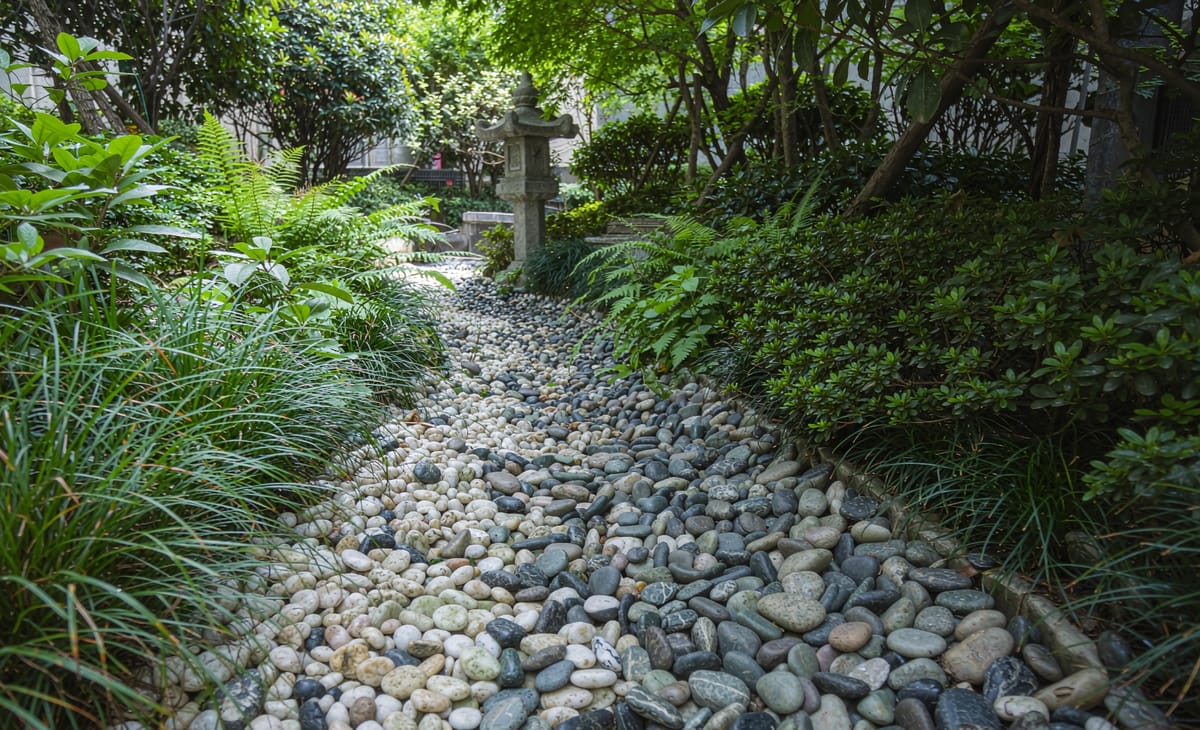
In a zen garden the raked field is not gravel at all — it is a 2–6 mm angular granitic or quartz sand, because a rake needs a narrow, angular, single-size grain to hold a clean ridge. Garden gravel's role is the frame around that field: 8–16 mm sub-angular washed stone as the transition band between the raked sand and the planting or paving, and 20–40 mm stone as island edging and as the 'dry waterfall' where the composition reads water without any water being present.
That division is what makes the composition work. Rounded 8–16 mm stone cannot hold a rake line — it rolls back into the furrow — but it is exactly right as the border where the eye needs a change of scale without a change of colour. The 20–40 mm grade is heavy enough to sit as a deliberate line around a rock group, and coarse enough that moss and leaf litter do not knit it into a mat. Keep the whole garden to one rock family and two tones; a warm buff gravel dropped into a cool grey scheme is visible from the gate.
Build it so the layers do not migrate. A geotextile under the raked sand and a separate one under the gravel band, with a rigid or buried edge between them, stops sand washing into the gravel and gravel rolling into the sand — the two failure modes that ruin a zen garden in its first wet season. Keep the gravel band at least 0.5 m wide so it reads as a band rather than a scatter, and at 50 mm depth that is roughly 40 kg per linear metre.
For quantity planning, the frame is usually a small fraction of the order: a 30 m perimeter at 0.8 m wide and 50 mm deep is 1.2 m³, or roughly 1.9 tonnes — well under a container, which is why zen-garden buyers normally combine the 8–16 mm framing stone with the sand and the 20–40 mm accent stone in a single mixed container.
Work each layer separately and then add them. Ballast at 50 mm over a 20 m² basin floor is about 1.6 tonnes; a 2 m² bog bed at 300 mm adds roughly a tonne; a 30 m edge band at 10–20 mm and 45 mm deep adds about 0.6 tonnes. That is a 3.2-tonne project — nowhere near a container, which is the practical reason most water-feature buyers order three grades at once and carry the balance into other work.
Container economics favour mixing. A 20 ft box takes 24–27 tonnes of gravel, and at 1.6 tonnes per cubic metre that is only about 15–17 m³ of the roughly 33 m³ available — the load is weight-limited, not volume-limited, so two or three grades can travel together at almost no freight penalty. Split them by one-tonne FIBC bags so the grades stay separate on site, or by 20–25 kg bags if the material is going into resale, which at 24 tonnes means 1,200–1,350 bags to count and label.
Write the purchase order as three lines, each with its own band, washing requirement and rock type. Ballast: 20–40 mm, washed, rounded, inert, fines ≤1–2%, laid 50–75 mm. Bog media: 8–16 mm, washed single-size, fines ≤1%, inert, carbonate-free, 300 mm depth. Edge band: 10–20 mm, washed, colour held against a sealed wet reference. Add bag mass tolerance of about ±1% on 20–25 kg bags, and state that substitutions between lines are not accepted without written approval — the grades are not interchangeable, and a supplier short of one band will otherwise ship the nearest.
Before the container closes, check against the order rather than a photograph. Sieve each band from a production sample, rinse a handful in a clear jar to see how much the water clouds, drop dilute acid on a stone of each grade to confirm the rock is not calcareous, weigh five bags per lot, and seal a 1 kg wet reference from each grade signed by both sides. Stock grades normally ship in one to two weeks; a specific band produced to order takes three to five. Those five checks take an hour and they are the only thing standing between a delivered container and a rebuild of the basin.
It depends on the layer. Use 20–40 mm washed rounded stone as ballast over the liner at 50–75 mm depth, about 75–120 kg per square metre. Use 8–16 mm washed inert single-size gravel as bog-filter media at 300 mm depth, about 450–480 kg per square metre. Use 10–20 mm washed stone at 40–50 mm for the visible edge band, about 60–80 kg per square metre. Order them as three separate line items, because they are not interchangeable.
No. Loose stone under a flexible liner concentrates load on individual particles, and a 20–40 mm stone with an edge can perforate a 1 mm membrane under the weight of the water. The standard detail is a compacted blinded base, a geotextile, 50 mm of sand or soft fines-free soil, the liner, a second protection geotextile, and only then the ballast stone on top. Put any required drainage in a separate French drain outside the liner footprint.
Plan on 300 mm of washed 8–16 mm single-size inert gravel, which is about 450–480 kg per square metre at a bulk density of 1.5–1.6 tonnes per cubic metre. Size the bed at roughly 10–20% of the pond's surface area, so a 20 m² pond needs a bed of about 2–4 m², or 0.9–1.9 tonnes of stone. Keep fines at or under 1% and feed water in at the bottom so it rises through the bed.
The raked field should be 2–6 mm angular granitic or quartz sand, because gravel cannot hold a rake ridge. Garden gravel frames it: 8–16 mm sub-angular washed stone as the transition band between sand and planting, and 20–40 mm stone as island edging and dry waterfall. Use a band at least 0.5 m wide, keep to one rock family and two tones, and separate the sand and gravel layers with geotextile and a buried edge.
“Over 13,000 ASTM standards operate globally. Defined and set by us, they improve the lives of millions every day. Combined with our innovative business services, they enhance performance and help everyone have confidence in the things they buy and use.”
ASTM International, “About ASTM Overview” — official page
Water features are the most natural fit for river materials: water-worn pebbles and rocks around ponds, stream…
Zen gardens reduce the landscape to three materials: raked sand or fine gravel for water and openness, selecte…
Japanese garden design uses stone as its structural vocabulary: larger stones placed as islands and mountains,…
Garden landscaping brings together every stone category: ground cover for beds and borders, gravel for paths, …
Everflorae — Artificial Plants & Trees
From the same supplier group, Everflorae supplies UV-stable artificial trees, palms and green walls that pair with stone — one source for hotels, resorts, malls and Japanese gardens.
Send your product, specification and destination — our sales team will prepare a quotation.