 SWME TRADE
Commercial Landscaping
Commercial landscaping is the volume end of the stone trade: office parks, public spaces, housing developments…
SWME TRADE · Blog
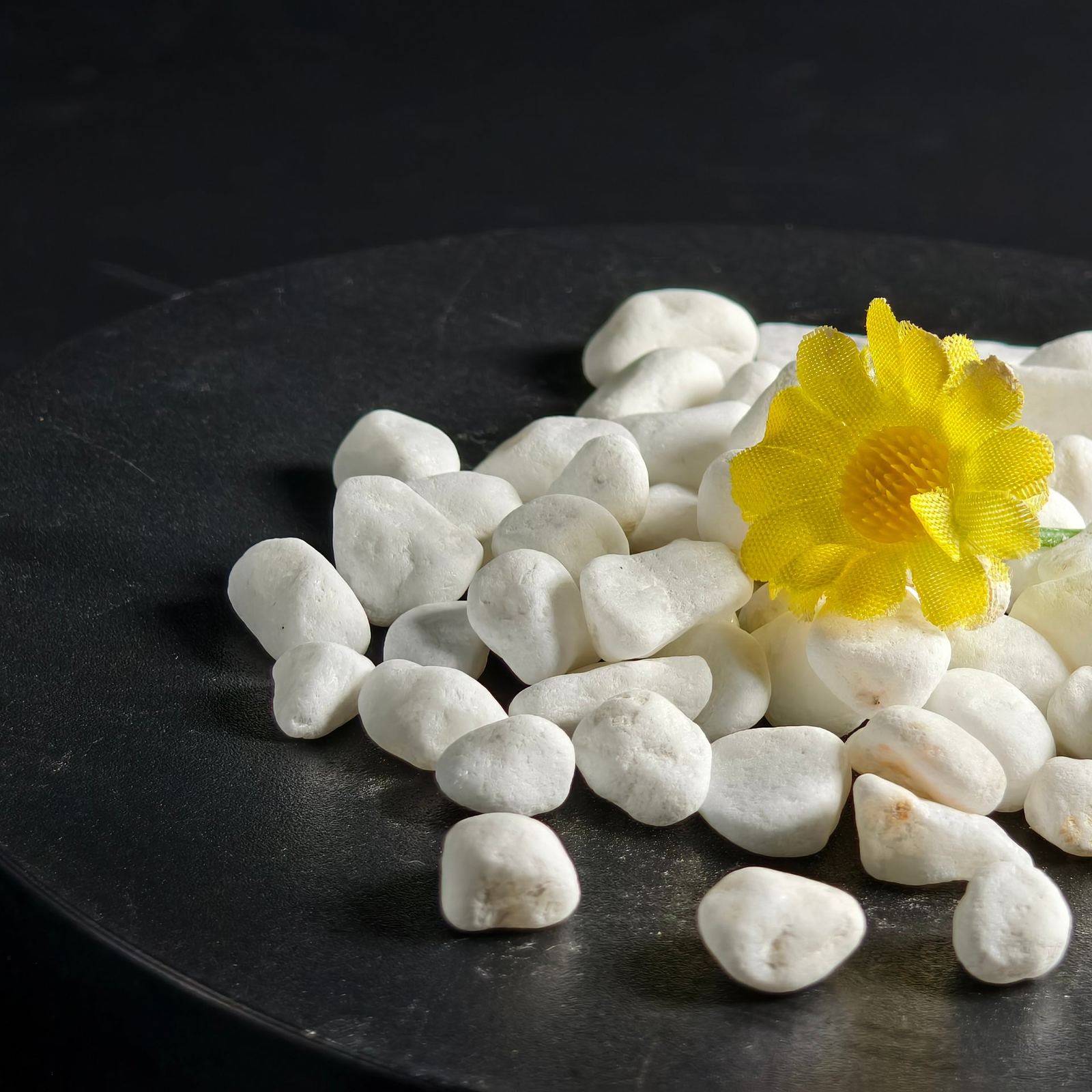
A white pebbles manufacturer selects and sorts stone rather than making it, so whiteness is a measured grade — L* and yellowness b* — not a promise. Verify the numbers behind the sample, screen out soft carbonate blending, and plan around a 24–27 tonne container MOQ, with the whitest grades needing 25–50 tonne production runs.
Published · By Gardenstone Editorial Team · Educational article from the SWME TRADE team
A white pebbles manufacturer does not make white stone — it selects, washes and colour-sorts it, so the thing to verify is the whiteness system behind the sample: a measured lightness value with a stated method, a yellowness limit, washing that removes iron staining, and sorting that removes soft carbonate stone. Plan commercially around one 20 ft container of 24–27 tonnes, with the whitest grades drawn from 25–50 tonne production runs and 15–30 days of production after sample approval.
White is the least forgiving colour in the decorative stone trade. Every flaw a mixed-colour blend can hide — dust film, iron flecks, an off-tone pebble — shows immediately on a white bed, which is why two bags of "white pebbles" from different plants can look like two different products. The manufacturer you want is the one that can name its whiteness in numbers, not adjectives.
Professional buyers treat whiteness the way steel buyers treat grade. The two numbers that matter are L* (lightness, where 100 is pure white) and b* (yellowness, where positive values read cream or yellow). A stone measuring L*88 with a warm b* and a stone measuring L*92 with a near-zero b* both get sold as "white", but beside a rendered wall or a pale deck they are visibly different products, and they were sorted at very different cost.
That cost gap is the honest explanation for a cheap quote. To lift a grade from L*88 to L*92, the plant rejects a far larger share of its raw feed — every cream, grey and stained pebble goes to the discard pile — so the price difference you see between suppliers is mostly rejection rate, not margin. Ask each supplier what proportion of its feed survives as the grade you are buying; a plant answers with a percentage, a reseller answers with a price list.
One warning about photographs. Dry pebble photographs wash out tone differences, and camera auto-white-balance quietly "corrects" yellow casts away. Accept whiteness only as a measured value on a sealed sample, checked wet, in daylight — never from a listing image.
The white comes out of the ground, not off a line. Most commercial white pebble is either white marble or dolomite recovered from a specific seam, or pale quartz-rich river pebble from a white-dominant stratum. The plant's contribution is washing off clay and iron-oxide film, screening into bands such as 8–16, 16–25, 20–40 and 40–75 mm, and picking out everything that is not white. If a supplier claims it can "produce" a whiter grade on demand, it is really offering coating, wax or dye — and coated white pebble greys and peels outdoors within a couple of seasons.
Polishing is a legitimate finish but not a whiteness cure. A tumbled-matt pebble and a polished pebble from the same box read differently under light — polish deepens contrast and darkens the wet look — yet the underlying tone is unchanged. Buy polish as a finish decision, never as a way to make an off-white stone look whiter, and never accept a polished sample as the reference for a matt supply.
Iron is the practical enemy of white. Rust-coloured flecks and streaks come from iron-bearing stone in the feed and from machinery or recirculated wash water that stains the surface. This is why a white pebbles line deserves its own question in any audit: what does the plant do about iron, and how clean is its wash water?
The commonest way to cheapen a white pebble load is blending in soft, chalky white stone — crushed marble or limestone chips cut to pebble shapes, or off-white carbonate pebble from a cheaper seam. It looks acceptably white in a dry bag. But carbonate stone fizzes under dilute acid, weathers yellow-grey within a few seasons, and raises soil pH beside acid-loving planting — so the blend reveals itself on the project, a year after the container cleared customs.
Two field checks take minutes. Drop dilute acid or even strong vinegar on a handful of stones: fizzing means carbonate, which may be acceptable as a declared fraction but not as an undeclared one. Scrape a hard steel point across a pebble: true quartz-rich white pebble resists a steel knife, while marble and limestone scratch readily. Then break a pebble open — the interior should match the white face all the way through, with no grey core under a thin white skin.
The fix is contractual, not inspective alone. Write the rock type into the purchase order, cap any carbonate fraction explicitly, and require that no dye, coating, wax or optical brightener has been used. A serious white pebbles manufacturer signs those lines without hesitation; a blender stalls on exactly those lines.
Ask for one continuous two-minute phone video walking from the raw feed stockpile through the wash plant, screen decks, sorting table and bagging station to the loaded pallets. Photographs are curated; a single-take walk is hard to fake, and a trading office cannot produce one on request. Watch specifically for the sorting table — on a genuine white line, the reject pile beside it is large, and that pile is your quality insurance.
Then ask the question that sorts plants from repackers: where does the rejected stone go? A real producer names its own secondary products — mixed-colour blends, sub-base aggregate — because it sells the rejects. Also request a photo of the settling pond or water-recycling tank taken the same week, and the sieve report for your band with the mesh photographed against a tape measure.
Close the audit with paperwork and a physical reference. Ask for the plant's whiteness measurement method and last lot values, agree that a sealed wet sample drawn from your production lot is the arbitration reference, and book the right for a third-party inspection at loading. A supplier who resists all three is quoting from a price list, not a production line.
Seven lines carry the quality risk. First, the grade expressed as numbers: a minimum L* with the measuring method named, plus a yellowness ceiling on b*. Second, rock type and a carbonate fraction cap. Third, the millimetre band with explicit oversize and undersize limits, not just the band name. Fourth, washed condition with a fines limit near 1%. Fifth, a declaration of no dye, coating, wax or brightener. Sixth, the sealed wet reference sample drawn from the production lot, retained by both sides. Seventh, the remedy: tolerance on delivery of roughly plus or minus 1.5 L* points against the sealed sample, with re-sorting or replacement at the seller's cost if the lot misses.
Wet-state checking is the clause buyers skip and later regret. White pebble darkens and saturates when wet, and tone differences between lots show more sharply in the wet state than dry — a lot that matched the dry sample can drift visibly on a rain-wetted bed. So confirm the sample in its wet state, outdoors, and photograph both side by side on a white tray. Keep one bag per lot as your reorder reference; a year later it is the only thing that makes a top-up container match the original installation.
White pebbles carry the same three stacked minimums as other decorative stone, with one whiteness-specific twist. The commercial shipping unit is one 20 ft container holding 24–27 tonnes — white pebble is dense enough that a box is weight-limited long before it is volume-full. Within that, a single size-and-colour run usually needs 5–10 tonnes to be worth setting up. Price tiers typically step at one container, three to five, and ten or more.
The twist is grade. Standard snow-white from an actively worked seam is available at container scale, but the whitest, tightest-tolerance grades are drawn from much larger production batches — a plant may need a 25–50 tonne run to yield one container of L*92 material, because the sorting yield at that grade is a fraction of the feed. Expect the top grades to carry either a higher per-tonne price, a larger minimum, or an obligation to take the balance of the run; get that in writing before designing a project around the whitest tone.
Most first orders split the container across two or three adjacent bands — 8–16 mm for inlay and waterline detail, 16–25 mm as the all-purpose cover, 20–40 mm for bold ground cover and dry creek beds — each written as its own line with its own tolerance and sealed sample. Half containers of 10–12 tonnes exist, but fixed handling and freight spread over fewer tonnes usually push the per-tonne cost well above a full box, and a private-label retail bag programme adds its own packing minimum of roughly 500–1,000 printed bags.
It selects rather than makes. A white pebbles manufacturer recovers white marble, dolomite or quartz-rich river pebble from a known seam, washes off clay and iron film, screens it into bands such as 8–16, 16–25, 20–40 and 40–75 mm, and colour-sorts out every non-white stone. Whiteness is set by the deposit and protected by sorting, not added on a production line.
By lightness and yellowness values, not by eye. Buyers specify a minimum L* value with a named measuring method, plus a ceiling on b* to limit yellow cast, and confirm the figures on a sealed sample checked wet in daylight. A practical delivery tolerance is about plus or minus 1.5 L* points against the sealed sample; dry photographs and listing images are not acceptable evidence.
Break one pebble open: a coated or lightly dyed stone shows a white skin over a grey or coloured core, while genuine white pebble is the same tone all the way through. Wipe the surface with a cloth and a little mineral spirit or acetone — colour on the cloth means coating. For blending, drop dilute acid or vinegar on the stones: carbonate marble or limestone chips fizz, and a hard steel point scratches them easily, while quartz-rich white pebble resists both.
The commercial unit is one 20 ft container of 24–27 tonnes, weight-limited before it is volume-full; a single size-and-colour run usually needs 5–10 tonnes, and price tiers step at one, three to five and ten or more containers. The whitest grades are the exception: because sorting yield at the top of the range is low, they may require a 25–50 tonne production run per container, so confirm the grade minimum in writing before ordering.
“ISO 9001 is a globally recognized standard for quality management. It helps organizations of all sizes and sectors to improve their performance, meet customer expectations and demonstrate their commitment to quality.”
ISO, ISO 9001:2026 “Quality management systems — Requirements” — official page
Commercial landscaping is the volume end of the stone trade: office parks, public spaces, housing developments…
Garden landscaping brings together every stone category: ground cover for beds and borders, gravel for paths, …
Everflorae — Artificial Plants & Trees
From the same supplier group, Everflorae supplies UV-stable artificial trees, palms and green walls that pair with stone — one source for hotels, resorts, malls and Japanese gardens.
Send your product, specification and destination — our sales team will prepare a quotation.