 SWME TRADE
Commercial Landscaping
Commercial landscaping is the volume end of the stone trade: office parks, public spaces, housing developments…
SWME TRADE · Blog
A natural pebbles manufacturer does not make stone — it dredges river pebble and washes, screens and colour-sorts it. Ask about the deposit, the recovery rate for your size band, the 5–10 tonne run minimum per size and colour, and the 24–27 tonne container that sets the commercial MOQ.
Published · By Gardenstone Editorial Team · Educational article from the SWME TRADE team
A natural pebbles manufacturer does not manufacture stone. It dredges or quarries river pebble and then washes, screens and colour-sorts it in its own plant. Expect a 24–27 tonne container as the commercial unit, a 5–10 tonne minimum for any single size-and-colour run, and 15–30 days of production after the sample is approved.
That distinction decides what you audit. The factory floor matters less than the deposit it is fed from, because colour, roundness and rock mix are set in the ground, not on the line. Two plants running identical screens can ship very different stone if one is digging a richer seam.
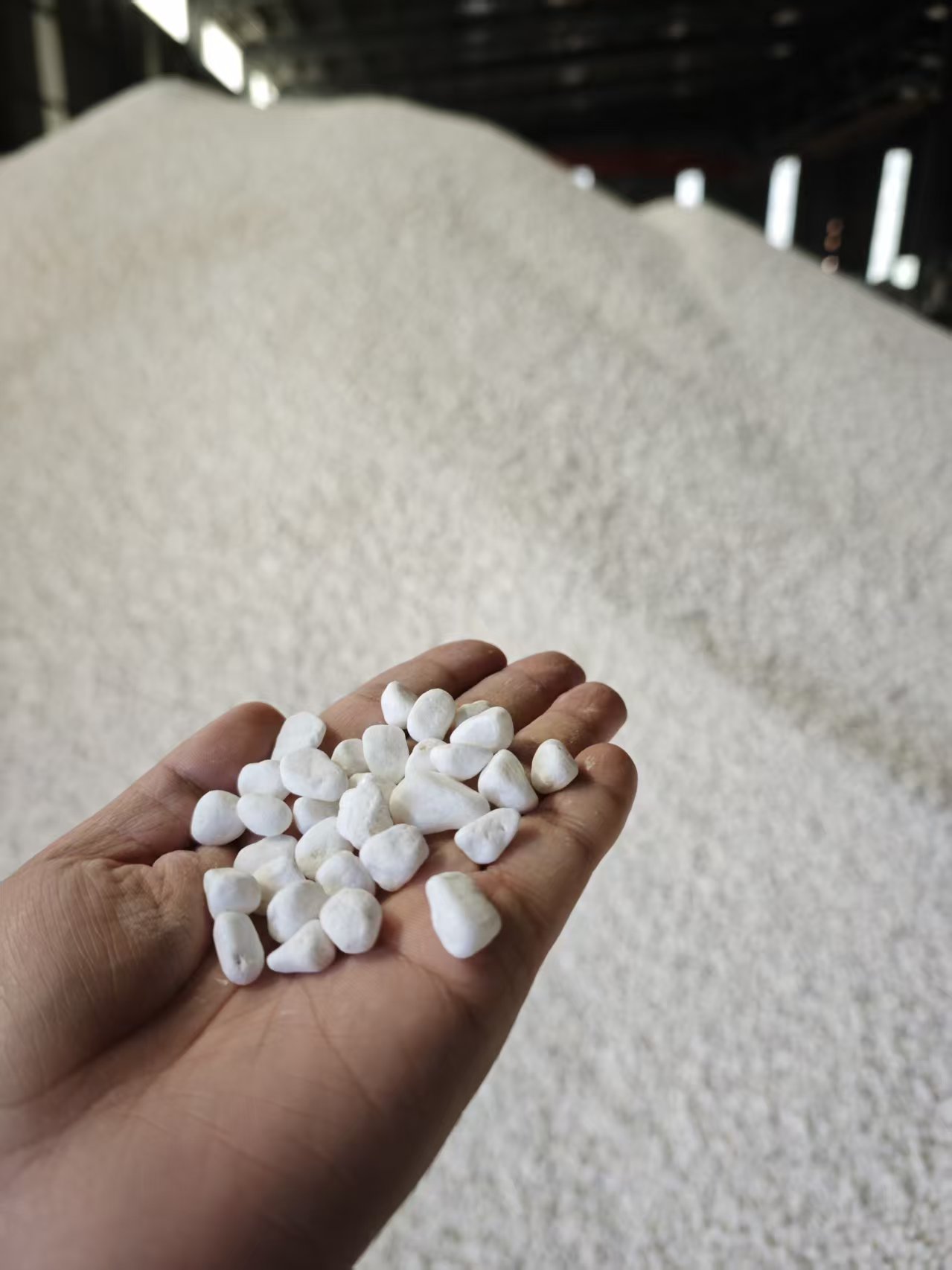
Five steps, no crushing. Raw feed is excavated or dredged and stockpiled; washed in a trommel or attrition scrubber to strip clay and iron-oxide film; screened on two or three decks into millimetre bands such as 8–16, 16–25, 20–40 and 40–75 mm; hand-picked or optically sorted for colour; then de-dusted, weighed and bagged. Everything that makes the stone attractive happened in the river, long before the plant saw it.
This is the first filter on a supplier. If a plant offers to "produce" a colour, a shade or a size you want, what it is really offering is dye, coating or crushed-and-tumbled material — three different products that behave differently on site. Natural pebble is bought, not formulated: the plant can only select, clean and grade what its deposit contains.
Ask which deposit the material comes from — an active riverbed, an old river terrace, beach shingle or glacial outwash. Alluvial riverbed pebble is the best-rounded and most colour-stable; terrace and glacial material is more angular and more mixed. The answer predicts what the stone looks like in three years, before you see a single photograph.
Break a pebble open. Natural river pebble shows a weathering rind outside and an internal fabric matching its parent rock, worn smooth all the way round. Crushed-and-tumbled material shows a fresh angular fracture face where the stone was broken, with wear only on the corners the tumbler reached. One broken stone settles what a hundred dry photographs cannot.
Then pin down the seam. A working pit has layers, and layers differ in colour and rock mix. A container pulled from one stratum and a top-up pulled from the layer below can differ by a visible tone step — the commonest cause of a reorder that no longer matches the project. Record the pit and lot on the purchase order and have the plant retain a sealed wet sample from that lot.
Rock mix is the third variable. River deposits are usually polymictic — granite, quartzite, basalt, sandstone, and often a fraction of limestone or dolomite. That carbonate fraction fizzes under dilute acid, yellows with age and raises soil pH beside acid-loving planting. For a planting bed rather than a drainage margin, specify a carbonate limit, not just a colour.
Raw river feed does not arrive in your size band. A plant digging a mixed 5–80 mm deposit might recover 25–40% of the feed as a tight 16–25 mm grade: oversize goes to landscape rock, undersize to grit and sand, off-colour stone into a mixed blend. The price of a narrow natural grade carries all of that rejection inside it.
Which is why two plants can quote the same nominal grade a third apart and both be honest — the one with the richer seam for your band is throwing less away. Ask each supplier in writing what recovery it gets for your band from its current seam. A plant answers with a percentage and a sieve curve; a reseller answers with a price list.
The follow-up is more revealing: what happens to your oversize and undersize? A plant names its own secondary products because it sells them. And if a supplier claims any size band, any quantity, on demand, treat it as a warning — natural sizes come out of the ground, they are not dialled in.
Ask for one continuous two-minute video, shot on a phone in a single take, walking from the raw stockpile through the screen deck, wash plant, sorting table and bagging station to the loaded pallets. Photographs are curated; a continuous walk is not, and a trading office cannot produce one. It filters most of the field in a single email.
Then request three stills: the screen mesh with a tape measure laid against it, which must match the band you ordered — a 16–25 mm order should not be running a 10–30 mm deck; the settling pond or water-recycling tank, which every washing plant has and a re-bagger does not; and the colour-sorting table with the crew at it, since hand-picking labour is the clearest proof that sorting is real.
Three questions finish the audit, and only a production manager answers them without hesitation: tonnes per shift, the rejection percentage against a sealed sample, and who buys the oversize. Add the paperwork — a licence whose scope includes stone processing, export records for your market, and permission for a third-party inspection at loading.
The MOQ for natural pebbles is not one number but three, stacked. The run minimum comes first: a single size-and-colour combination usually needs 5–10 tonnes to be worth setting up, because the plant is taking a slice from a 30–50 tonne batch and will not stop the line for two tonnes. Then the container: a 20 ft box carries 24–27 tonnes of loose pebble and is weight-limited long before it is volume-full. Then price tiers, which typically step at one container, three to five, and ten or more.
Most first orders split the container across two or three adjacent grades — 8–16 mm for inlay and waterline work, 20–40 mm for ground cover, 40–75 mm for edging and dry creek beds — each written as its own line with its own tolerance and sealed sample, and bagged or labelled separately so the yard can receive it grade by grade. Half containers of 10–12 tonnes exist, but fixed handling and freight spread over fewer tonnes usually make them dearer per tonne than a full box.
Natural material adds a penalty crushed stone does not have. If the colour and size you want is not in the current seam it cannot be made, so the MOQ becomes an offer to sort it out of a larger batch — with a sorting premium, or an obligation to take the balance. Get that in writing before you design a project around a tone, and confirm the seam is still being worked before each reorder.
Nine lines do the work: rock type and deposit; roundness class (natural rounded, tumbled or sub-angular); the millimetre band with explicit oversize and undersize limits, not just the band name; washed condition with a fines limit around 1%; a wet sealed reference drawn from the production lot; a declaration of no dye, coating or wax; packing format and bag count per tonne; the inspection right and the remedy for a lot that misses specification; and the pit and lot ID for reorder matching.
Production runs 15–30 days after deposit and sample approval; four to six weeks ahead of Chinese New Year, and a little longer in flood season, when some river dredging is restricted and wet weather slows drying. A supplier who promises a fixed date on natural material without checking the seam first is not standing at the plant.
It does not manufacture stone. A natural pebbles manufacturer dredges or quarries river pebble, washes it to strip clay and iron film, screens it into millimetre bands such as 8–16, 16–25, 20–40 and 40–75 mm, colour-sorts it by hand or optically, and bags it. Colour, roundness and rock mix come from the deposit, so the plant's real capability is selection and grading, not production.
Natural pebbles carry three stacked minimums: about 5–10 tonnes per size-and-colour run, one 20 ft container of 24–27 tonnes as the commercial shipping unit, and price tiers that step at one, three to five and ten or more containers. Most first orders split one container across two or three adjacent grades, each written as its own line with its own tolerance and sealed sample.
Break one open. Natural river pebble has a weathering rind and a worn, rounded surface all round, with an internal fabric matching its parent rock. Crushed-and-tumbled pebble shows a fresh angular fracture face where the stone was broken, with wear only on the corners. A drop of dilute acid is a second check: a carbonate fraction fizzes, which matters near planting beds and water.
Ask for a single continuous two-minute video walking from the raw stockpile through the screens, wash plant, sorting table and bagging station to the pallets. Then request a photo of the screen mesh with a tape measure against it, a photo of the settling pond, and the plant's recovery rate for your size band. A real plant answers without hesitation and accepts a third-party inspection at loading.
“Over 13,000 ASTM standards operate globally. Defined and set by us, they improve the lives of millions every day. Combined with our innovative business services, they enhance performance and help everyone have confidence in the things they buy and use.”
ASTM International, “About ASTM Overview” — official page
Commercial landscaping is the volume end of the stone trade: office parks, public spaces, housing developments…
Garden landscaping brings together every stone category: ground cover for beds and borders, gravel for paths, …
Pathways combine the functional and decorative sides of landscaping stone: the surface must stay stable underf…
Everflorae — Artificial Plants & Trees
From the same supplier group, Everflorae supplies UV-stable artificial trees, palms and green walls that pair with stone — one source for hotels, resorts, malls and Japanese gardens.
Send your product, specification and destination — our sales team will prepare a quotation.