 SWME TRADE
Garden Landscaping
Garden landscaping brings together every stone category: ground cover for beds and borders, gravel for paths, …
SWME TRADE · Blog
Natural river pebbles run at 1.5–1.7 tonnes per cubic metre laid loose, so budget 45–51 kg per square metre at a 30 mm depth, 60–68 kg at 40 mm and 75–85 kg at 50 mm — one tonne covers 12–22 m², a 20 kg bag covers a quarter to half a square metre, and a full 20 ft container covers 360–600 m² depending on depth.
Published · By Gardenstone Editorial Team · Educational article from the SWME TRADE team
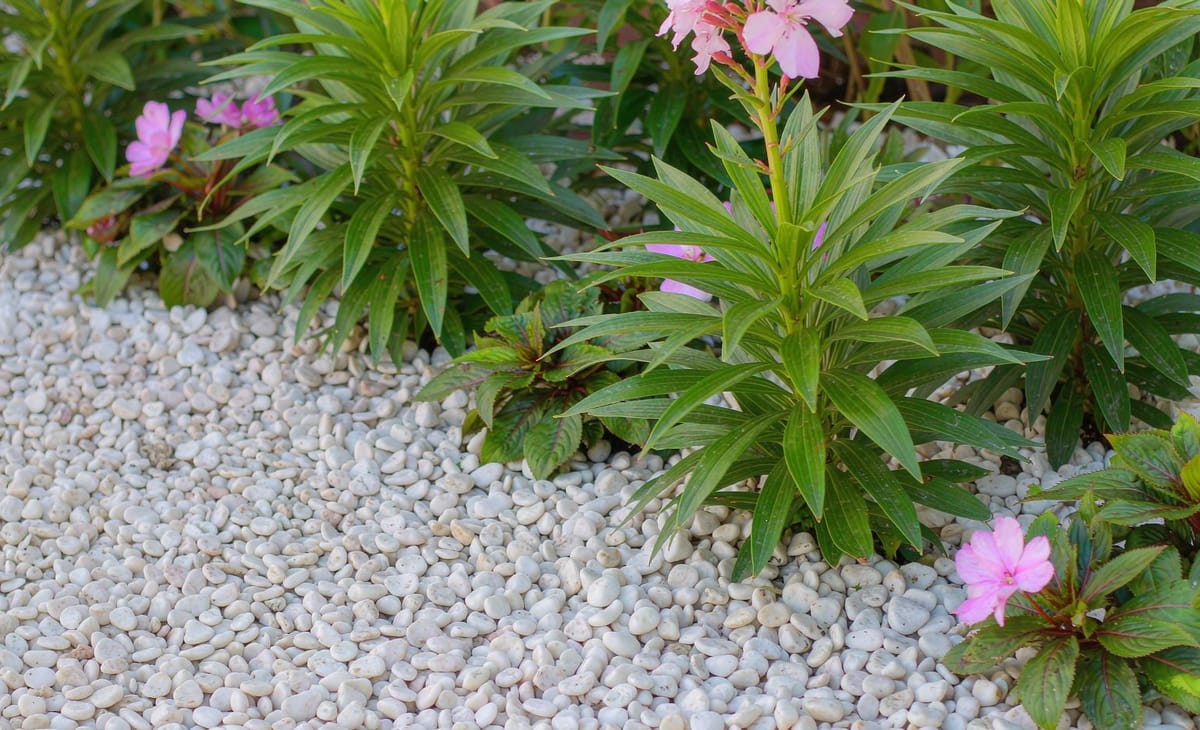
Natural river pebbles weigh about 1.5–1.7 tonnes per cubic metre laid loose, and their smooth, rounded profile puts most single-size grades near the middle of that band. The practical budget is 45–51 kg per square metre at a 30 mm finished depth, 60–68 kg at 40 mm and 75–85 kg at 50 mm. Working backwards, one tonne covers 19–22 m² at 30 mm, 15–17 m² at 40 mm and 12–13 m² at 50 mm.
In bag terms, a standard 20 kg bag covers roughly 0.40–0.45 m² at 30 mm and 0.25–0.33 m² at 40 mm. Two numbers — the finished depth and the 1.5–1.7 t/m³ loose bulk density — therefore convert any garden area into an order quantity, and the steps below turn them into a buying formula you can put straight on a purchase order.
The coverage calculation is four lines long. First, measure the area in square metres (length × width, splitting odd shapes into rectangles and adding them). Second, choose the finished depth in millimetres and divide by 1,000. Third, multiply area × depth × 1.6 — 1.6 is the midpoint loose density for washed, rounded natural pebbles. Fourth, add 5–10% for edges, curves and first-season settlement.
A worked example: an 80 m² planted border at 40 mm depth needs 80 × 0.040 × 1.6 = 5.1 tonnes, plus 10% = about 5.6 tonnes, which is 280 twenty-kilogram bags or just over a fifth of a 20 ft container. Run the same border at 30 mm and 50 mm and you get 4.2 t and 7.0 t — which is why fixing the depth on the plan before ordering matters more than any other variable.
The reliable laying-depth rule is 2 to 2.5 times the largest stone in the grade. Natural pebbles graded 8–16 mm read best at 30–40 mm deep, 16–30 mm grades need 40–50 mm so no membrane shows between the stones, and 30–50 mm feature pebbles sit at 50–75 mm. Laid thinner than 1.5 times their largest stone, rounded pebbles rock underfoot and expose the membrane in the gaps.
Depth also follows the job. Decorative topping over soil in beds sits at 30–40 mm, while pebbles that carry foot traffic on paths or line drainage zones such as dry river beds need the full 50 mm so water flow and footsteps do not push the round stones aside.
Laying natural pebbles is a five-step job. First, clear and level the area and dig the edges in a shallow trench. Second, lay a woven geotextile membrane — not thin plastic, which tears and silts up — and overlap joints by at least 100 mm. Third, fit a rigid edging restraint; round pebbles migrate, so the edge holds the line. Fourth, spread the pebbles in two lifts and rake to the target depth of 2–2.5 times the largest stone. Fifth, settle the layer with a fine water spray so the stones lock into the matrix.
Slopes are the one case that changes method. Rounded natural pebbles roll, so on gradients steeper than roughly 10–15% either terrace the area with horizontal edging restraints or blend in angular gravel to lock the surface. On flat ground a correctly laid layer needs no compaction — rolling round stone only crushes the fines you paid washed money to remove.
At 30 mm depth one square metre takes 45–51 kg — 2.3–2.6 twenty-kilogram bags. At 40 mm it is 60–68 kg, or 3–3.5 bags. At 50 mm it is 75–85 kg, roughly 4 bags. A 10 m² path at the common 40 mm depth is therefore a 30–35 bag job, the point where most buyers switch from retail bags to bulk.
The crossover matters for cost as much as convenience: one tonne in a jumbo bag equals about fifty 20 kg bags, and a full 20 ft container holds 24–27 loose tonnes. Retail bags suit balconies, display zones and small front gardens measured in single-digit square metres; anything above roughly 50 m² is almost always cheaper bought by the tonne and decanted on site.
Three physical factors move coverage by 10–15% either way. A single-size grade of round pebbles nests loosely — voids run about 38–42% of volume — while a blended grade nests tighter at 28–32%, so a tonne of mixed sizes covers slightly more area at the same depth. Flatter or more elongated stones tile more efficiently than near-spherical ones, buying another 10–15% coverage per tonne.
Settlement is the factor buyers forget. A loose, uncompacted pebble layer settles 10–15% in the first season as round stones work into the substrate, so the honest order adds 5–10% contingency on top of the calculated tonnage and keeps a wet, scale-referenced photo of the delivered batch so any top-up matches in colour and size.
Natural pebbles are dense enough that a 20 ft container fills on weight before it looks full: 24–27 tonnes. At 40 mm depth that single container covers roughly 360–450 m² of ground; at 30 mm it stretches to 470–600 m²; at 50 mm it shrinks to 290–360 m². Because the load is weight-limited rather than volume-limited, mixing two size grades in the same container costs no extra ocean freight.
Put the arithmetic on the purchase order so the supplier verifies it rather than guesses it: total m², finished depth in mm, and the resulting kg/m². A PO reading 240 m² at 40 mm = 60–68 kg/m² = 14.4–16.3 t, ordered as 16 t in jumbo bags at a net weight tolerance of ±2%, washed, fines under 1%, removes almost every misunderstanding that produces short shipments. Our natural pebbles page lists the current size grades and packing options to check any quote line against.
At a 30 mm depth one square metre needs 45–51 kg, which is 2.3–2.6 twenty-kilogram bags; at 40 mm it needs 60–68 kg or 3–3.5 bags; at 50 mm it needs 75–85 kg or about 4 bags. Add 5–10% extra for edges and settlement.
One tonne covers 19–22 m² at a 30 mm depth, 15–17 m² at 40 mm and 12–13 m² at 50 mm, based on a loose bulk density of 1.5–1.7 tonnes per cubic metre for washed, rounded natural pebbles.
Clear and level the area, lay a woven geotextile membrane with 100 mm overlaps, fit a rigid edging restraint, spread the pebbles in two lifts to a depth of 2–2.5 times the largest stone, then settle the layer with a fine water spray. A 16–30 mm grade needs a 40–50 mm finished depth.
On gradients up to roughly 10–15% rounded pebbles stay in place if the edges are restrained. On steeper slopes they roll, so terrace the area with horizontal edging or blend in angular gravel to lock the surface before laying.
“Over 13,000 ASTM standards operate globally. Defined and set by us, they improve the lives of millions every day. Combined with our innovative business services, they enhance performance and help everyone have confidence in the things they buy and use.”
ASTM International, “About ASTM Overview” — official page
Garden landscaping brings together every stone category: ground cover for beds and borders, gravel for paths, …
Stone-topped flower beds replace mulch with a permanent surface: stones suppress weeds when laid over membrane…
Pathways combine the functional and decorative sides of landscaping stone: the surface must stay stable underf…
Everflorae — Artificial Plants & Trees
From the same supplier group, Everflorae supplies UV-stable artificial trees, palms and green walls that pair with stone — one source for hotels, resorts, malls and Japanese gardens.
Send your product, specification and destination — our sales team will prepare a quotation.