 SWME TRADE
Garden Landscaping
Garden landscaping brings together every stone category: ground cover for beds and borders, gravel for paths, …
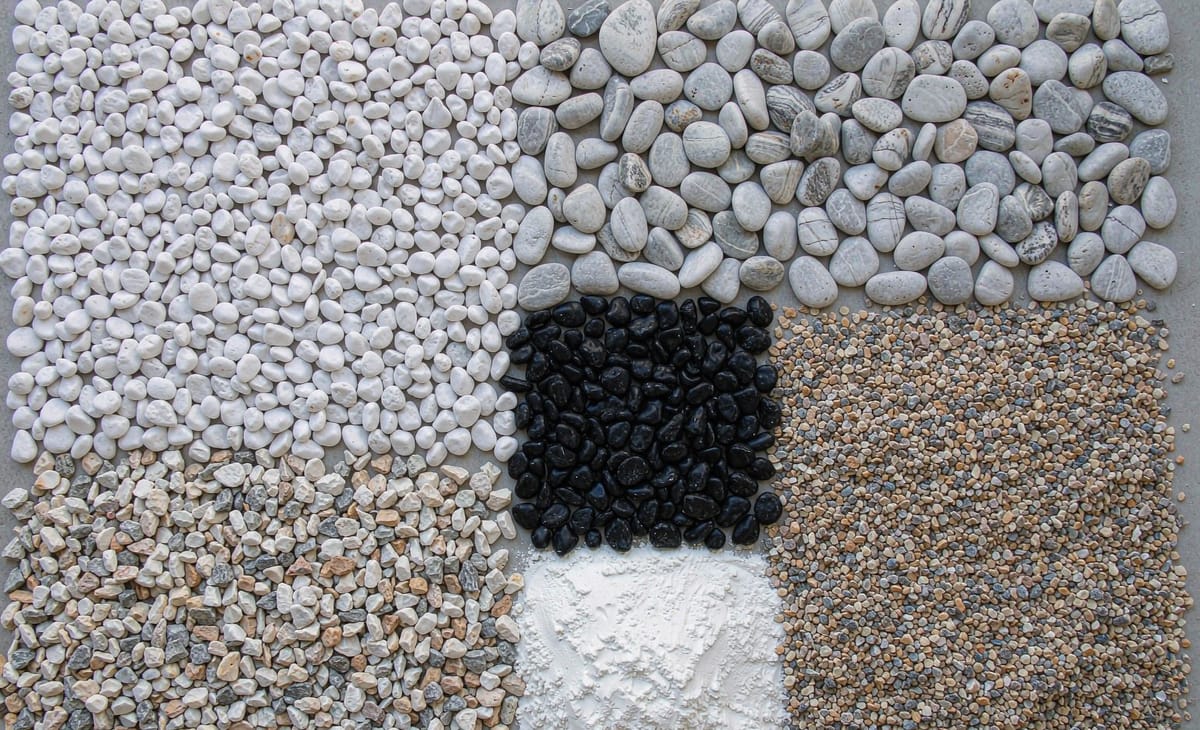
SWME TRADE · Blog
Natural pebbles have no single per-tonne price — it depends on rock, colour, size band and wash — but a 20 ft container holds 24–27 tonnes, one tonne covers about 15–17 m² at 40 mm, and freight is 60–80% of landed cost. See how to convert bag and jumbo prices and compare quotes fairly.
Published · By Gardenstone Editorial Team · Educational article from the SWME TRADE team
There is no single per-tonne price for natural pebbles — it depends on rock type, colour, size band and wash condition — but as a planning rule a 20 ft container holds 24–27 tonnes, one tonne covers about 15–17 m² at a 40 mm depth, and sea freight is 60–80% of the landed cost. Compare supplier quotes per square metre, not per tonne.
The honest answer to the price question is a formula, not a number. Strip the freight and packaging out of the quote and reduce it to cost per finished square metre at the depth you will actually lay. Everything else — the rock, the colour, the bag — only matters once two quotes sit on the same per-square-metre basis, which is the only comparison a landscape contractor can defend in front of a client.
Natural pebbles are tumbled only — smoothed by water and abrasion, with no resin, wax or paint coating. That removes both the coating premium and the coating-failure risk that polished grades carry (outdoor coatings lose their shine in 1–2 years under UV and splashing). The trade-off is that the colour is the raw sorted colour: a bright, uniform white is achievable but matte, and you cannot get the deep lacquered black of a coated grade.
Because no coating step is involved, the same rock in a natural finish typically costs 10–30% less per tonne than its polished or colour-washed equivalent — which is why natural pebbles are the default for beds, paths and water features where a subtle, non-reflective surface is preferred. When you read a 'per-tonne price' you should always ask which finish the number refers to, because the same nominal grade can be quoted two very different ways.
Four variables set the ex-works price. Rock type and colour lead: inert granite and quartz are cheap and stable, while marble and limestone cost more and are carbonate (they raise pH in ponds and streams), and rare or unusually uniform colours carry a premium for selective sorting. Size band matters because finer gradings need more screening and discard more oversize material.
Wash quality and moisture are the quiet costs. A low fines limit (near 1%) means more washing and more water handling; stone quoted on a dried-weight basis is cheaper to ship than stone still carrying 3–6% surface water you pay freight on. And freight dominates the landed price: because pebbles are dense, a container hits its weight ceiling (24–27 t) long before it is full, so the per-tonne ocean and trucking cost barely moves with the stone's value — which is why two very different grades can land at a similar delivered cost.
The conversion is fixed arithmetic, and running it is the fastest way to see which quote is actually cheaper. Per-tonne equivalent = bag price ÷ net bag weight in kilograms × 1,000. A 20 kg bag at USD 4.00 is USD 200 per tonne; a 25 kg bag at USD 4.60 is USD 184 per tonne; a 1-tonne FIBC jumbo is priced directly. Do this sum on every bag quote before you shortlist a supplier.
A bag price is never just the stone. It also carries the woven or laminated bag, the printing, the filling labour, the pallet and stretch wrap, and the extra breakage that comes with hundreds of small handling events instead of one. That stack is why the same natural pebbles in printed 20 kg retail bags commonly work out at two to four times the per-tonne equivalent of the identical grade in a jumbo bag — so bags win only when you need under a tonne, lack a forklift, or are reselling in small units. For the full product range see the [natural pebbles](https://www.gardenstoneexport.com/products/natural-pebbles/) category page.
Coverage depends only on bulk density and layer depth. Natural pebbles run about 1.5–1.7 tonnes per cubic metre, so one tonne occupies 0.59–0.67 m³. Spread at 40 mm it covers 15–17 m²; at 30 mm, 20–22 m²; at 50 mm, 12–13 m²; at 75 mm, only 8–9 m². Add 5–10% for edges, slopes and first-season settlement, more on a curved bed with a fall.
This is why cost per square metre beats cost per tonne. A cheaper stone laid at 50 mm can cost more per finished metre than a pricier stone laid at 30 mm, because depth — not price — drives the tonnage. Buyers who specify depth first and then solve for tonnage stop being fooled by a low per-tonne headline, and they can put one defensible number in front of a client regardless of bag size, stone grade or supplier.
Seven lines carry the price risk. State the price validity (30–60 days) and a freight-escalation cap — for example the agreed ocean rate plus or minus a fixed percentage, so a freight spike does not quietly rewrite the deal. Specify the grade precisely: size band with tolerance, colour tolerance, fines limit near 1%, and moisture on a dried-weight basis. Require a wet-sample seal and loading photographs attached to the report.
Then add the reconciliation clause: total bags × net weight must equal the declared tonnage, with any shortfall beyond tolerance made good or credited. Ask for a weighing record — ten bags weighed at random, with the scale reading photographed. It costs the factory twenty minutes and it converts a vague assurance into evidence you can use if the delivered stone looks lighter or warmer than the approved sample.
Natural pebbles usually cost less than polished grades (no coating) while still lasting decades in a matte, non-fading finish — so they win wherever a subtle surface is wanted and a glossy look is not. Against gravel, natural pebbles cost more per tonne but are smoother underfoot and stay put better on gentle slopes; bark is the cheapest by far but decomposes and needs yearly top-up. Larger landscape stone delivers more drama per square metre but covers far less area per tonne.
The fair question is not 'cheapest per tonne' but 'lowest cost per finished year'. On a bed you will look at for ten years, natural granite or quartz pebbles that cost a little more up front and never need topping up usually beat bark and edge out gravel on labour, while staying cheaper than polished grades. Choose the rock for the job — inert granite or quartz near water, tumbled grades for bare-foot paths — and the per-tonne premium is money you never spend again.
There is no single per-tonne price, because natural pebbles are defined by rock type, colour, size band and wash condition. The figure that matters is cost per square metre at your specified depth: one tonne covers about 15–17 m² at 40 mm and 12–13 m² at 50 mm, freight is roughly 60–80% of the landed cost, and a 20 ft container holds 24–27 tonnes.
One tonne is 50 bags of 20 kg or 40 bags of 25 kg; a 1-tonne FIBC jumbo is one unit. A 20 ft container of 24–27 tonnes therefore holds about 1,200–1,350 bags of 20 kg, 960–1,080 bags of 25 kg, or 24–27 jumbo bags. Palletised loads typically carry 10–15% less because pallet height and spacing reduce usable payload.
By the tonne, always, for the stone itself. A bag price carries the bag, the printing, the filling labour, the pallet and the extra handling, which commonly makes the per-tonne equivalent of printed retail bags two to four times the per-tonne price of the same grade in a 1-tonne jumbo bag. Bags win only when you need under a tonne, lack a forklift, or are reselling in small units.
Usually yes, by about 10–30% per tonne for the same rock and colour, because natural pebbles are tumbled only with no resin, wax or paint coating step. You trade the deep gloss and colour uniformity of a coated grade for a matte, non-reflective surface — which is the preferred look for most beds, paths and water features anyway.
“Trade Map provides comprehensive global trade data for over 230 economies, with monthly, quarterly and yearly updates using official reported data and mirror data techniques.”
ITC Trade Map, trademap.org — official page
Garden landscaping brings together every stone category: ground cover for beds and borders, gravel for paths, …
Commercial landscaping is the volume end of the stone trade: office parks, public spaces, housing developments…
A dry river bed (dry creek bed) is a landscape feature that mimics a natural stream channel — both as a design…
Everflorae — Artificial Plants & Trees
From the same supplier group, Everflorae supplies UV-stable artificial trees, palms and green walls that pair with stone — one source for hotels, resorts, malls and Japanese gardens.
Send your product, specification and destination — our sales team will prepare a quotation.