 SWME TRADE
Garden Landscaping
Garden landscaping brings together every stone category: ground cover for beds and borders, gravel for paths, …
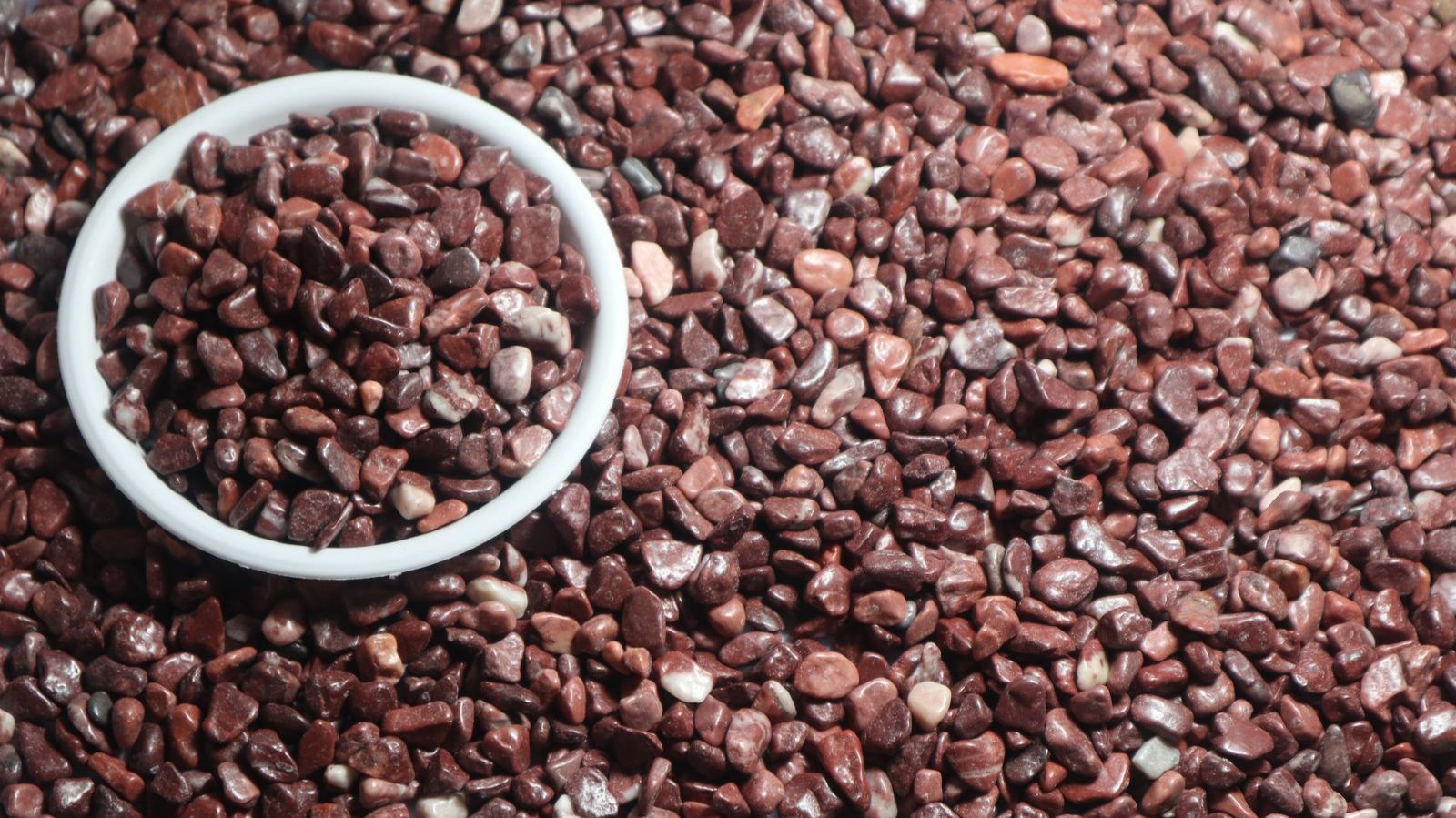
SWME TRADE · Blog
A 20 kg bag of garden pebbles holds about 0.013 m³ — enough to cover roughly 0.3 m² at 40 mm. Here is the bag-to-tonne-to-square-metre maths, why 20 kg, 25 kg and 50 lb bags are the same product in different wrappers, and how to turn a bag price into a price per ton you can actually compare.
Published · By Gardenstone Editorial Team · Educational article from the SWME TRADE team
A standard 20 kg bag of garden pebbles holds roughly 0.012–0.013 m³ of stone — 12 to 13 litres — which covers about 0.3 m² at a 40 mm layer depth. A 25 kg bag holds 0.015–0.017 m³. One tonne is therefore 50 bags of 20 kg or 40 bags of 25 kg, and a 20 ft container carrying 24–27 tonnes holds roughly 1,200–1,350 bags.
Nearly every quantity question in this trade — price per bag, bags per pallet, bags per container, bags for a 120 m² bed — reduces to those three conversions between kilograms, cubic metres and square metres. Buyers who keep them straight negotiate better, because they can compare a bag price against a tonne price without guessing, and they can tell a supplier's "about 1,300 bags" from an actual loading plan.
The one thing a bag count cannot tell you is how many individual stones are inside. At 20–40 mm a 20 kg bag holds several hundred pebbles, but the number swings with shape, grading and how tightly the bag was filled — so specify weight and band, never "a bag of about 300 stones".
Coverage depends on density and layer depth, nothing else. Garden pebbles run about 1.5–1.7 tonnes per cubic metre in bulk, so one tonne occupies 0.59–0.67 m³. Spread that tonne at 40 mm and it covers 15–17 m²; at 30 mm, 20–22 m²; at 50 mm, 12–13 m²; at 75 mm, only 8–9 m². Divide by 50 and you have the coverage of a 20 kg bag: about 0.30–0.34 m² at 40 mm, 0.40–0.44 m² at 30 mm, and 0.24–0.26 m² at 50 mm.
Two corrections matter more than the arithmetic. First, depth is a design decision, not a default: 30–40 mm hides the weed membrane and reads as a finish, 50 mm is the practical minimum over rough sub-base, and 75 mm is what you need where feet, paws or wheelbarrows will disturb the surface. Second, add 5–10% for edges, slopes, tree wells and touch-up — on a curved bed with a 1:12 fall, 10% is realistic, and on a rectilinear bed on flat ground 5% is enough.
Pebbles also settle. A loose layer loses 5–10 mm of apparent depth in the first season as stones nest, which is invisible on a 75 mm bed and obvious on a 30 mm one. If the finished look matters, buy the depth you want plus settlement, not the depth that looks right on delivery day.
The stone is identical; the bag is a market convention. 20 kg dominates hand-carried distribution because it stays under the 23 kg manual-handling thresholds used across much of Europe and Australia. 25 kg is the standard across continental Europe and much of the Middle East, and it remains liftable by one person with correct technique. 50 lb (22.7 kg) is the North American retail and landscape-supply convention, and 2 lb (0.9 kg) poly bags are the garden-centre impulse unit. Bulk buyers take 1-tonne or 1.25-tonne FIBC jumbo bags instead.
This matters commercially in two ways. A quote of "USD X per bag" means nothing until the net weight is stated — a 25 kg bag at the same bag price as a 20 kg bag is 20% cheaper per tonne, not the same deal. And bag dimensions change the count per container even at equal weight: a stouter, wider bag fills the same box with fewer units, so always reconcile bags × net weight against the declared tonnage rather than trusting the bag count alone.
Watch moisture. Washed pebbles drained but not dried can carry 3–6% surface water, which is 0.6–1.2 kg of water in a 20 kg net bag and 0.75–1.5 kg in a 25 kg bag. That water is freight you pay for, and in a sealed retail bag it becomes condensation, mould on the printed label and lumpy stone on the shelf. Ask for a moisture figure on a dried-weight basis and a fines limit near 1%.
There is no single market price per ton, because "garden pebbles" is a family of products defined by four variables: rock type and colour, size band, finish, and washed condition. The conversion, however, is fixed. Price per tonne equivalent = bag price ÷ net bag weight in kilograms × 1,000. A 20 kg bag at USD 4.00 is USD 200 per tonne of material; a 25 kg bag at USD 4.60 is USD 184 per tonne. Run that sum before you shortlist a supplier — it is the fastest way to see which quote is actually cheaper.
The gap between a retail bag price and a bulk per-tonne price is not margin alone. It is the bag itself (printed laminated film or woven PP with a header card), the filling labour, the pallet and stretch wrap, the extra inventory you must hold in many small units, and the breakage and pilferage that come with a hundred handling events instead of one. That stack is why the same pebbles sold in 20 kg printed retail bags commonly work out at two to four times the per-tonne equivalent of the same stone in a tonne bag — and why distributors who resell should price their own bags from the bulk tonne price upward, not downward from a competitor's shelf tag.
For a like-for-like comparison, normalise everything to cost per square metre at your specified depth. Ask each supplier for: net weight per bag, price per bag, bags per pallet, price per tonne for the same grade in a jumbo bag, Incoterm and named port, and whether the price includes pallets and loading. Four of five quote lines are usually missing on the first reply, and the missing ones are where the difference hides. Also confirm the validity window — 30 to 60 days is normal, and a quote without one is not a price, it is an opinion.
A 20 ft general-purpose container takes 24–27 tonnes of garden pebbles depending on the shipping line's payload limit and the road weight rules at destination. In 20 kg bags that is 1,200–1,350 bags; in 25 kg bags, 960–1,080; in 50 lb bags, roughly 1,050–1,190; in 1-tonne jumbo bags, 24–27 units. Note what is not in that list: volume. Pebbles are dense enough that the box hits its weight ceiling long before it is full — a 33 m³ container typically carries only 15–18 m³ of stone.
Palletising cuts the load. Shrink-wrapped pallets protect the bags and unload in minutes with a pallet jack, but the pallet height and the space between stacks usually cost 10–15% of payload, so a palletised 20 ft load may be 21–24 tonnes rather than 26. For a distributor selling by the pallet that trade is worth it; for a contractor buying loose-stowed bags it is wasted freight. Whichever you choose, write it into the loading plan and get photographs of the sealed container — bag counts are argued about after arrival, and photographs end the argument.
Mixed loads are normal and worth planning. Splitting one container across two or three adjacent size bands — for example 10 tonnes of 8–16 mm, 10 tonnes of 16–25 mm and 6 tonnes of 20–40 mm — improves your resale range at almost no freight penalty, but each band needs its own line on the purchase order, its own sealed sample and its own bag marking, or the warehouse will spend a week sorting bags that look identical.
Seven lines carry the risk. Net weight per bag with a tolerance — plus or minus 1–2% per bag and plus or minus 0.5% on the total shipment is standard, measured on a calibrated scale at loading rather than estimated. Bag construction: new polypropylene woven, UV-stabilised, with gusset dimensions and stitch density stated, and lamination if the bags will sit outdoors. Printing: artwork, number of colours, and the minimum print run, because bag printing is usually the longest lead item in the whole order. Pallet type: plastic or presswood avoids ISPM-15 heat-treatment marking entirely. Marking: batch number and size band on every bag, so a mixed delivery stays sortable.
Then the reconciliation clause: total bags × net weight must equal the declared tonnage, and any shortfall beyond tolerance is made good in the next shipment or credited. Ask for a weighing record — ten bags weighed at random, with the scale reading photographed — attached to the loading report. It costs the factory twenty minutes and it converts a vague assurance into evidence.
Finally, keep one sealed bag per batch in your own warehouse. When a top-up order arrives eleven months later and the tone looks fractionally warmer, that bag is the only reference that settles whether the stone drifted or the light did.
Work the chain in one direction only: area to volume to tonnage to bags to cost. A 120 m² bed at 50 mm needs 120 × 0.05 = 6 m³ of stone; at 1.6 t/m³ that is 9.6 tonnes; add 7% for edges and settlement and you are buying 10.3 tonnes, which is 515 bags of 20 kg or 412 bags of 25 kg. Price those two options and you will usually find the 25 kg route marginally cheaper per tonne but harder to handle on a residential site — a decision about labour, not about stone.
Then divide the landed cost by the square metres actually finished, and keep that number. Cost per square metre is the only figure that survives a change of bag size, a change of depth or a change of supplier, and it is the figure a landscape contractor can put in front of a client without a footnote. Distributors should compute it too, because it tells them what their shelf price has to be to leave a workable margin after freight, breakage and slow-moving stock.
One last operational note: order in whole pallets or whole layers where you can. A part pallet of loose bags arrives with torn corners and a bag count nobody can verify, and the labour to restack it usually costs more than the stone you saved by trimming the order.
A 20 kg bag contains about 0.012–0.013 m³ of garden pebbles, or 12–13 litres, and covers roughly 0.3 m² at a 40 mm layer depth. In individual stones that is several hundred pebbles at a 20–40 mm grading, but the count varies with shape and fill, so buy by net weight and size band rather than by stone count. A 25 kg bag holds 0.015–0.017 m³, about 20% more stone.
One 20 kg bag covers about 0.30–0.34 m² at 40 mm, 0.40–0.44 m² at 30 mm, and 0.24–0.26 m² at 50 mm, based on a bulk density of 1.5–1.7 tonnes per cubic metre. Add 5–10% for edges, slopes and settlement. Expressed per tonne, the same stone covers 15–17 m² at 40 mm and 12–13 m² at 50 mm.
By the tonne, always, for the stone itself. A bag price carries the bag, the printing, the filling labour, the pallet and the extra handling, which commonly makes the per-tonne equivalent of printed retail bags two to four times the per-tonne price of the same grade in a 1-tonne jumbo bag. Bags win only when you need less than a tonne, when the site has no forklift, or when you are reselling in small units.
A 20 ft container of garden pebbles holds 24–27 tonnes, which is 1,200–1,350 bags of 20 kg, 960–1,080 bags of 25 kg, or 24–27 one-tonne jumbo bags. Palletised loads typically carry 10–15% less because pallet height and spacing reduce usable payload, so a palletised container may hold 21–24 tonnes instead of 26.
“Trade Map provides comprehensive global trade data for over 230 economies, with monthly, quarterly and yearly updates using official reported data and mirror data techniques.”
ITC Trade Map, trademap.org — official page
Garden landscaping brings together every stone category: ground cover for beds and borders, gravel for paths, …
Commercial landscaping is the volume end of the stone trade: office parks, public spaces, housing developments…
Everflorae — Artificial Plants & Trees
From the same supplier group, Everflorae supplies UV-stable artificial trees, palms and green walls that pair with stone — one source for hotels, resorts, malls and Japanese gardens.
Send your product, specification and destination — our sales team will prepare a quotation.