 SWME TRADE
Zen Garden
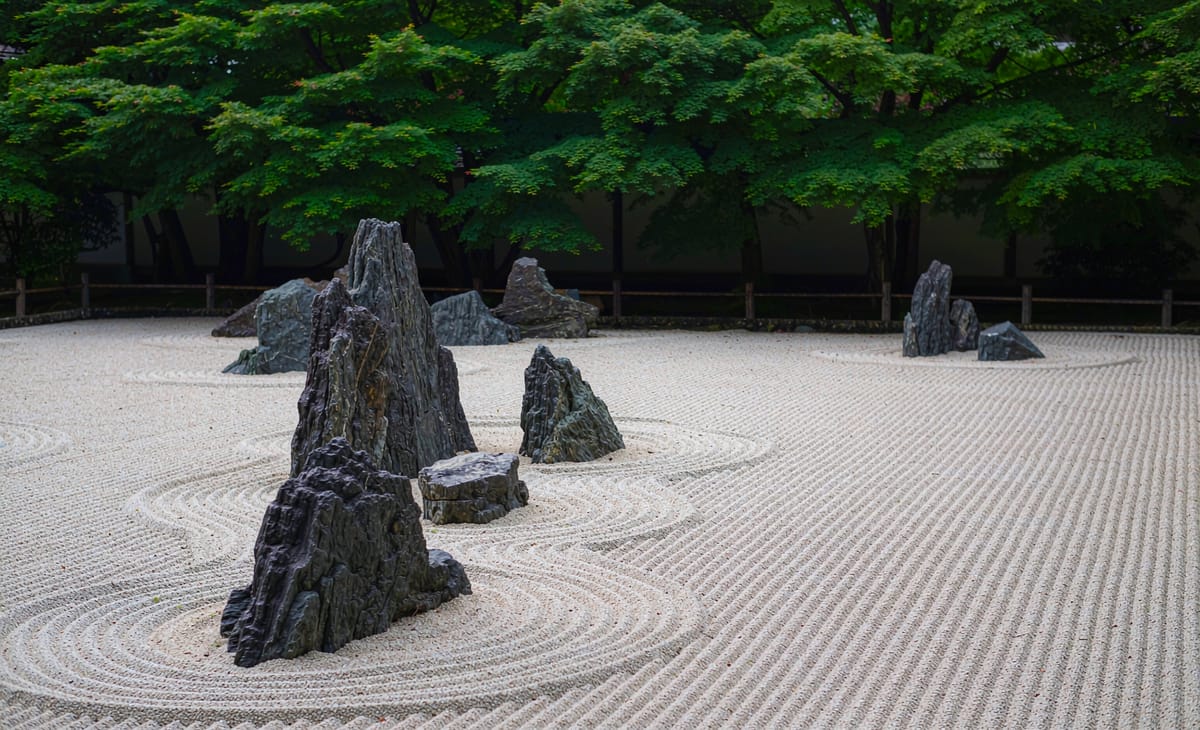
Zen gardens reduce the landscape to three materials: raked sand or fine gravel for water and openness, selecte…
SWME TRADE · Blog
The best black pebbles for a zen garden are washed, through-coloured black basalt: 8–16 mm angular black granite for raked gravel planes and 20–40 mm sub-rounded black pebbles for path edges, step surrounds and pond margins. This guide covers size choice, laying depth, coverage per square metre, MOQ and bulk container buying, and quality checks before shipment.
Published · By Gardenstone Editorial Team · Educational article from the SWME TRADE team
The best black pebbles for a zen garden are washed, through-coloured black basalt in the 8–16 mm band for raked gravel planes, laid 30–50 mm deep over a compacted, weed-membraned base. Black granite at 20–40 mm suits path edges and step surrounds, while 30–60 mm rounded pebbles belong at pond margins — about 45–85 kg per square metre.
Black works in a zen garden for a perceptual reason rather than a decorative one. The design vocabulary is narrow — a raked plane, a few upright stones, moss, a single water line — and every material has to read as one deliberate surface. Black recedes at distance, holds a crisp raked ridge at close range, and goes reflective when wet without needing a pond. Set against moss or a pale gravel, it also supplies the dark anchor the composition needs. The trade-off is that black is unforgiving: dust, oversize particles and batch drift all show on it first, and a zen garden is read from a metre away rather than from a passing car. So the useful question is not which black pebble photographs best, but which grade the designer actually specified.
Match the band to the role, and specify shape as well as size. For raked kare-sansui planes use 8–16 mm angular black crushed granite laid 30–50 mm deep; the angular faces hold a raked ridge and the dark tone reads as deep shade between the grains. For path edges and step surrounds use 20–40 mm sub-rounded black pebbles, small enough not to fight the stepping stone. Pond and water-feature margins take 30–60 mm rounded black pebbles so the waterline reads as an intentional band.
Shape is the specification most often left vague, and it changes the result more than buyers expect. Rounded alluvial black pebbles read as water and belong in stream beds and pond edges; angular crushed black granite reads as dry land and belongs in raked fields and gravel planes. Specify angular, sub-rounded or rounded in the purchase order, not just the millimetre band, and hold a sealed sample both sides sign off on. Where a plan pairs a dark bed with a light ground plane, that contrast is the design — put the black in the margins, the stream bed and the moss edge rather than in the raked field, and do not let a supplier substitute a lighter grey granite to 'brighten' the bed.
A zen garden is finished work, so the base is where the job is won. Excavate and compact the sub-base, then lay a woven permeable weed membrane across the full bed, lapped at the joints and turned up at moss and planting boundaries so soil cannot migrate into the stone. A rising soil line is the most common way a black bed loses its crispness, because any soil reaching the surface reads as grey dust on black.
Place the stone in lifts and dress it to a consistent depth — 30–50 mm for raked planes, 40–60 mm where the stone must read as volume. Keep the edge between black stone and moss tight; a 20–30 mm gap invites weeds and breaks the plane. Work the raked pattern before the bed is walked on, and re-rake after any foot traffic, because a zen garden's value is that the surface is undisturbed when the client sees it.
Two details decide whether the colour survives the first season. Specify washed, dust-free stone at supply, because fines make black stone look grey until it rains. And judge the colour wet: black shifts further between dry and wet than any other shade, so a sample approved from a dry container photograph can arrive looking like two different materials after a week of rain. Keep a sealed 1 kg reference, compare it wet, and retain a labelled sample from each production lot.
Budget by area and depth, and write the arithmetic into the enquiry so both sides can check it. At 50 mm depth one tonne of 20–40 mm black pebbles covers roughly 13 m²; at 25 mm that rises to about 26 m² per tonne, and at 75 mm it falls to around 9 m². For finer raked beds, 10–20 mm stone at 30–40 mm depth runs roughly 45–65 kg per square metre, and coarser 20–40 mm at the same depth runs roughly 60–85 kg per square metre because the larger voids take more weight to fill.
A 30 m² raked black plane at 40 mm depth therefore needs roughly 1.4–2.5 tonnes depending on grade, plus a 5–10% margin for settlement, edge build-up and spillage. That sits comfortably inside one container: a 20 ft container carries about 24–27 tonnes, or roughly 1,200–1,350 × 20 kg bags. Because black basalt is dense, black orders tend to be weight-limited rather than volume-limited — worth knowing when pricing freight, since a second, lighter product can fill volume you are already paying for.
Bulk black pebble supply for zen garden, water-feature and path programmes normally starts at one 20 ft container — about 24–27 tonnes, or roughly 1,200–1,350 × 20 kg bags. Set the minimum order quantity in both tonnes and bags so the two cannot drift apart in correspondence, confirm whether mixed pallets of two size bands are allowed, and confirm the pack split: 20–25 kg PP bags on pallets for retail and merchant resale, 1-tonne FIBC jumbo bags for project delivery, or loose loading in a lined container where the site can handle it.
Ask suppliers to state the MOQ per size band rather than per product line, because a supplier willing to mix two bands in one container is quoting a different MOQ from one that will not, and the comparison is otherwise meaningless. Where a project is phased, agree in advance which phase carries the leftover margin and store those bags on site — for zen work the top-up material must be the same lot, because black is the colour that most clearly shows a phase boundary. For retail and distribution, palletised 20–25 kg bags with a printed grade label usually outperform jumbo bags on shelf life and handling, even at a higher per-tonne price.
Per-bag weight is worth pinning down early, because it is the number that quietly decides your landed cost. A 20 kg bag and a 25 kg bag of nominally 'the same' grade do not price the same per tonne once pallet, freight and handling are counted, and a supplier quoting a cheap per-bag rate on a light bag is often selling a lighter product rather than a cheaper one. Ask for the price basis in both forms — cost per tonne and cost per bag — and check which side the quoted figure is on before comparing two suppliers. Treat the per-tonne figure as the primary comparison and the per-bag figure as the operational one, and expect a supplier to move one without moving the other.
When comparing black pebble suppliers, separate the factors you can verify from the factors you cannot. Grade, size band, shape, colour reference, fines limit and packaging are all checkable against a sealed sample and a written specification. Origin claims, 'sustainability' language and vague 'lifetime value' claims are not, and none of them should move the decision once two suppliers have quoted the same specification. Ask each supplier for the same six figures — tonnes per container, bags per container, bag weight, within-band percentage, fines limit and mass tolerance — and put them in the same table. A supplier who cannot supply those six without hedging is telling you something useful.
Choose the material honestly. Natural black basalt is through-coloured, so a chipped or scuffed stone still looks black. Dyed black pebbles are cheaper per tonne and photograph well, but they expose a lighter core the first time a wheel, rake or pressure washer reaches them; on a composition viewed up close and maintained for years, the through-coloured option is the one that still reads correctly in year three.
Then write the purchase order against enforceable terms: nominal size band in millimetres with a within-band percentage and an oversize/undersize cap (90–95% within the nominal band with the remainder in one adjacent band is a workable commercial figure); particle shape, stated as angular, sub-rounded or rounded; colour as a sealed 1 kg wet reference with a maximum share of off-reference stones counted in three random 1 kg scoops from different pallets; washed with fines and dust at or under 1–2%; broken and fractured particles at or under 5%; and unit mass tolerance of about ±1% on a 20–25 kg bag or ±1–2% on a jumbo bag. Verify before the container ships: sieve each band on a sample drawn from production rather than the sample room, run a wash test against the agreed fines limit, compare a wet 1 kg scoop from three pallets against the sealed reference, spot-check bag mass on at least five bags per lot, photograph the loaded container with date and lot reference, and retain a labelled sample from every production lot so a drift surfaces in container two rather than on site in container eight.
Use 8–16 mm angular black crushed granite for raked gravel planes, laid 30–50 mm deep over a compacted, weed-membraned base. Step to 20–40 mm sub-rounded black pebbles for path edges and stepping-stone surrounds, and 30–60 mm rounded black pebbles for pond and water-feature margins. Specify particle shape as well as the size band, since rounded alluvial stone and angular crushed granite read differently in the finished bed.
At 50 mm depth one tonne of 20–40 mm black pebbles covers roughly 13 m², and at 25 mm depth about 26 m² per tonne. For raked beds, 10–20 mm stone at 30–40 mm depth runs roughly 45–65 kg per square metre and 20–40 mm runs roughly 60–85 kg per square metre. Add 5–10% for settlement, edge build-up and spillage; one 20 ft container carries about 24–27 tonnes.
Bulk black pebble orders normally start at one 20 ft container, about 24–27 tonnes or roughly 1,200–1,350 × 20 kg bags, with availability stated per size band rather than per product line. Pack options are 20–25 kg PP bags on pallets for retail and merchant resale, 1-tonne FIBC jumbo bags for project delivery, or loose loading in a lined container. Ask whether mixed pallets of two size bands are allowed, and get the MOQ written in both tonnes and bags.
For zen gardens, pools and water features, natural through-coloured black basalt is the safer specification. A chipped or scuffed natural stone stays black, whereas dyed pebbles expose a lighter core once the surface coating wears, frost-moves or is pressure-washed. Dyed stone is acceptable for a small seasonal display but is a poor choice wherever colour consistency is written into the contract, and it should never be approved from a dry photograph alone.
“ISO 9001 is a globally recognized standard for quality management. It helps organizations of all sizes and sectors to improve their performance, meet customer expectations and demonstrate their commitment to quality.”
ISO, ISO 9001:2026 “Quality management systems — Requirements” — official page
Zen gardens reduce the landscape to three materials: raked sand or fine gravel for water and openness, selecte…
Japanese garden design uses stone as its structural vocabulary: larger stones placed as islands and mountains,…
Water features are the most natural fit for river materials: water-worn pebbles and rocks around ponds, stream…
Pathways combine the functional and decorative sides of landscaping stone: the surface must stay stable underf…
Everflorae — Artificial Plants & Trees
From the same supplier group, Everflorae supplies UV-stable artificial trees, palms and green walls that pair with stone — one source for hotels, resorts, malls and Japanese gardens.
Send your product, specification and destination — our sales team will prepare a quotation.