 SWME TRADE
Garden Landscaping
Garden landscaping brings together every stone category: ground cover for beds and borders, gravel for paths, …
SWME TRADE · Blog
A wood grain stone price per ton is built from tone and layer quality, piece size and thickness class, edge finish, selection basis and packing — not from a single market rate. This guide explains what the material is, which factors move the per-ton price, how to compare quotes honestly per square metre, quantity arithmetic for containers and borders, how to vet a wood grain stone supplier, and what a contractor-grade specification covers.
Published · By Gardenstone Editorial Team · Educational article from the SWME TRADE team
There is no single market rate for wood grain stone: a wood grain stone price per ton is assembled from the tone and quality of the layering, the piece size and thickness class, whether edges are cleft or sawn, who does the selection, and how the order is packed. A 20 ft container carries about 24–27 tonnes of it, and the honest way to compare quotations is cost per square metre at the specified thickness, not the per-ton headline.
That matters more for this material than for most landscape stone. Wood grain stone is sold on its pattern, and pattern is where the money sits: two lots at the same weight can differ enormously in usable yield once broken or irregular layering is sorted out. Buyers who compare only the headline per-ton figure usually discover the difference in container two.
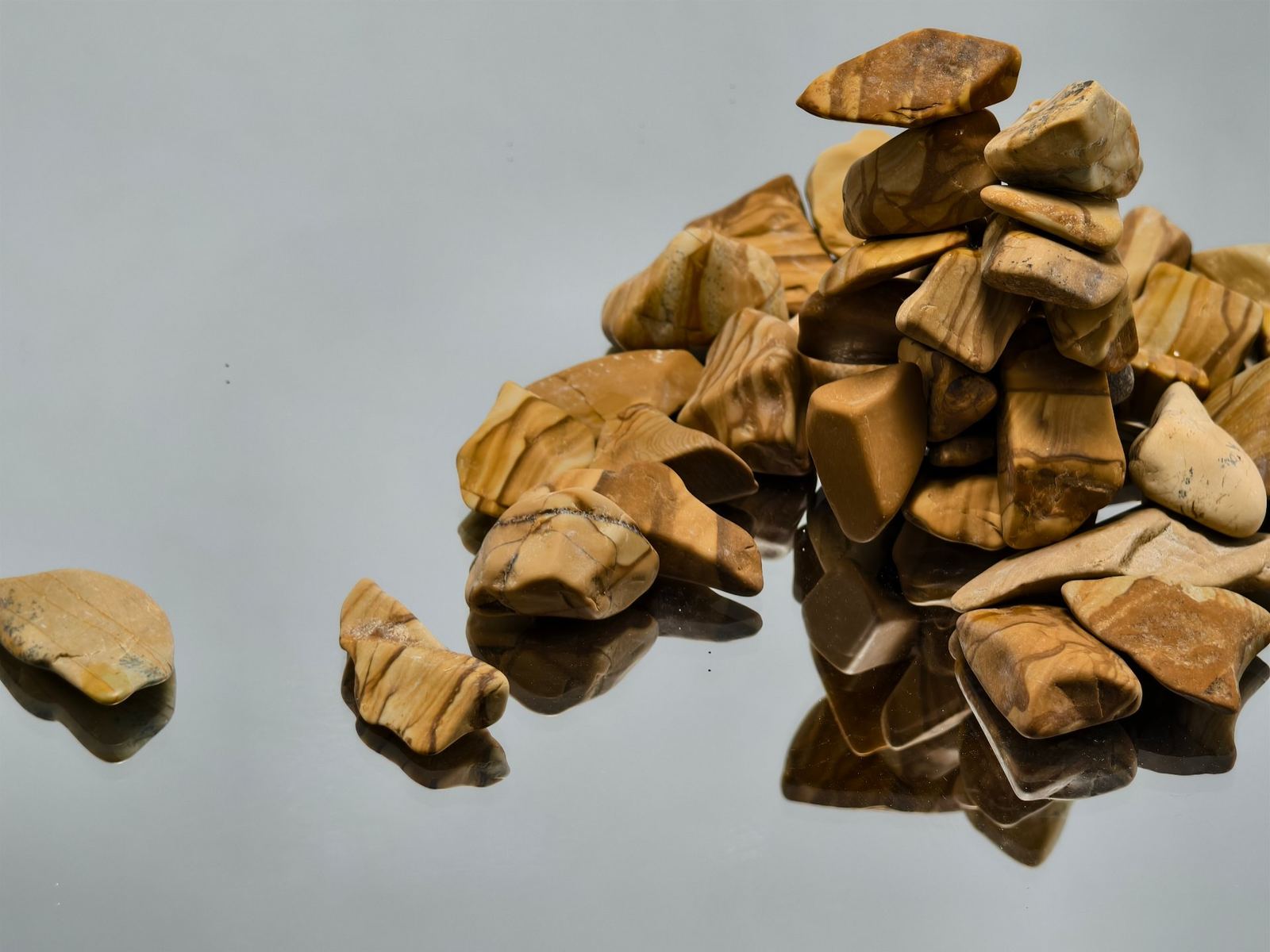
Wood grain stone is a layered natural stone whose bedding planes read like timber: straight or gently waving striations run through each piece, formed in the rock itself rather than applied as a coating or dye. In the trade it sits in the landscape-stone category as an accent material — borders, pathway edging, step treads, wall accents and water-feature surrounds — where the linear pattern creates structure that round pebbles and crushed gravel cannot.
It is sold by the ton because it is dense, heavy cargo handled by loader and weighed at dispatch. Solid stone of this family runs roughly 2.4–2.7 tonnes per cubic metre, and once pieces are packed loosely in bulk bags or crates the voids between them bring the effective shipping density down to roughly 1.6–1.9 tonnes per cubic metre. Larger feature pieces and selected slabs may be quoted by the piece instead — but whatever the selling basis, freight is charged on a weight-limited cargo, which is why the per-ton figure follows the shipment all the way to the port.
Six factors build the quotation, in roughly this order of impact. Tone and layer quality come first: uniform, straight striations across a whole lot command the top of the range, while mixed or broken layering trades near the floor. Piece size and thickness class come second — larger, thicker pieces carry more quarry selection and more handling per tonne. Third is the edge and surface finish: natural cleft pieces ship as they split, while sawn, calibrated or brushed edges add processing steps and move the price up.
The remaining three are commercial. The selection basis — supplier-selects by grade, or buyer-selects from photos of current stock — changes both the price and the risk. Packing moves the number: loose bulk in one-tonne jumbo bags is the cheapest format, while pieces crated on pallets for export add timber, labour and pallet volume. And freight closes the gap to landed cost, which for a dense, weight-limited cargo is meaningful per tonne and worth negotiating on every repeat order. A quotation that quotes only a per-ton rate without stating these six items is not a comparable quotation.
Four working classes cover most scopes. Pieces 30–50 mm thick in lengths of roughly 300–600 mm make step treads, coping and entry paving accents, laid flat on the bed. Border and edging stock in the 60–150 mm class is set on edge along pathways and beds — roughly 8–14 pieces per linear metre depending on piece width. Wall accent and garden-wall stock runs 80–150 mm thick, and random flat pieces from 20–40 mm up cover water-feature surrounds and decorative ground where a banded texture is wanted.
Layered stone has one technical property bulk buyers must respect: it is stronger across the layers than along them. Laid flat on its natural bed, a piece resists load and weather well; exposed laminations set on edge in a frost zone are the plane where freeze–thaw and delamination start. So exterior specifications in frost-exposed markets should ask for sound, low-absorption stone with no open partings, and the laying detail should state which face is up. Used within those limits — as borders, steps, edging, wall accents and water features rather than a trafficked driving surface — the material performs exactly as its landscape role promises.
Flat-laid quantities are thickness arithmetic. At a solid density of roughly 2.4–2.7 tonnes per cubic metre, a 30 mm paving course needs about 70–80 kg per square metre and a 50 mm course about 120–135 kg; add 5–10% for cutting waste, breakage and top-ups. Edging is counted rather than weighed — count the linear metres and carry the same margin. Bulk wood grain stone for filling and accent bands is estimated like other aggregate, at the laid depth times the effective packed density.
The container plan follows from the packing format. A 20 ft container takes about 24–27 tonnes, and because the stone is dense, weight usually arrives before volume — but crated, palletized piece stone carries timber and air, and a crate-heavy load can reach the volume limit first. That is exactly why mixed shipments (flat paving plus on-edge borders plus ground-cover bags) need a written loading plan with each class packed and labelled separately, agreed before the order is confirmed rather than negotiated at the port weighbridge.
Five questions separate a producer from a pass-through trader. Which quarry or deposit does the material come from, and is it a single consistent layer? What processing sits behind it — splitting, sawing, calibration, brushing? Who selects the pieces, and against what written grade? What does current stock actually look like — photos with a clear size reference, taken wet and dry, because banded stone shifts tone more than almost any other landscape material when it dries? And what is the minimum order quantity per size class, not per product line?
For phased or repeat orders, add the documentation test: batch photos carrying the shipment reference, retained samples per lot, and a written tone and layer tolerance across containers. A wood grain stone supplier with lot records can prove consistency from container one to container ten; one without can only promise it. When comparing a wood grain stone price per tonne between suppliers, normalise first — confirm whether each quote is loose or crated, which thickness class it covers, and whether selection is included — and then compare on cost per square metre at the specified thickness. Every quote that survives that normalisation is a real quote.
Write the order against numbers. A workable specification covers seven items: the piece size and thickness class in millimetres with a tolerance; the selling basis per line — tonne, piece or size class; the tone and layer grade, held as a sealed wet reference sample; the edge and surface finish named; a soundness clause — no open partings, no delaminating pieces; the packing format per line, from jumbo bags to crated pallets; and the loading plan, stating which lines are weight-limited and which are volume-limited.
Before shipment, keep the inspection short and repeatable: draw pieces from different crates and compare them wet and dry against the sealed reference; tap-test for soundness, because a dull note on a layered stone flags a hidden parting; check counts against the packing list for piece-sold lines; and photograph everything with the shipment reference visible. Two clauses protect the rest: lot retention, so tone drift surfaces in container two instead of on site, and a breakage allowance for piece-sold stone, because a cracked tread is a replacement, not a discount.
The price per ton moves with tone and layer quality, piece size and thickness class, edge and surface finish, selection basis, packing format and freight — uniform straight striations and sawn or calibrated edges sit at the top of the range, loose bulk in jumbo bags near the bottom. Because quotes differ on packing and thickness class, compare suppliers on cost per square metre at the specified thickness rather than on the per-ton headline.
At a solid density of roughly 2.4–2.7 tonnes per cubic metre, a 30 mm paving course needs about 70–80 kg per square metre and a 50 mm course about 120–135 kg. Add 5–10% for cutting waste, breakage and settlement, and count border stone separately — on-edge edging pieces run roughly 8–14 pieces per linear metre depending on piece width.
About 24–27 tonnes. The stone is dense, so a bulk or bagged load is weight-limited and the weight ceiling arrives before the container looks full. A crate-heavy load of selected pieces carries more timber and air and can become volume-limited, which is why the loading plan should state, line by line, which classes are weight-limited and which are volume-limited.
Not as a trafficked surface. Layered stone is stronger across the layers than along them, and point loads from vehicles work the bedding planes apart, so wood grain stone belongs in borders, pathway edging, step treads, wall accents and water-feature surrounds. Where the design wants the look near traffic, set the pieces on edge and bed them firmly, and specify a harder crushed stone for the driving surface itself.
“Trade Map provides comprehensive global trade data for over 230 economies, with monthly, quarterly and yearly updates using official reported data and mirror data techniques.”
ITC Trade Map, trademap.org — official page
Garden landscaping brings together every stone category: ground cover for beds and borders, gravel for paths, …
Japanese garden design uses stone as its structural vocabulary: larger stones placed as islands and mountains,…
Commercial landscaping is the volume end of the stone trade: office parks, public spaces, housing developments…
Water features are the most natural fit for river materials: water-worn pebbles and rocks around ponds, stream…
Everflorae — Artificial Plants & Trees
From the same supplier group, Everflorae supplies UV-stable artificial trees, palms and green walls that pair with stone — one source for hotels, resorts, malls and Japanese gardens.
Send your product, specification and destination — our sales team will prepare a quotation.